Advanced Speaking Expressions

In this lesson, you’ll learn 15 advanced Business English expressions for work and everyday conversation.

I’ll explain what each expression means, give you natural examples and show you how some of them are used in meetings, project discussions and conversations with colleagues.

The aim isn’t to fill every sentence with idioms. It’s to understand the expressions people really use and have a few of them ready when they fit the situation.

Video lesson

Watch the video lesson

Watch Harry explain these advanced speaking expressions and listen to how they sound in natural spoken English.

Let’s go through the expressions one by one. Some are particularly useful at work, while others are common in both professional and everyday English.

The important thing isn’t simply to know the meaning. You also need to know when the expression sounds natural.

Expressions 1–4

Expressions for opinions and discussions

These four are useful when you want to give an opinion, add a fact or bring a discussion back to the main point.

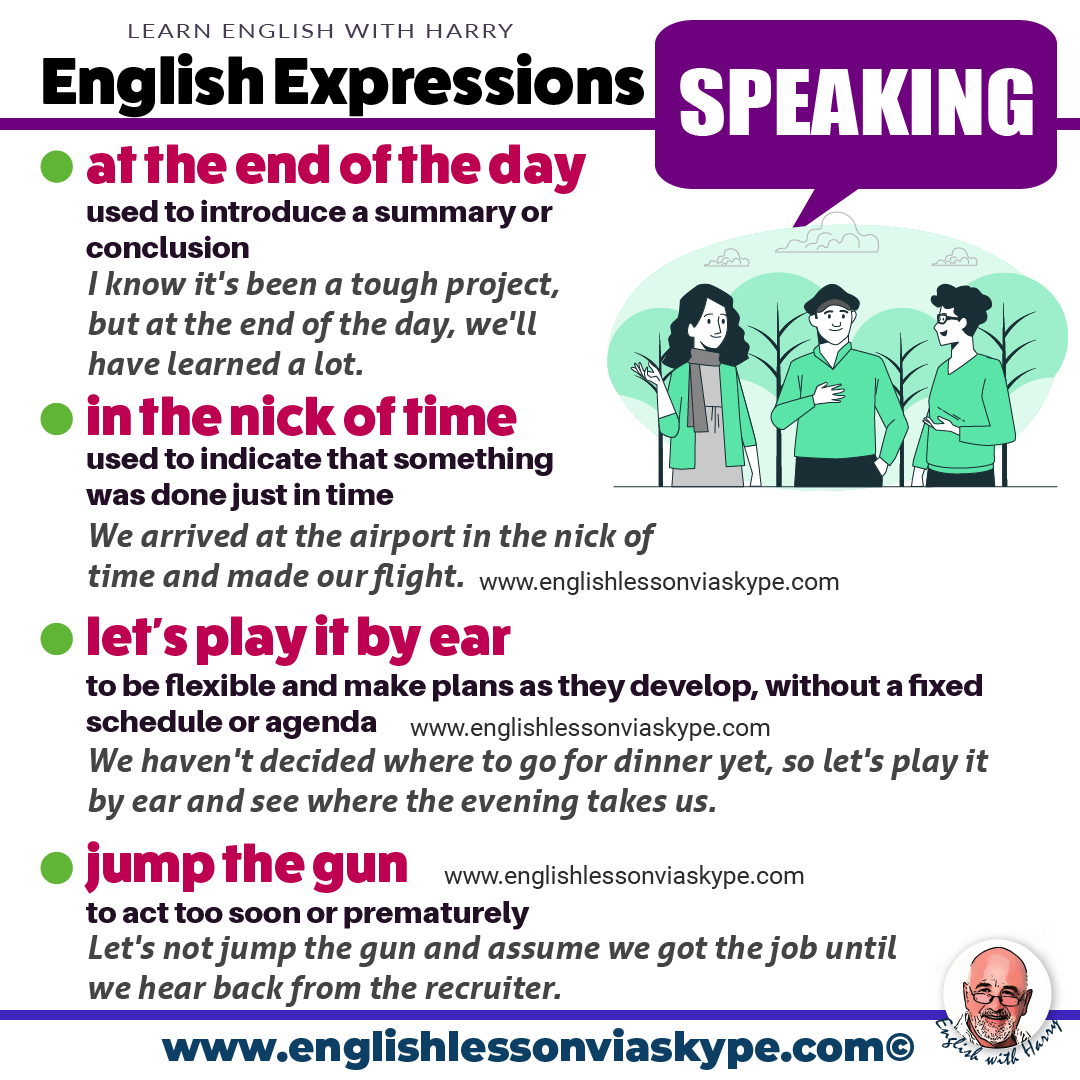
1. At the end of the day

Meaning

Used when you want to give the final or most important point after considering everything.

Examples

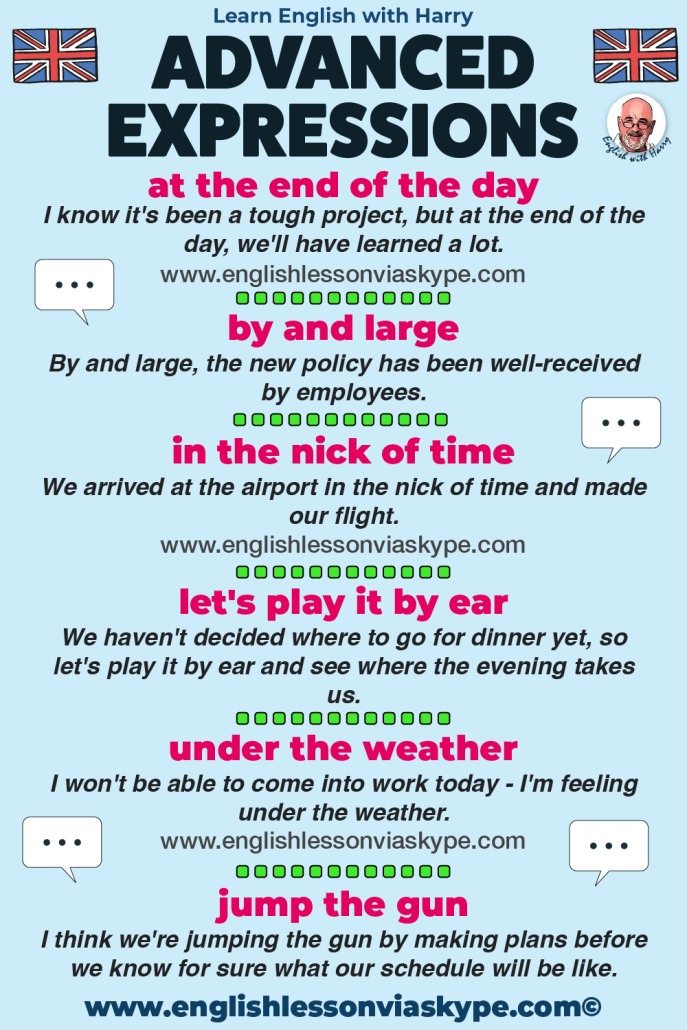
I know it’s been a tough project, but at the end of the day, we have learnt a lot.

I know this has been a tough year, but at the end of the day, it will help you pass the exams.

At the end of the day, I think we can all agree that family is what’s most important.

At work, you’ll often hear this expression when somebody wants to bring a discussion back to the main point.

At work

At the end of the day, we need to decide whether the client is prepared to accept the new deadline.

We can discuss the details, but at the end of the day, the main issue is cost.

It’s a very common expression, so don’t use it every time you want to summarise something. You can also say:

  • The main point is…
  • What really matters is…
  • Overall, I think…

2. As a matter of fact

Meaning

Used when you want to introduce a fact or add information that the other person may not know.

Examples

As a matter of fact, I’ve just finished talking to Granny.

As a matter of fact, I sent an email to you two minutes ago. You should see it in your inbox.

As a matter of fact, I’ve just got off the phone to that client. I’m going to meet them next week.

As a matter of fact, I’ve already completed that task. No need to remind me.

As a matter of fact, I won’t be able to attend the meeting tomorrow. I’m going to meet with that client.

You can also use it when somebody assumes something that isn’t correct.

Manager: Do we still need to contact the supplier?

You: As a matter of fact, I spoke to them this morning. They’ve already agreed to send the replacement.

Business English note

Be a little careful with this expression when you correct somebody. Depending on your tone, it can sound quite strong.

A softer alternative is:

Actually, I spoke to them this morning.

3. By and large

Meaning

Generally, overall or in most cases.

Examples

You get one or two people who are regularly late, but by and large, everybody seems to start work around the same time.

By and large, I tend to agree with you.

By and large, the new policy has been well received by employees.

By and large, we tend to get a lot of rain in the months of March and April.

This is useful at work when you want to give an overall view without saying that something is true in every case.

At work

By and large, the feedback from the client has been positive.

By and large, the rollout has gone according to plan.

The new system is working well, by and large, although we still have a few technical problems.

4. In the grand scheme of things

Meaning

Used when you look at the wider situation and decide that one particular problem isn’t as important as it first appeared.

Examples

In the grand scheme of things, this setback is quite minor. Don’t worry.

In the grand scheme of things, a few extra dollars spent here and there isn’t a big deal.

At work

We’re a day behind schedule, but in the grand scheme of things, that shouldn’t affect the launch.

The first presentation didn’t go particularly well, but in the grand scheme of things, it was one meeting. We can learn from it and try again.

Use this expression carefully when the problem is important to the person you’re speaking to. If a client is angry because you have missed an important deadline, telling them that it isn’t important in the grand scheme of things could sound dismissive.

Advanced Business English expressions for work and everyday conversations
Expressions 5–8

Expressions for deadlines and workload

These four come up whenever you’re talking about time, pressure and how much work you already have.

5. In the nick of time

Meaning

Just before it became too late.

Examples

We arrived at the airport in the nick of time, just as our flight was being called.

The paramedics arrived in the nick of time and saved the person’s life.

I took my roast beef out of the oven in the nick of time. A few minutes later, it would have been burnt.

At work

The figures arrived in the nick of time, so we managed to include them in the presentation.

Legal approved the contract in the nick of time.

We finished the proposal in the nick of time and sent it just before the deadline.

This is conversational English, but it’s perfectly natural when you’re talking to colleagues.

6. Jump through hoops

Meaning

Have to go through many difficult or unnecessary steps to get something done.

Examples

Ha, that boss! He makes you jump through hoops just to get your salary.

I had to jump through hoops to get all this paperwork done on time. It was a really challenging time.

The candidate had to jump through hoops to get the job, but it was worth it in the end.

At work

We had to jump through hoops to get the budget approved.

They’re making us jump through hoops just to get access to the new system.

We had to jump through several hoops before the application was approved.

There’s usually some frustration behind this expression. You’re suggesting that the process was more difficult than it needed to be.

7. Throw in the towel

Meaning

Give up or stop trying because you don’t think you’ll succeed.

Examples

I’m going to throw in the towel. I really can’t work this out.

After trying for months, I finally threw in the towel and admitted that I couldn’t complete the task.

At work

The first proposal was rejected, but I don’t think we should throw in the towel yet.

After six months of negotiations, the company finally threw in the towel.

We’ve tried three different approaches. I’m not ready to throw in the towel just yet.

Business English note

This is quite informal. It’s natural in conversation, but in a formal report you would normally say something more direct:

We decided not to continue with the project.

8. Have a lot on your plate

Meaning

Have a lot of responsibilities, work or problems to deal with at the same time.

Examples

I can’t take on any more work at the moment. I have a lot on my plate.

I’d love to go out with you tonight, but I can’t. I have a lot on my plate, and I need to get this work completed.

At work

I’ve got quite a lot on my plate this week. Could we look at this on Monday?

I know you have a lot on your plate, so I’ll keep this brief.

She has a lot on her plate with the product launch and the new client account.

If you’re using this expression to explain why you can’t accept more work, make the result clear.

Say what it means for the deadline
Instead of

I have a lot on my plate.

Say

I have a lot on my plate this week, so I won’t be able to finish this by Friday. I can have it ready on Monday.

Why: now the other person knows exactly what you can and can’t do.
Speak Up in Meetings

Speak in English without planning every sentence in your head

In meetings, you may understand the discussion and know exactly what you want to say, but still need too long to find the words.

Speak Up in Meetings gives you practical phrases for joining the discussion, buying time, asking for clarification, giving your opinion, disagreeing carefully and checking decisions.

Get Speak Up in Meetings for €17 →

€17 · Instant access · One-time payment

Expressions 9–12

Expressions for plans and everyday work situations

These four are for the ordinary situations that come up every week: a plan that isn’t fixed yet, a task that looks simple, a day when you’re unwell, a decision taken too early.

9. Play it by ear

Meaning

Decide what to do as the situation develops instead of making a fixed plan now.

Examples

We haven’t decided where to go for dinner yet, so let’s play it by ear and see where the evening takes us.

I’m not sure what time I’ll be able to finish my work today, so let’s play it by ear and decide on a meeting time once I’m done.

At work

We don’t know when the client will finish, so let’s play it by ear.

Let’s play it by ear and decide tomorrow whether we need another meeting.

I’m not sure how long the first session will take. We can play the afternoon by ear.

This is natural, conversational English. It works well when the plan really can stay flexible.

Don’t use it when somebody needs a clear commitment.

Client: When will the final report be ready?

You: Let’s play it by ear.

That answer is too vague. Give the client a clear date.

10. It’s not rocket science

Meaning

Something isn’t particularly complicated or difficult to understand.

Examples

Cooking an omelette is not rocket science. You break a few eggs, whisk them with some ingredients and voilà.

Don’t worry about figuring out how to use this new software. It’s not rocket science.

You’ll hear this expression at work, but be careful with it. Between colleagues it can sound light and informal:

At work

Once you know where the reports are stored, it’s not rocket science.

When somebody is struggling to understand
Can sound impatient

It’s not rocket science.

Safer at work

It’s quite straightforward once you know how it works.

Why: the first version tells the other person the task is easy, which can sound insulting when they are having difficulty. The second version says the same thing about the task without saying anything about them.

Other safer alternatives:

  • It should be fairly simple once we have the information.
  • There are only a few steps involved.
Useful advanced English expressions for workplace conversations

11. Under the weather

Meaning

To feel slightly ill or unwell.

Examples

I won’t be able to come to work today. I’m feeling under the weather.

She’s been feeling under the weather. I think a few days in bed will do her the world of good.

At work

I’m feeling a little under the weather today, so I’m going to work from home.

Maria’s under the weather, so she won’t be joining the meeting.

I was a bit under the weather yesterday, but I’m feeling much better today.

Business English note

This is common, conversational English. For a more formal message, you can simply say:

I’m unwell today and won’t be able to attend the meeting.

12. Jump the gun

Meaning

Act too soon, before you have enough information or before the right time.

Examples

I think we’re jumping the gun by making plans before we know for sure what our schedule will be like.

Let’s not jump the gun and assume we got the job until we hear back from the recruiter.

At work

I think we may be jumping the gun. We haven’t seen the final figures yet.

Let’s not jump the gun and tell the client until the decision has been confirmed.

We don’t want to jump the gun by hiring more people before the contract is signed.

This can be particularly useful in meetings, because it lets you question the timing without simply saying that somebody is wrong: I think we may be jumping the gun a little. We still need approval from finance.

Expressions 13–15

Expressions for difficult decisions and getting started

The last three are about doing the difficult thing, starting something and agreeing that somebody has found the real problem.

13. Bite the bullet

Meaning

Finally do something difficult or unpleasant that you have been avoiding.

Examples

When the toothache persists, you have to bite the bullet and make that visit to the dentist.

I know you’re nervous about the presentation, but you just have to bite the bullet and get it done.

I don’t want to have a conversation with my boss, but I have to bite the bullet and tell him that I’m leaving.

At work

I’ve been avoiding the conversation, but I need to bite the bullet and speak to my manager.

We may have to bite the bullet and delay the launch.

The figures aren’t improving. I think we need to bite the bullet and review the whole project.

This is informal, but very common in spoken English.

14. Get the ball rolling

Meaning

Start an activity, discussion, process or project.

Examples

Who wants to get the ball rolling? Who’s got the first idea?

Let’s get the ball rolling on planning the party by setting a date and sending out invitations.

We need to get the ball rolling on this project if we want to meet the deadline.

At work

Shall we get the ball rolling?

I’ll send the first draft today to get the ball rolling.

We need approval from the director before we can get the ball rolling.

Let’s get the ball rolling with the first two markets and see how they respond.

This is one of the expressions in this lesson that you’ll hear quite often in meetings and project discussions.

15. Hit the nail on the head

Meaning

Identify the exact point, cause or problem correctly.

Examples

Yes, you’ve hit the nail on the head.

You hit the nail on the head. I’ve been feeling really stressed out lately.

At work

I think you’ve hit the nail on the head. The problem isn’t the price. It’s the delivery time.

Sarah hit the nail on the head when she said we were trying to do too much at once.

You’ve hit the nail on the head. We need clearer responsibilities, not another meeting.

You might also hear this when a team is trying to understand why something has gone wrong.

A: We didn’t respond to the customer quickly enough.

B: Yes, I think you’ve hit the nail on the head. That’s probably why they cancelled the contract.

It’s a useful way to show strong agreement with somebody’s explanation or analysis.

Episode 439

Listen to the podcast lesson

Prefer to listen while you’re driving, walking or working? This lesson is also available as an episode of Speak Better English with Harry.

The full podcast episode contains additional expressions, so you can continue listening if you want more practice.

Choosing an expression

How to use these expressions in Business English

You don’t need to avoid idioms and everyday expressions simply because you’re at work. People use them in meetings, calls and normal conversations with colleagues all the time.

The important question is whether the expression fits the person and the situation.

Useful in meetings and project discussions

These are particularly useful when you’re discussing work.

Expression Use it when
At the end of the day You want to return to the main point.
At the end of the day, we need a decision by Friday.
By and large You’re giving an overall assessment.
By and large, the feedback has been positive.
Have a lot on your plate You’re talking about workload.
I have quite a lot on my plate this week, so I’ll need until Monday.
Play it by ear The plan can stay flexible.
Let’s play it by ear and decide after we hear from the client.
Jump the gun You think somebody is acting too early.
I think we may be jumping the gun. We don’t have approval yet.
Get the ball rolling You want to start.
I’ll arrange the first meeting to get the ball rolling.
Hit the nail on the head Somebody has identified the real issue.
I think you’ve hit the nail on the head. The problem is the timing.

Natural, but more informal

These are very common, but they’re more conversational.

  • in the nick of time
  • jump through hoops
  • throw in the towel
  • bite the bullet
  • under the weather

They’re perfectly natural with many colleagues. In a formal document or a very formal conversation with a client, simpler language may be better.

Expressions to use with a little care

As a matter of fact

Useful, but it can sound quite corrective depending on your tone.

In the grand scheme of things

Useful for putting a problem into perspective, but don’t use it to dismiss a problem that matters to somebody else.

It’s not rocket science

Natural between colleagues, but it can sound insulting if the other person is having difficulty understanding something.

The aim isn’t to use as many expressions as possible. Choose the ones that genuinely help you say what you mean.

Speak Up in Meetings

Have the words ready when you need to speak

Speak Up in Meetings gives you practical phrases for joining the discussion, buying time, asking for clarification, giving your opinion, disagreeing carefully and checking decisions. You can use them in face-to-face, Teams and Zoom meetings.

Get Speak Up in Meetings for €17 →

€17 · Instant access · One-time payment

Your turn

Practice: which expression fits the situation?

Read each situation and choose the expression that fits.

1. Your team wants to announce a decision before the client has confirmed it.

  • Let’s throw in the towel.
  • Let’s not jump the gun.
  • Let’s hit the nail on the head.
Show answer

B. Let’s not jump the gun.

Nothing has been confirmed yet, so announcing the decision would be acting too early.

2. Your manager asks you to take on another task, but you already have several important deadlines.

  • I have a lot on my plate at the moment.
  • I’m under the weather.
  • Let’s get the ball rolling.
Show answer

A. I have a lot on my plate at the moment.

Then add what it means for the deadline, so your manager knows exactly what you can and can’t do.

3. You want the team to start preparing a new project.

  • Let’s play it by ear.
  • Let’s get the ball rolling.
  • Let’s throw in the towel.
Show answer

B. Let’s get the ball rolling.

This is the expression for starting a project, a discussion or a process.

4. Your colleague has identified the exact reason why a customer is unhappy.

  • You’ve hit the nail on the head.
  • You’ve jumped the gun.
  • You’ve got a lot on your plate.
Show answer

A. You’ve hit the nail on the head.

You’re showing strong agreement with somebody’s explanation of the problem.

5. You can’t decide the exact plan yet because you’re waiting for more information.

  • Let’s play it by ear for now.
  • Let’s bite the bullet.
  • It’s not rocket science.
Show answer

A. Let’s play it by ear for now.

You’ll decide as the situation develops instead of fixing the plan today.

6. You have been avoiding a difficult conversation with your manager, but you know you need to have it.

  • I’ll throw in the towel.
  • I’ll bite the bullet and speak to her.
  • I’ll jump the gun.
Show answer

B. I’ll bite the bullet and speak to her.

You’re finally doing the difficult thing you have been putting off.

Making them stick

How to remember advanced English expressions

You don’t have to learn all 15 expressions at once.

Choose three or four that you can imagine using in your own work. Then replace the details in the examples with your real project, client, manager or deadline. For example:

  • We need to get the ball rolling on the new website.
  • I have a lot on my plate before Thursday.
  • I think we may be jumping the gun.
  • You’ve hit the nail on the head.

Say the sentences aloud a few times. It’s much easier to use an expression in a real conversation when you’ve already practised saying it.

Common questions

Frequently asked questions about advanced English expressions

What are useful Business English expressions for work?

Useful Business English expressions include phrases you can use to discuss projects, workload, deadlines, decisions and problems naturally. For example:

  • get the ball rolling
  • have a lot on your plate
  • jump the gun
  • hit the nail on the head

These are common in workplace conversations.

Can I use idioms in Business English?

Yes. People use idioms and everyday expressions regularly at work, especially in spoken English.

The important thing is to know how formal or informal an expression is and whether it suits the person you’re speaking to.

Is “at the end of the day” professional?

Yes. You’ll hear at the end of the day in meetings and workplace discussions. It means that you’re giving the main or final point.

It’s very common, however, so avoid using it repeatedly.

What does “I have a lot on my plate” mean at work?

It means that you have a lot of work, responsibilities or problems to deal with. For example:

I have a lot on my plate this week, so I won’t be able to finish this until Monday.

Can I say “it’s not rocket science” at work?

You can, but be careful. It can sound friendly and informal between colleagues, but it may sound rude if you say it to somebody who is struggling to understand something.

A safer alternative is:

It’s quite straightforward once you know how it works.

What does “let’s play it by ear” mean at work?

It means that you don’t want to make a fixed decision yet. You’ll decide later when you have more information or when you see how the situation develops.

What does “get the ball rolling” mean in Business English?

It means to start a discussion, activity, project or process. For example:

I’ll organise the first meeting so we can get the ball rolling.

How can I use advanced English expressions more naturally?

Don’t try to memorise long lists. Choose a few expressions that fit situations you regularly have at work.

Make your own examples and practise saying them aloud. That makes them much easier to use when you need them.

In short

15 advanced English expressions to remember

In this lesson, you’ve learnt:

  1. at the end of the day
  2. as a matter of fact
  3. by and large
  4. in the grand scheme of things
  5. in the nick of time
  6. jump through hoops
  7. throw in the towel
  8. have a lot on your plate
  9. play it by ear
  10. it’s not rocket science
  11. under the weather
  12. jump the gun
  13. bite the bullet
  14. get the ball rolling
  15. hit the nail on the head

You don’t need to use all of them.

Choose the expressions that suit the conversations you actually have. Practise them with your own examples, and they’ll become much easier to use when you need them.

Keep learning

More English for work

If this lesson was useful, these will help you say what you need to say at work more clearly.