
Adjectives to Describe Physical Appearance

Describing someone’s physical appearance in English sounds simple until you need to choose the right word.

You may know basic words such as tall, short, thin or beautiful, but English has many more ways to describe how a person looks. The difficult part is knowing which words sound natural, which are informal, and which can sound rude or too personal.

In this English vocabulary lesson, you’ll learn common and advanced adjectives to describe physical appearance, including words for someone’s build, hair and general appearance. You’ll also learn which descriptions are safe to use in everyday conversation and which ones you should use with care.

If you use English at work, there’s also a short section on describing someone professionally. The language you use with friends isn’t always appropriate when you’re talking about a colleague, client or someone you’ve met at a business event.

By the end of the lesson, you’ll be able to describe people in English more naturally and with much more precise vocabulary.

Video lesson

Stop using basic words: 20 better English adjectives

This video teaches more advanced adjectives for describing physical appearance — a strong match if you want to move beyond basic vocabulary. Watch it first, then use the explanations and examples below to practise.

The basics

How to describe someone’s appearance in English

Before we look at individual adjectives, let’s get the basic sentence patterns right.

If you want someone to describe another person’s physical appearance, ask:

Asking

What does he look like?

What does she look like?

What does your new manager look like?

What does the person you met at the conference look like?

You can answer in several ways.

  • be + adjective He’s tall and quite slim. / She’s short and well-built. / He’s good-looking. / She’s very attractive.
  • have + noun She has long dark hair. / He has a beard. / She has brown eyes. / He has bushy eyebrows.
  • with + a physical feature He’s the tall man with the beard. / She’s the woman with short dark hair. / I spoke to a man with jet-black hair.

You can also mention clothing if you’re trying to identify someone:

Adding clothing

He’s tall, with short grey hair, and he’s wearing a navy jacket.

She has shoulder-length dark hair and she’s wearing glasses.

Have, not be, for hair and features

  • She is long hair.She has long hair.

We can say She is long-haired, but in everyday English She has long hair is much more common.

Easy to confuse

What does he look like? vs What is he like?

These two questions are easy to confuse.

Question What it asks about
What does he look like?Physical appearance
What is he like?Personality and character
Appearance

What does your new colleague look like?

He’s quite tall, with short dark hair and glasses.

Personality

What’s your new colleague like?

He’s friendly, calm and very easy to work with.

This small difference is important when you’re learning how to describe people in English.

Advanced English adjectives to describe physical appearance. Save
The vocabulary

Common adjectives to describe physical appearance

Sometimes students learning English use one adjective again and again.

Have you guessed which one?

Nice. A nice baby. A nice-looking girl. A nice man. A nice woman. Boring…

Why nice isn’t enough

There’s nothing wrong with nice, but it doesn’t tell us very much. Let’s expand your English vocabulary and look at more precise adjectives you can use when describing a person.

1beautiful

Meaning: very attractive. It’s particularly common when describing women, but it can also describe children and, in some contexts, men.

ExamplesShe looked beautiful in the photographs.
They have a beautiful little baby.

For men, handsome and good-looking are traditionally more common. Be careful not to use beautiful simply because you mean nice: a beautiful woman describes appearance, while a nice woman normally describes character.

2handsome

Meaning: attractive, traditionally used to describe men.

ExampleHe was a tall, handsome man in his early forties.

You’ll still hear handsome very often, although good-looking and attractive can be used for both men and women.

3good-looking

Meaning: physically attractive. It works for both men and women.

ExamplesHer brother is very good-looking.
They’re a good-looking couple.

Good-looking is useful because it’s natural, common and fairly neutral.

4pretty

Meaning: attractive in a delicate or pleasant way. It’s most often used for women and girls.

ExamplesMary looked very pretty in that dress.
She has a pretty face and a lovely smile.

Pretty is less strong than beautiful or gorgeous.

5attractive

Meaning: a useful neutral word for someone whose appearance is pleasant or appealing.

ExamplesHe’s an attractive man in his fifties.
She’s very attractive.

It can describe men or women and often sounds more neutral than beautiful, handsome or gorgeous.

6cute

Meaning: attractive in a sweet or appealing way. It’s particularly common for babies, children and animals.

ExamplesThat’s a really cute baby.
Look at that puppy. He’s so cute.

Adults also use cute about other adults, particularly in informal conversation — I met him yesterday. He’s quite cute. That use is informal and may suggest romantic attraction.

7gorgeous

Meaning: extremely attractive or beautiful. It’s informal and quite strong.

ExamplesYou look gorgeous in that dress.
She has gorgeous hair.

It’s a word you’ll hear quite often in everyday British and Irish English.

8ugly

Meaning: very unattractive. Be careful with this one.

ExampleThe Ugly Duckling eventually became a beautiful swan.

It’s a perfectly normal English adjective, but calling another person ugly is very direct and can be extremely rude. You’re more likely to need it for a fictional character, a story or repeating what someone else has said. Learn the word, but don’t assume that every English word you learn is a word you should use about someone.

Size and shape

English adjectives for someone’s build

Build means the general size and shape of someone’s body. When somebody asks What does he look like?, you might answer He’s quite tall and well-built or She’s short and slim, with dark hair.

Here are some useful words.

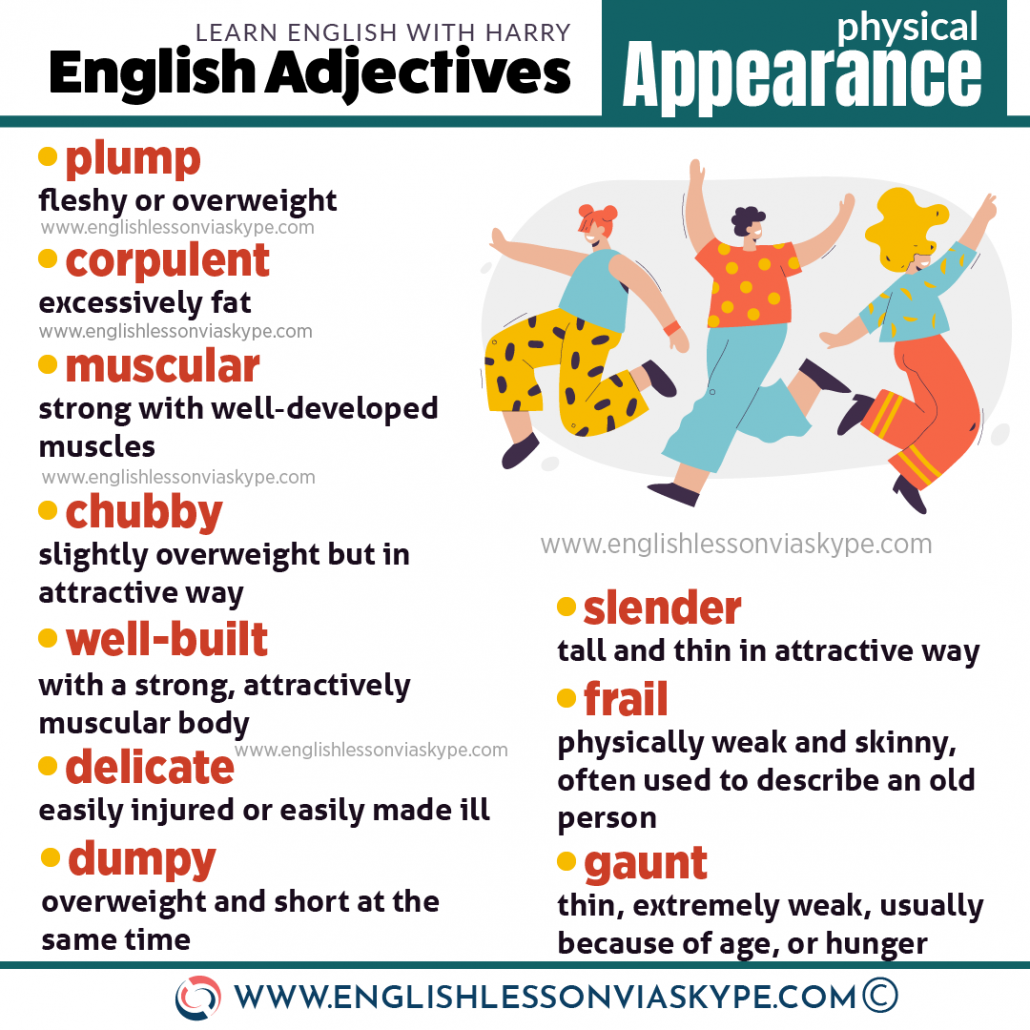
1well-built

Meaning: having a strong, solid or muscular body.

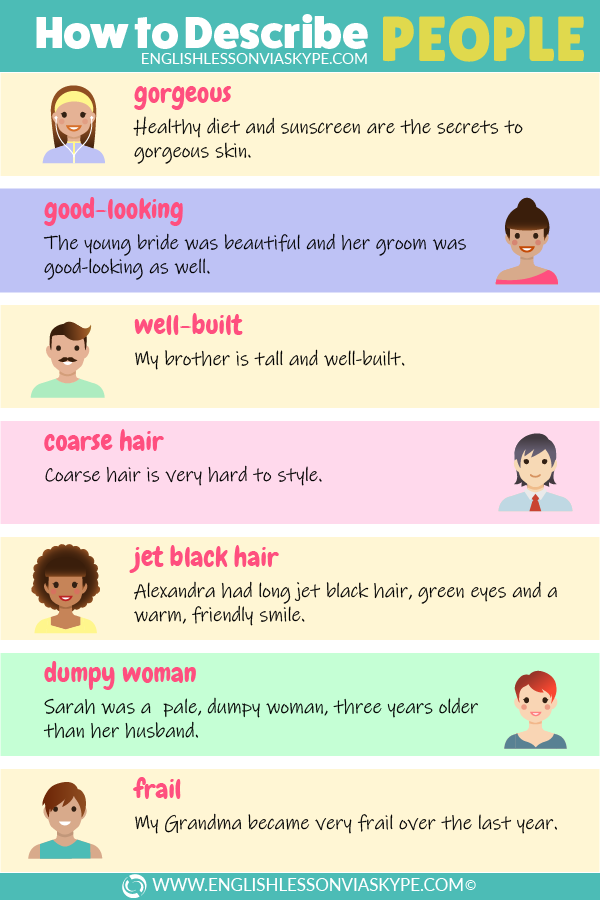
ExamplesMy brother is tall and well-built.
The man was in his thirties, well-built and quite tall.

We use well-built more often for men.

2slim

Meaning: thin in a way that is generally considered healthy or attractive.

ExamplesShe’s tall and slim.
He has a slim build.

Slim usually has a positive or neutral meaning.

3slender

Meaning: similar to slim, but it often suggests a more delicate or elegant shape.

ExamplesShe was tall and slender.
The dancer had a slender figure.

It’s less common in normal conversation than slim, but it’s useful descriptive vocabulary.

4skinny

Meaning: very thin, and it often has a negative meaning.

ExamplesHe was a skinny teenager.
I was really skinny when I was younger.

Be careful when you use skinny about another person. Slim is usually much more neutral.

5lanky

Meaning: tall and thin, often with long arms and legs. It can also suggest that the person moves slightly awkwardly.

ExamplesHe was a lanky teenager, but he filled out as he got older.
The new goalkeeper is tall and lanky.

It’s particularly common when describing teenagers or young men.

6frail

Meaning: physically weak and delicate, often used when someone has become weaker because of age or illness.

ExamplesHis grandmother had become quite frail.
She looked small and frail.

Frail isn’t simply another word for thin. The important idea is physical weakness.

7chubby

Meaning: slightly fat or rounded. It’s very common when describing babies and young children.

ExampleThe baby had lovely chubby cheeks.

Using chubby to describe an adult can be sensitive, so use it carefully.

Use with care

Be careful when describing someone’s weight

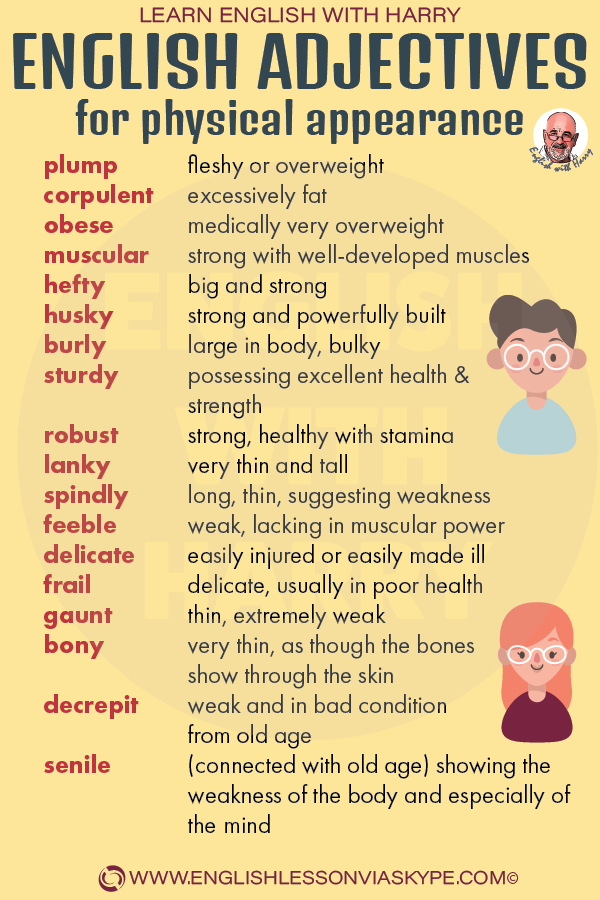
Words connected with weight are particularly sensitive in English. You may learn words such as fat, overweight, plump, skinny, chubby and dumpy. That doesn’t mean they’re equally appropriate in conversation.

  • fat — a normal English word, and some people use it about themselves. But describing somebody else as fat can easily sound rude.
  • overweight — more neutral in medical or factual contexts. Commenting on a colleague’s weight, though, is usually unnecessary.
  • plump — can sound old-fashioned when describing adults.
  • skinny — often sounds negative.
  • dumpy — traditionally describes someone, usually a woman, who is short and rather fat. It can sound insulting and dated. Recognise it when you read or hear it, but I wouldn’t recommend using it about someone.
The real lesson

The important point isn’t simply to learn more adjectives. You need to know how the words actually sound to the person listening.

Describing physical appearance in English Save
Hair and facial features

English vocabulary for describing hair

Hair gives us lots of useful vocabulary for describing someone accurately. Instead of saying She has nice hair, you can be much more precise.

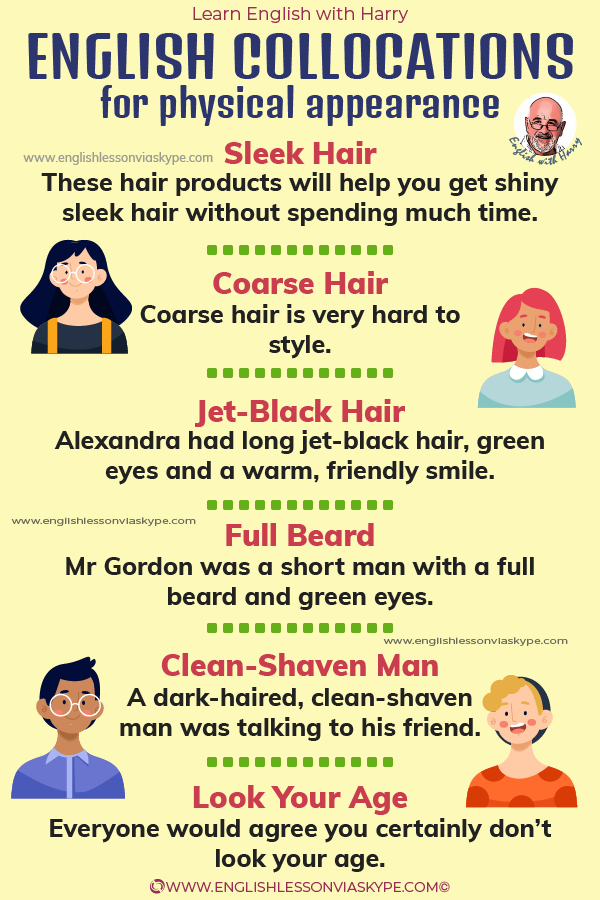
1sleek hair

Meaning: hair that is smooth, shiny and lies flat.

ExamplesShe has long, sleek dark hair.
The model had beautifully sleek hair.

2coarse hair

Meaning: hair with a thicker, rougher texture rather than a very soft or fine texture.

ExampleHe has thick, coarse hair.

Coarse describes the texture of the hair. It doesn’t mean unattractive.

3jet-black hair

Meaning: extremely dark black.

ExamplesShe has long jet-black hair and green eyes.
He was easy to recognise because of his jet-black hair.

Notice the hyphen when we put the expression before a noun: jet-black hair.

4dark-haired

Meaning: having dark hair.

ExamplesA dark-haired man was waiting outside.
She’s tall and dark-haired.

We can create several similar adjectives: blonde-haired, red-haired, grey-haired, long-haired, short-haired. In everyday conversation, though, we often simply use haveShe has blonde hair. / He has short grey hair.

5bushy eyebrows

Meaning: very thick eyebrows.

ExamplesHe has dark hair and bushy eyebrows.
Her bushy eyebrows are one of her most distinctive features.

Bushy commonly appears with eyebrows, beard and moustache.

6clean-shaven

Meaning: a man who has no beard or moustache.

ExamplesHe’s tall, dark-haired and clean-shaven.
I was expecting somebody with a beard, but he was completely clean-shaven.

Clean-shaven is a very useful adjective when you need to identify or describe someone.

English collocations for physical appearance. Improve English from intermediate to advanced level. Save
Natural combinations

More collocations for describing physical appearance

Learning vocabulary as collocations makes it easier to remember and use naturally. Instead of learning youthful by itself, learn a youthful appearance. Instead of learning black, learn jet-black hair. Here are some useful combinations.

1youthful appearance

Meaning: looking younger than you might expect.

ExamplesHe’s in his fifties, but he has a very youthful appearance.
Her short haircut gives her a more youthful appearance.

You can also say She looks young for her age, which is very common in everyday conversation.

2warm smile

Meaning: a smile that makes someone look friendly and welcoming.

ExamplesShe had dark hair and a warm, friendly smile.
He greeted everyone with a warm smile.

3broad shoulders

Meaning: a wide upper body.

ExamplesHe’s tall, with broad shoulders and short dark hair.
He has quite a broad-shouldered build.

Broad-shouldered can also be used as an adjective.

4distinctive features

Meaning: parts of someone’s appearance that make them easy to recognise.

ExamplesShe has very distinctive features.
His beard is probably his most distinctive feature.

This is particularly useful when you’re identifying somebody without making a judgement about whether they’re attractive.

5striking appearance

Meaning: an appearance that attracts your attention because there is something particularly noticeable about the way the person looks.

ExamplesShe has a very striking appearance.
His height and jet-black hair give him quite a striking appearance.

Striking doesn’t necessarily mean beautiful. It means noticeable or impressive.

Putting it together

How to give a natural description of someone

Try to combine two or three details instead of producing a long list of adjectives.

Natural examples

She’s quite tall, with shoulder-length dark hair and brown eyes.

He’s medium height, well-built and clean-shaven.

She’s slim, with short blonde hair and glasses.

He’s a tall, lanky young man with curly hair.

She has a youthful appearance, sleek dark hair and a warm smile.

These sound much more natural than a string of short sentences: She is tall. She is slim. She has dark hair. She has brown eyes.

You can also start with the most useful identifying information:

  • He’s the tall man with short grey hair.
  • She’s the woman with glasses sitting near the window.

That’s often exactly how native speakers describe someone in a real situation.

At work

Describing someone’s physical appearance at work

So what does all of this have to do with English for work? More than you might think. You may need to identify someone at a conference, tell a colleague who you spoke to, explain who they need to find at reception or describe somebody they haven’t met before.

At work

Have you met Thomas from the German office?

No. What does he look like?

He’s tall, with short grey hair and glasses. He’s usually with the finance team.

At work

Who do I need to speak to when I arrive?

Ask for Anna. She has short dark hair and wears glasses. She’ll be at the registration desk.

That sounds normal because the description has a practical purpose.

Keep workplace descriptions neutral

At work, stick to useful identifying information.

  • He’s tall, with short grey hair.
  • She has curly dark hair and glasses.
  • He’s the clean-shaven man in the blue jacket.
  • She’s the woman with shoulder-length blonde hair at the reception desk.

Be much more careful with comments such as:

  • She’s gorgeous.
  • He’s really handsome.
  • She’s skinny.
  • He’s overweight.
  • She looks old.

These phrases may be grammatically correct, but grammar isn’t the problem. In a professional setting, comments about attractiveness, weight or apparent age can sound too personal. If you simply need to help somebody identify a colleague, describe features that are useful and factual.

Appearance and clothing often work together

In a workplace situation, clothing can make the description much easier.

Add one useful detail

Just appearance: He’s tall.

Appearance + clothing: He’s tall, with short dark hair, and he’s wearing a grey suit.

Just hair: She has blonde hair.

Hair + clothing: She has shoulder-length blonde hair and she’s wearing a green jacket.

You don’t need an elaborate description. You simply need enough information for the other person to know who you mean.

Free resources

Use English at work too?

Knowing vocabulary is one part of learning English. The difficult moment often comes when you need the words quickly in a meeting, email or conversation at work.

I’ve put together free Business English resources for those situations, including practical phrase guides, quizzes and tools for meetings and workplace communication.

Explore free Business English resources →
Your turn

Practise describing physical appearance in English

Now try using the vocabulary yourself. Don’t try to learn every adjective on this page at once. Choose five or six expressions that are new to you and use them in complete sentences. For example:

  • well-built
  • lanky
  • sleek hair
  • jet-black hair
  • clean-shaven
  • youthful appearance

Now imagine three people.

Person 1

A man in his forties. He’s tall. He has a strong body. He has no beard.

You could say

He’s a tall, well-built, clean-shaven man in his forties.

Person 2

A young woman. She has very smooth black hair and a friendly smile.

You could say

She has sleek, jet-black hair and a warm smile.

Person 3

A teenage boy. He’s very tall and thin, with long arms and legs.

You could say

He’s a tall, lanky teenager.

Your turn

Think of somebody you know. Can you describe:

  • their height?
  • their build?
  • their hair?
  • one distinctive feature?
  • what they’re wearing?

Try to describe the person in two sentences without using nice. That’s the challenge.

Episode 211

Listen to the lesson

Prefer listening? In episode 211 of Speak Better English with Harry, Harry looks at intermediate and advanced English adjectives for describing people’s physical appearance and explains how to use them in everyday conversation.

Listen while you’re travelling, walking or practising your listening, then come back to the examples above.

Quick review

Physical appearance vocabulary: quick review

Here are the key words again.

Word Meaning
beautifulvery attractive
handsomeattractive, traditionally used for men
good-lookingattractive, used for men and women
prettyattractive in a delicate or pleasant way
attractivepleasant or appealing in appearance
cuteattractive in a sweet way, usually informal
gorgeousextremely attractive, informal
well-builtstrong and solid in build
slimthin in an attractive or healthy-looking way
slenderslim and often graceful
skinnyvery thin, often negative
lankytall and thin, sometimes slightly awkward
frailphysically weak and delicate
sleek hairsmooth, shiny hair
coarse hairhair with a thick or rough texture
jet-black haircompletely black hair
bushy eyebrowsvery thick eyebrows
clean-shavenwithout a beard or moustache
youthful appearancelooking younger than expected
striking appearancenoticeable or impressive appearance
distinctive featuresphysical features that make someone easy to recognise
Common questions

Frequently asked questions about describing physical appearance in English

How do you describe someone’s physical appearance in English?

Start with general information such as height and build, then add useful details about hair, eyes, facial features or clothing.

She’s quite tall and slim, with shoulder-length dark hair. / He’s medium height, well-built and clean-shaven.

You normally don’t need to describe every detail. Choose the features that make the person easy to recognise.

What question do you ask about someone’s appearance?

Ask What does he look like? or What does she look like?

What does your new manager look like? — She’s tall, with curly dark hair and glasses.

Don’t confuse this with What is she like?, which asks about personality.

What are good adjectives for describing physical appearance?

Useful adjectives include tall, short, slim, slender, well-built, attractive, good-looking, handsome, pretty, lanky, clean-shaven and dark-haired.

You can also use collocations such as sleek hair, jet-black hair, bushy eyebrows, broad shoulders and youthful appearance.

Can you use good-looking for both men and women?

Yes. Good-looking can describe both men and women.

He’s a good-looking man. / She’s very good-looking.

It’s a common and natural adjective in everyday English.

Is skinny rude in English?

Skinny often has a negative meaning because it suggests that somebody is extremely thin.

If you simply want a neutral description, slim is usually safer: She’s slim sounds more neutral than She’s skinny.

Is it polite to say someone is fat?

It depends on the situation and the person, but describing somebody else as fat can easily sound rude or unnecessary.

Words such as overweight, plump and chubby can also be sensitive.

In many situations you don’t need to mention somebody’s weight at all. Use a different identifying feature if you can.

What does clean-shaven mean?

Clean-shaven describes a man who doesn’t have a beard or moustache.

He usually has a beard, but he was clean-shaven when I saw him.

It’s a useful neutral adjective when describing someone’s appearance.

How should I describe someone at work?

Keep the description neutral and factual.

She has short dark hair and wears glasses. / He’s tall, with grey hair, and he’s wearing a navy jacket.

Avoid unnecessary comments about attractiveness, body weight or apparent age. The aim is normally to identify the person, not judge their appearance.

One-to-one lessons

Want to speak English more naturally?

You may understand English well but still hesitate when you need to describe something, explain your point or find the right words quickly.

In a one-to-one lesson, we can look at the English you actually need, correct the mistakes that are holding you back and give you a clear plan for improving your speaking.

Book your free trial lesson →

Free trial lesson · Trial details and the booking form are on the same page

Share this lesson

Found this lesson useful? Share it with someone who is building their English vocabulary.

Keep learning

More English lessons about describing people

If this lesson was useful, these will help you describe people more precisely and talk about what they’re like.