
Here you will learn English phrases for meetings. Business English expressions that you will be able to use for:
- small talk
- if you’re the chairman
- if you have a question
- if you want to interrupt
This will help you to feel confident using your business English and improve your language skills and communicate effectively with customers and colleagues.
Table of Contents

Harry
Useful English Phrases for Meetings
Share and help other students to improve English skills
Wherever, wherever you are, keep safe and keep well. Today we’re going to talk to you about some business English expressions. In particular, we’re going to look at English phrases for meetings, around the start and perhaps the closing of meetings. So if you’re not used to hosting a meeting, particularly if you’re not used to hosting (meaning to hold a meeting in English) well, hopefully some of the English phrases for meetings that I have for you would be helpful.
Intermediate to Advanced English Marathon

INSANITY: doing the same thing over and over again and expecting different results.
Albert Einstein
- What you'll learn:
- better understanding of more complex grammar structures
- advanced English vocabulary words
- British & American slang
- perfect your listening skills through practing different accents
- This marathon is for you if you're:
- stuck at an intermediate English level
- tired of confusing explanations
- a mature student
- shy & introverted
small talk
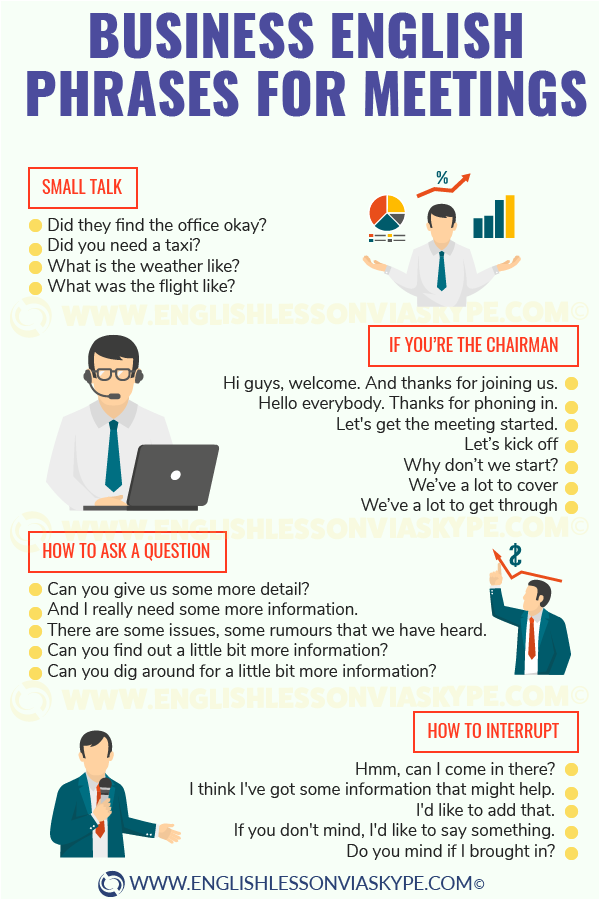
Like all meetings at the beginning, there’s often a lot of small talk, particularly if you haven’t seen the people for a while. There may be talking about how they got there to the meeting.
- Did they find the office okay?
- Did you need a taxi?
- What is the weather like?
- What was the flight like?
It’s something that you can use as small talk.
And of course, a lot of meetings take place, not physically, but on a conference call. So in this case what you’re going to say won’t make any difference. The expressions and phrases would be exactly the same.
Of course, the small talk might be a little bit different because they’re going to be in their own offices and haven’t travelled.
So you might just ask something about the weather, the football match, the family if you know them well.
But small talk always helps to break the ice and get people warmed up and ready for the meeting.
English Phrases for Meetings
if you’re the chairman
If you’re the chairman of the meeting, then you can start by saying something like:
- Hi guys, welcome. And thanks for joining us.
- Hello everybody. Thanks for phoning in. (if it’s a conference call)
- Let’s get the meeting started.
- Let’s kick off
- Why don’t we start?
- Everybody seems to be present. Anybody else can join later as they come.
- We have a lot to cover
- We have a lot to get through
so yet you’re making everybody aware that the meeting won’t go on longer than is absolutely necessary. But we have a lot to get through. We have a lot to cover. So the sooner we start, the sooner the meeting will end.
English Phrases for Meetings
phrases around the start of the meeting
If you’ve got a very formal structure and somebody kept minutes or the notes on the last meeting, well it’s always a good place to start.
Let’s start with the minutes of the last meeting.
Has anybody got any questions arising from those minutes?
Meaning: is there anything in the minutes that they need to be explained or they don’t understand or something has fallen through the instructions that haven’t been followed up.
So let’s start with the minutes of the last meeting as anybody got any questions or anything they wished to add.
So somebody might like to add something following on from that particular meeting. Something has perhaps has changed, some action has taken place that has resulted in something either been resolved or perhaps it is now off the agenda.
It’s a good opportunity at the beginning of the meeting just to find out where everybody is.
If you want to know has everybody read the minutes:
Is everybody okay with the minutes?
Has everybody understood the minutes and is there anything additional to add?
Anything extra that people should know?
Let’s start with the minutes of the last meeting. Anybody, any questions or anything they wish to add or would like to add before we move on?
So again, you’re just letting people know that we just spend a few minutes with this and then we’ll move on to the items that are specific to this particular meeting today. Okay?
get onto the first item
You should all have a copy of this week’s agenda. So you’re setting the scene, you’re going to refer to this agenda.
In case of anybody around the table or on the conference call who hasn’t got a copy of it, then you would be happy to send it to them.
So everybody is up to date, let’s get onto the first item. So this is the next part:
What is the first item to be covered?
So you look around and you see who is the most appropriate person to cover this first item. So you might pick somebody like Michael and you can say:
Okay Michael, can I come to you first? Can you give us a quick update as to where we are with the new product development?
Or the application or the design. So depending on what business you’re in, you want this guy Michael who is probably the key person involved in this part of the product or the project. You want him to give everybody an update as to where we are. So you’re identifying him and he is then going to give everybody a quick update as to where he is aware the company is with the application, with the product, with the development, whatever it happens to be.
And then you will thank him.
Okay, thanks, Michael. That’s very clear. Anybody, any questions? Anybody got anything to add?
And then again, you open it to everybody around the table or in the various conference locations if they, anything that they wished to ask specifically.
English Phrases for Business Meetings
move onto the next item
Next. So this is again, we’re going to move on to the next point.
- What’s next?
- Let’s move on.
- We, as I said, we’ve got a lot to do so there are a couple of these points that we may be able to get through quite quickly.
So again, you’re letting people know that you don’t want to spend all day on these points.
And then you might ask some questions of the people.
- Have you had time to consider?
- Question, what can you add to improve the situation?
- Are there any obvious elephant traps?
- Are there any obvious impediments? Anything that you can add?
how to pull people back
If people start talking about things, not particular to what you want to talk about, we’ll then pull them back.
- Okay guys, let’s stick to the point that stick to the agenda.
- I know there’s a lot you want to talk about, but no, we can cover those outside the meeting.
- I really want to stick to the agenda and want to stick to the point we are getting off the point.
- Please, let’s stick to what we are talking about. Let’s not wonder.
- Let’s stick to our agenda and let’s stick to the points that we are talking about.
So very clearly letting people know that you want to cover everything. They’ll get a chance to raise issues later on.
business English Phrases for Meetings
how to ask a question
Somebody might ask some questions:
- Can you give us some more detail?
- And I really need some more information.
- There are some issues, some rumours that we have heard.
- Can you find out a little bit more information?
- Can you dig around for a little bit more information?
So when you ask somebody to dig around, it means go and find some facts, talk to some people, and try and find out exactly what’s happening out there in case. So yes, we want to stick to the facts but if there is a rumour, then we need to know what it is.
coming to the end
So once you’ve gone through all of the points and you’re, as I said, writing your minutes, then you come to the end and you might say something like:
- Well, I think that covers everything for today.
- I believe we’ve covered everything. Thanks for attending. Thanks for your input. Thanks for your contribution.
- Has anybody got anything else to raise?
Meaning, is there any other issue that they would raise? And here we’re talking about any other business, and you’ll often see this on the end of an agenda AOB – any other business. So once we’ve covered all the key points, then we’re onto any other business. And that’s when you’re asking people, okay, anybody got anything else to raise? You’re probably sitting there with your fingers crossed hoping that they don’t raise any more issues. But if they do, then you have to be prepared to deal with them.
encourage participants
During the meeting when people are raising points, then you might like to add some phrases to support them.
- Oh, that’s a good point.
- Yeah, I see where you’re coming from.
Or you might want to ask something specific, a little bit deeper question:
- Where are you coming from?
- Can you give me a little bit more information?
- What do you think?
So you’re just trying to get people engaged and ask for an opinion.
how to interrupt a meeting
And there’ll be often times when people want to interrupt so they can use phrases like:
- Hmm, can I come in there?
- I think I’ve got some information that might help.
- I’d like to add that.
- If you don’t mind, I’d like to say something.
- Do you mind if I brought in?
This is very informal, but it’s used a lot.
If somebody wants to be really formal, they might use expressions:
Well, I would like to point out that.
Okay, so these are all typical business expressions and English phrases for meetings. The words that you can use when you’re hosting or attending a business meeting in English.
What I’ll do in the next couple of podcast episodes, I’ll introduce you to some other business English expressions that we can use for different meetings, whether it’s interviews or meetings with bosses. I will help you further with your English and particularly your business English.
Thanks for listening. And as always, if you want to contact me, you’ll get me on www.englishlessonviaskype.com and I’m very happy to talk to you. I’m glad you’re listening and catch up with you soon.
More Information
For more information on English idioms, English collocations and English phrasal verbs, check out the links below:
10 Ways to finish an email in English
How to talk about Money in English
Don’t forget to check out intermediate and advanced English lessons at Learning English with the BBC.
You will love these English lessons

WAIT vs AWAIT – What’s the Difference?
Wait vs Await, how to use them correctly? I have a very active account on Instagram @englishlessonskype and yesterday I

Other Words for Beautiful
Learn other words for beautiful in English. Perfect vocabulary for English proficiency exams. Advanced English collocations.

English Idioms about Love
Here you’re going to learn English idioms about love with meanings and examples. british council learn english list of idioms