
Many English learners make small mistakes with uncountable and plural nouns.
Uncountable and plural nouns can be difficult because some nouns that are countable in your language are uncountable in English.
We say:
- informationsinformation
- advicesadvice
- the news arethe news is
- a scissora pair of scissors
In this lesson, you’ll learn how uncountable nouns and plural-only nouns work, when to use is or are, and how to avoid common mistakes in everyday English and at work.
- Quick test
- Uncountable nouns: video lesson
- Uncountable, countable and plural-only nouns
- Common uncountable nouns in English
- How to count uncountable nouns
- Plural-only nouns in English
- Uncountable nouns: is or are?
- Common mistakes to avoid
- Listen to the podcast lesson
- Uncountable nouns you use at work
- Nouns that can be countable and uncountable
- Practice
- Frequently asked questions
- Quick summary
Quick test
Which sentence is correct?
- The information is correct.
- The information are correct.
- She gave me an advice.
- She gave me some advice.
- My trousers are too long.
- My trousers is too long.
- I need a new pair of scissors.
- I need a new scissor.
You’ll find the answers in the practice section below.
Uncountable nouns: is or are?
Watch this short lesson with Harry to hear how uncountable nouns work and which verb form you should use.
Uncountable, countable and plural-only nouns
There are three different patterns you need to recognise.
| Type of noun | Example | Can you use a number? | A / an? | Verb |
|---|---|---|---|---|
| Countable | report / reports | Yes | Yes, in the singular | is / are |
| Uncountable | information | No, not directly | No | is |
| Plural-only | scissors | Not directly | No | are |
A countable noun can normally be singular or plural.
- A report is ready.
- Three reports are ready.
An uncountable noun is normally treated as one mass or idea. It does not usually have a plural form.
- The information is correct.
A plural-only noun has a plural form even when you are talking about one object.
- The scissors are on the desk.
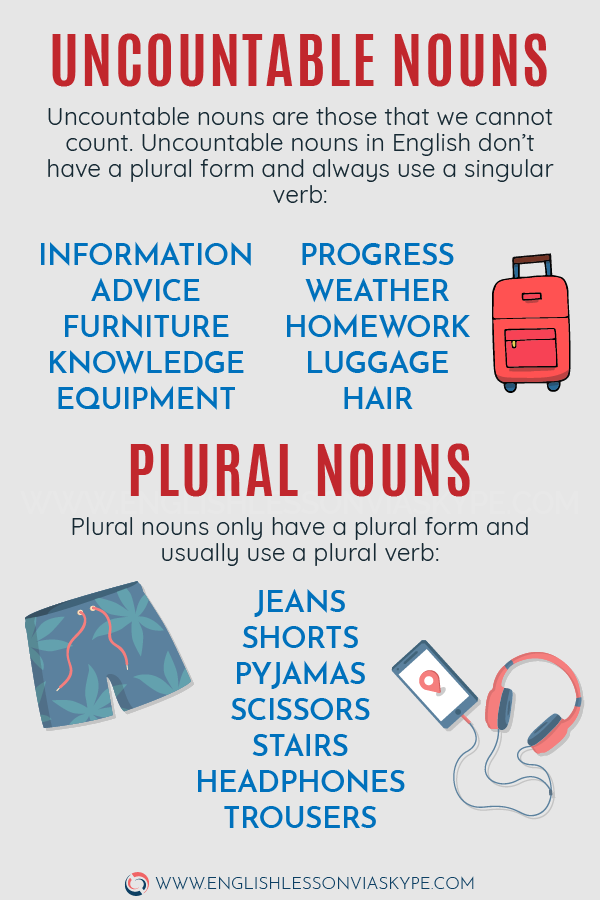
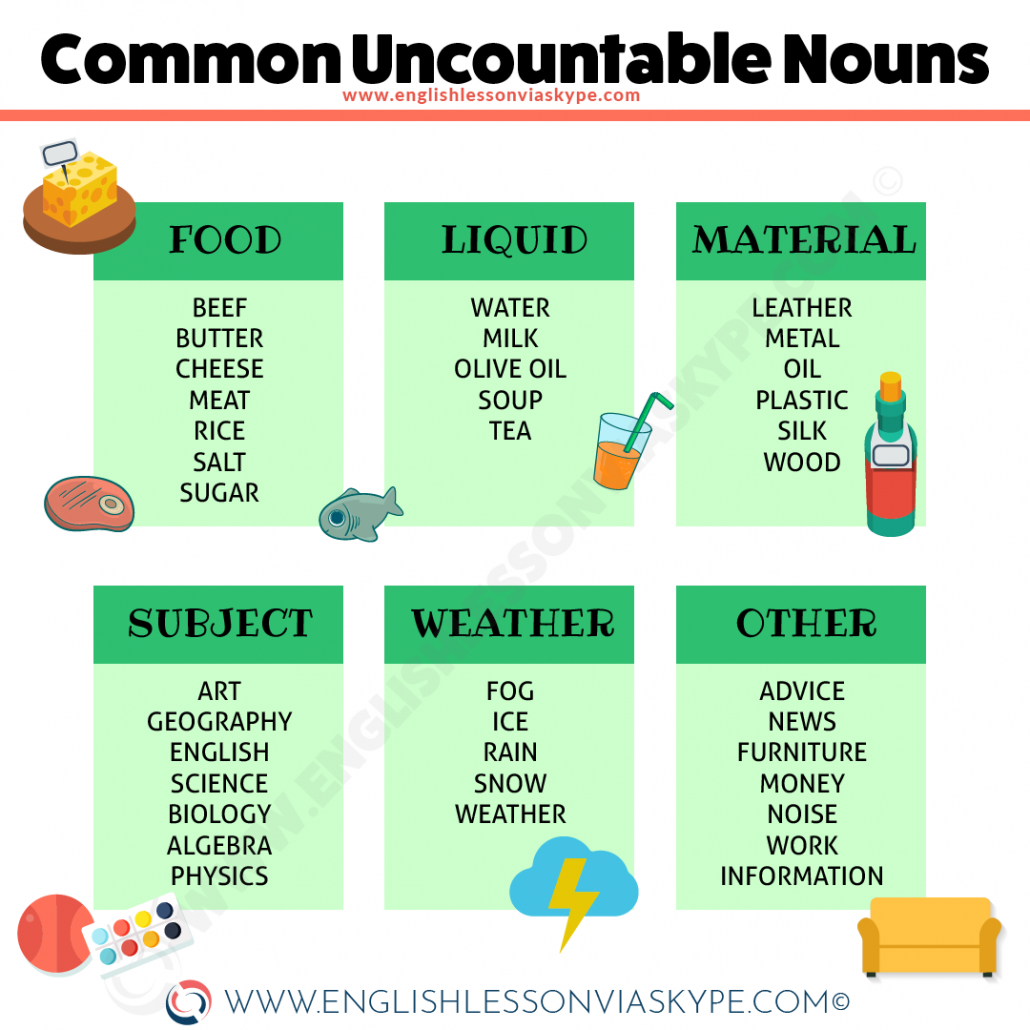
Common uncountable nouns in English
Uncountable nouns normally:
- do not have a plural form
- do not take a or an
- use a singular verb
- can be used with words such as some, any, much, little and a lot of
Here are some common examples.
- informationHe refused to give us any more information.
- adviceShe gave me some useful advice.
- furnitureWe’re going to sell some of our furniture.
- knowledgeHis knowledge of Italian is very good.
- equipmentYou need a lot of equipment for scuba diving.
- progressShe is making steady progress with her English.
- weatherThe weather is getting worse.
- homeworkMichael had a lot of homework last night.
- luggageI always take too much luggage when I travel.
- hairYour hair is getting very long.
These are the mistakes learners make most often with this list.
- some informationssome information
- two advicestwo pieces of advice
- new furnituresnew furniture
- several equipmentsseveral pieces of equipment
- a good progressgood progress
How to count uncountable nouns
You cannot normally put a number directly before an uncountable noun. Instead, use a countable expression.
information
- some information
- a piece of information
- three pieces of information
- three informations
advice
- some advice
- a piece of advice
- two pieces of advice
- two advices
furniture
- some furniture
- a piece of furniture
- several pieces of furniture
- several furnitures
equipment
- some equipment
- a piece of equipment
- five pieces of equipment
- five equipments
news
- some news
- a piece of news
- two pieces of news
- two news
You do not always need a piece of. In normal conversation, some information, some advice and some equipment are often the most natural choices.
Plural onlyPlural-only nouns in English
Some English nouns normally exist only in the plural form. Common plural-only nouns include:
- jeans
- shorts
- pyjamas
- trousers
- scissors
- headphones
- glasses
- clothes
- stairs
These nouns normally use a plural verb.
- These trousers are too small for me.
- The scissors are in the cupboard.
- My headphones are quite old.
- The stairs are very steep.
- My jeans is too small.My jeans are too small.
Use “a pair of” for one item
With nouns such as jeans, trousers, scissors and glasses, you can use a pair of when you want to talk about one item.
- I bought a new pair of jeans.
- Do you have a pair of scissors?
- I need a new pair of glasses.
The scissors are on the desk.
But:
The pair of scissors is on the desk.
The noun pair is singular, so we use is.
Uncountable nouns: is or are?
This is one of the most common questions about uncountable nouns.
Uncountable nouns normally take a singular verb
- The information is correct.
- The advice is useful.
- The equipment is ready.
- The furniture is expensive.
- The progress is encouraging.
- The news is good.
Plural-only nouns take a plural verb
- The trousers are ready.
- The scissors are on the table.
- The headphones are working.
- The stairs are dangerous.
News ends in s, but grammatically it is singular.
- The news are good.The news is good.
You can say:
- There is some good news.
- I have a piece of news for you.
- I have two pieces of news for you.
Common mistakes with uncountable and plural nouns
I need some informations about the project.
I need some information about the project.
I need two pieces of information before I can decide.
Can you give me an advice?
Can you give me some advice?
Can you give me a piece of advice?
The equipments are ready.
The equipment is ready.
All the equipment is ready.
We’ve made a good progress.
We’ve made good progress.
We’ve made a lot of progress.
We need to buy new furnitures.
We need to buy new furniture.
We need to buy three new pieces of furniture.
I bought a new jeans.
I bought a new pair of jeans.
I bought some new jeans.
Where is the scissor?
Where are the scissors?
Where is the pair of scissors?
The news are surprising.
The news is surprising.
Prefer to listen?
If you prefer to listen, Harry explains the grammar in more detail in Speak Better English with Harry, Episode 215: Uncountable and Plural Nouns in English Explained Clearly.
The episode covers countable and uncountable nouns, plural-only nouns, news, advice, information, luggage, work, and nouns that change meaning depending on how they are used.
Uncountable nouns you use at work
These grammar mistakes do not only appear in grammar exercises. Words such as information, advice, feedback, progress, equipment, software, research and work appear constantly in emails, meetings, reports and project updates.
Here are some examples you may need at work.
Information
- Could you send me the informations by Friday?
- Could you send me the information by Friday?
- I still need two pieces of information before I can complete the report.
Feedback
- I received three feedbacks from the client.
- I received some feedback from the client.
- I received three comments from the client.
Advice
- I need an advice before I reply.
- I need some advice before I reply.
- Could I ask you for a piece of advice?
Progress
- We made a good progress this week.
- We made good progress this week.
- We’ve made a lot of progress since Monday.
Equipment
- The new equipments are ready.
- The new equipment is ready.
- All the equipment has arrived.
Software
- We need to buy two new softwares.
- We need some new software.
- We need two new software packages.
Research
- We completed three researches.
- We completed some research.
- We completed three studies.
Work
- I have many works to finish before Friday.
- I have a lot of work to finish before Friday.
- I have several tasks to finish before Friday.
Could you send me the information by three this afternoon?
Thanks for the feedback. I’ll update the report.
We’ve made good progress, but we still need the final figures.
The equipment is ready for tomorrow’s test.
I need some advice before I reply to the client.
I’ve still got quite a lot of work to finish today.
Do you use English at work?
Knowing the grammar rule helps, but it does not always give you the words you need when someone asks you a question in a meeting or when you are trying to make an email sound right.
Choose a free resource for the situation you need: practise meeting English, check your email tone, prepare for unexpected questions or find useful workplace phrases.
Explore free Business English resources →Nouns that can be countable and uncountable
Some nouns can be both countable and uncountable. The meaning changes.
Hair
When you mean the hair on someone’s head in general, it is normally uncountable.
- Her hair is very long.
When you mean individual hairs, it can be countable.
- I found two grey hairs.
Coffee
Coffee is normally uncountable.
- I drink too much coffee.
But in a café, two coffees means two cups of coffee.
- Two coffees, please.
Experience
When you mean knowledge or skill gained over time, experience is uncountable.
- She has a lot of experience in finance.
When you mean a particular event, it is countable.
- It was an interesting experience.
- I had several unusual experiences while travelling.
Time
When you mean time in general, it is uncountable.
- Time goes quickly when you’re busy.
When you mean occasions, it is countable.
- I’ve been to Berlin three times.
This is why you cannot always decide whether a noun is countable or uncountable by looking at the word alone. The meaning matters.
Test your knowledge
Correct the mistake in each sentence.
1. Could you send me the informations by Friday?
Show answer
Could you send me the information by Friday?
2. The equipment are already in the meeting room.
Show answer
The equipment is already in the meeting room.
3. She gave me an useful advice.
Show answer
She gave me some useful advice.
Or
She gave me a useful piece of advice.
4. We’ve made a good progress this month.
Show answer
We’ve made good progress this month.
5. I bought a new jeans yesterday.
Show answer
I bought a new pair of jeans yesterday.
6. Where is the scissors?
Show answer
Where are the scissors?
Or
Where is the pair of scissors?
7. The news are better than we expected.
Show answer
The news is better than we expected.
8. I received three feedbacks on the report.
Show answer
I received some feedback on the report.
Or
I received three comments on the report.
Quick test answers
The four sentences from the top of the page.
Show the answers
- The information is correct.
- She gave me some advice.
- My trousers are too long.
- I need a new pair of scissors.
Frequently asked questions
Is information countable or uncountable?
Information is normally uncountable in English. Say:
- some information
- a piece of information
- two pieces of information
Do not normally say:
- an information
- two informations
Is advice countable or uncountable?
Advice is uncountable. Say:
- some advice
- a piece of advice
- two pieces of advice
Do not say:
- an advice
- advices
Is equipment singular or plural?
Equipment is an uncountable noun and normally takes a singular verb.
The equipment is ready.
To count individual items, say:
- three pieces of equipment
- three machines
- three devices
The best word depends on what the equipment actually is.
Is progress countable or uncountable?
Progress is normally uncountable.
- We’re making progress.
- We’ve made good progress.
- We’ve made a lot of progress.
Do not normally say:
- a progress
- progresses
Is news singular or plural?
News is grammatically singular even though it ends in s.
- The news is good.
- This is surprising news.
- I have a piece of news for you.
Do we say “the scissors is” or “the scissors are”?
Say:
The scissors are on the desk.
Scissors is a plural-only noun. However, when you use a pair of scissors, the noun pair is singular:
The pair of scissors is on the desk.
Is hair countable or uncountable?
It can be both. Use hair as an uncountable noun when you mean the hair on someone’s head generally:
Her hair is dark.
Use a hair or hairs when you mean individual strands:
- There’s a hair on my jacket.
- I found three grey hairs.
Quick summary: uncountable and plural nouns
Use uncountable nouns without a plural s:
- information
- advice
- furniture
- equipment
- progress
- feedback
- research
- work
Use a singular verb:
- The information is correct.
- The equipment is ready.
- The news is good.
Use plural verbs with plural-only nouns:
- The scissors are here.
- My trousers are too long.
- The headphones are working.
Use a pair of when you want to count one item such as scissors, jeans, trousers or glasses:
- a pair of scissors
- two pairs of jeans
- a pair of trousers
- three pairs of glasses
And remember:
- informationsinformation
- advicesadvice
- equipmentsequipment
- a progressprogress
- a jeansa pair of jeans
- a scissora pair of scissors
Need English for real situations at work?
If you use English in meetings, emails or conversations with colleagues and clients, choose one of the free Business English guides, quizzes or tools.
Practise the situation that causes you the most difficulty.
See free Business English resources →Free · Guides, quizzes and tools · Instant access
Related English lessons
If this lesson was useful, these will help you with the grammar and the situations around it.
- How to Use Articles Correctly in English Use it to learn when you need a, an or the, and why uncountable nouns do not normally take a or an. The lesson also covers articles with countable and uncountable nouns.
- Difference Between Job and Work Use it to understand why job is countable but work is normally uncountable, and how both words are used in everyday and workplace English.
- How to Ask for Clarification in English Use it when you need to check information, ask someone to explain a point or make your own meaning clearer in a conversation.
- Must-Have English Phrases for Online Meetings Use it to prepare phrases for asking questions, clarifying information, joining a discussion, interrupting politely and checking decisions in Teams, Zoom and other online meetings.