
Learn 30 phrasal verbs with get. Boost your English vocabulary and improve your speaking skills.
If you’re trying to improve your general English or conversational English. If you’re preparing for a proficiency exam. Or indeed, you might even be preparing for a job interview in English, we’re here to help you.
Listen to the podcast Speak Better English with Harry or watch it on YouTube at Learn English with Harry. englishclass101
List of phrasal verbs with get
30 Phrasal verbs with get

Harry
This particular lesson is about phrasal verbs using the verb get. So in fact, I’ve got 30 of them on the list.
So I’m going to be exhausted by the end of this. So hopefully, you and I are still awake.
There are lots of interesting phrasal verbs. And what I’m going to do is I’m going to tell you the meaning, explain it to you. And then give you a simple example that you’ll be able to use. Let’s go through them one at a time.
improve english on a budget
Online English Courses from €7.99


get about
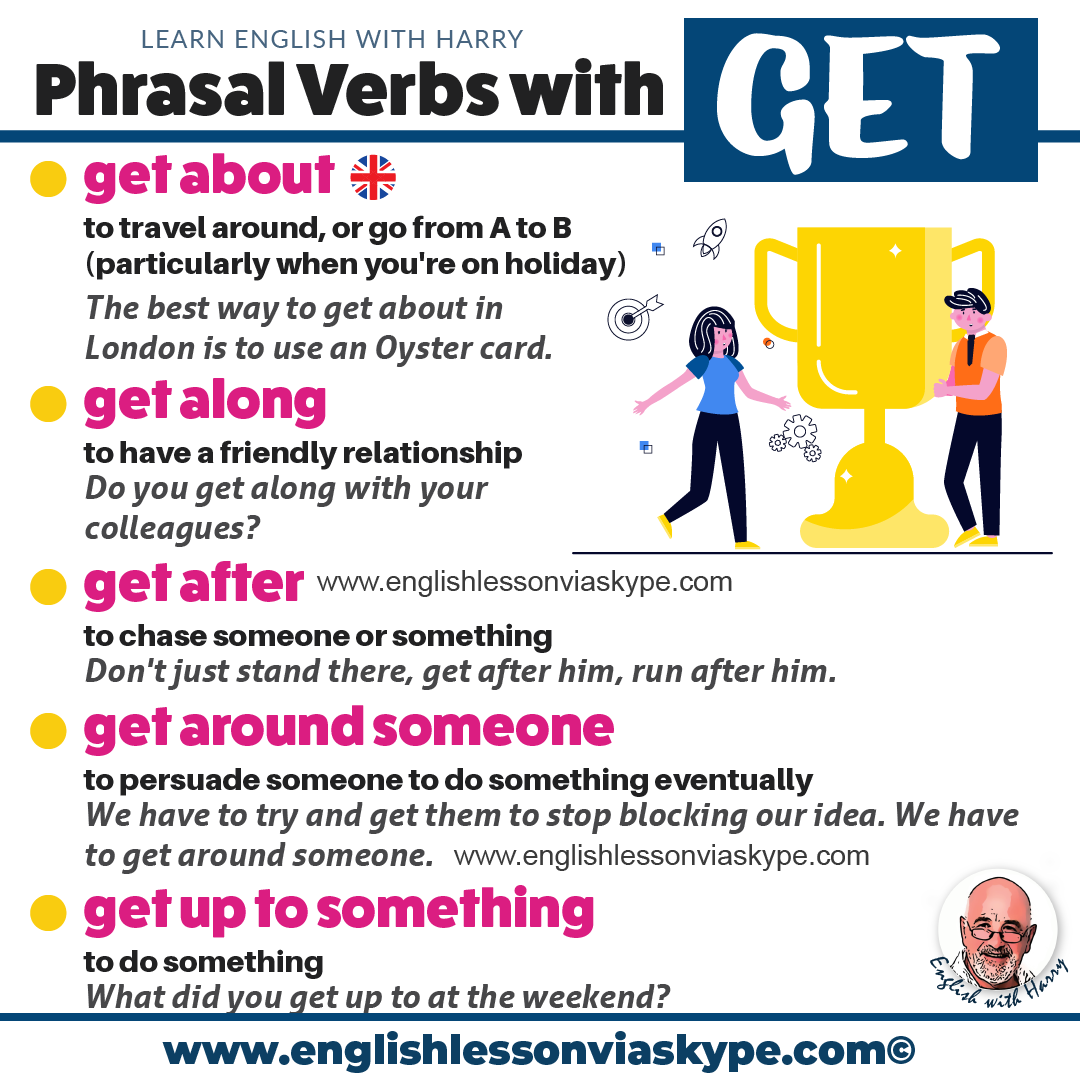
Meaning: (British English) to travel around, or go from A to B (particularly when you’re on holiday)
Example:
The best way to get about in London is to use an Oyster card. With this Oyster card, you can get about quite easily.
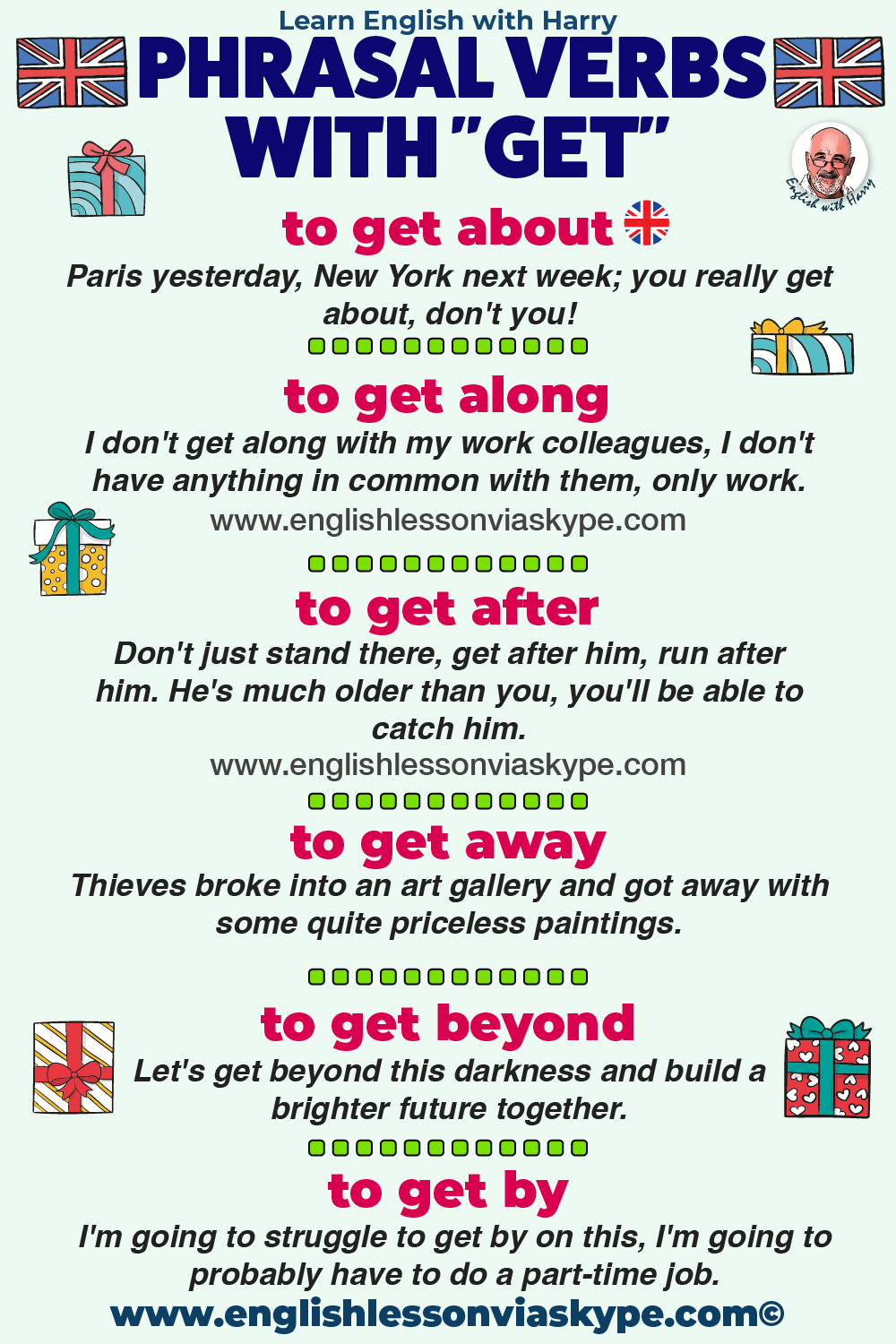
Paris yesterday, New York next week; you really get about, don’t you!
get along
Meaning: to have a friendly relationship
Example:
I’m a very, very friendly sort of person I get along with anybody who gets along with me.
Do you get along with your colleagues?
I don’t get along with my work colleagues, I don’t have anything in common with them, only work.
get after
Meaning: to chase someone or something
Example:
Don’t just stand there, get after him, run after him. He’s much older than you, you’ll be able to catch him.
Dad, Dad, the dog’s out! You have to get after him.
30 Phrasal verbs with get
get ahead
Meaning: to make progress, move in front of
Example:
He’s joined a really good company, he hopes to get ahead very quickly.
Can you drive a little bit faster and get ahead of them?
get away
Meaning: to leave, make an escape
Example:
Do you think we’ll be able to get away this weekend?
I’m cooking a special dinner, your favourite. It would be nice if we could sit down as a family and enjoy this meal.
get away with something
Meaning: to escape punishment for bad action
Example:
Thieves broke into an art gallery and got away with some quite priceless paintings.
Luckily for me, she didn’t go into the bedroom immediately. So I got away with it.
to get back to someone
Meaning: to communicate with someone at a later time or date
Example:
Leave it with me, I’ll get back to you later.
We will check and get back to you if further assistance is required.
book your trial English Lesson
get behind
Meaning: to support someone
Example:
Please come and support your team, get behind them.
Meaning: to fall behind, fail to make enough progress
Example:
Don’t expect me home before eight or nine at night. I got a little bit behind with my work due to my illness and need to catch up.
get beyond
Meaning: to get past some problem that you have or a difficulty
Example:
Look, just forget it, put it in the past. Let’s get beyond it. Let’s move on.
Let’s get beyond this darkness and build a brighter future together.
get by
Meaning: to be able to survive on a certain amount of money or food
Example:
I’m going to struggle to get by on this, I’m going to probably have to do a part-time job.
I’ve left some food already prepared in the fridge. So hopefully you’ll be able to get by on that.
get down to something
Meaning: to start doing something
Example:
I have to get down to some really hard work next week because that presentation is due by the end of the month.
Remember, those exams are early, so you’ve got to get down to some hard study.
get in
Meaning: to enter
Example:
Get in the car and just go. You’ll be surprised at what you might discover.
Meaning: to deliver or send something
Example:
Let’s get in some food for the party at the weekend.
get into something
Meaning: to start feeling something
get into a rage, get into a bad mood
Example:
I get into a bad mood when I start thinking about all the work that I have to do.
One night, he got into a rage and threatened to kill me.
get someone into something
Meaning: to become involved in a particular situation (usually bad)
Example:
David told the teacher that Johnny had broken the window. He got Johnny into trouble with the teacher.
I got her into difficulty with her landlord because I forgot to send the money.
get off
get to a good/bad start
Example:
Wow, you’ve really got off to a good start. You had some really good success with the sales.
I was trying to make a good impression, but I think I got off to a bad start here.
to get off something
Meaning: to descend, dismount, leave
Example:
You can get off the bus at the next stop and walk back to her house.
30 Phrasal verbs with get
get someone off
Meaning: to help someone avoid something
Example:
I got my friend off the night shift so that he could go along to the football match with me.
get on with something
Meaning: to continue
Example:
Come on, come on. Sit down and get on with the work. I’ll be back in 20 minutes.
get on with somebody
Meaning: have a good relationship
Example:
I get on with my in-laws very well. They are good people.
get sb/sth out
Meaning: to remove
Example:
Police had to smash the window to get the baby out of the car.
I’m on my own again. I just need to take some food out of the fridge.
Uncle Bill got my suitcase out of the car boot (trunk).
get over something/someone
Meaning: to recover from an upsetting experience, an illness
Example:
Within a few days, everything will be fine. She’ll get over it very quickly. She’s very resilient.
He got over the cold really, really quickly. I thought he would be sick for a few more days.
get past sth/sb
Meaning: to move ahead of someone or something that is in the way
Example:
Excuse me, I’m in a hurry, can I get past you?
I really want to get past this car so I can drive a little bit quicker.
Meaning: to be able to overcome something that has been on your mind for a long time
Example:
Oh, he just doesn’t seem to be able to get past that problem. He had the row last week with the boss, and it’s been going on forever.
speak better English with Harry podcast- episode 414
get around
Meaning: = to get about, to travel around, to get from A to B without difficulty
Example:
Oh, it’s easy. You just have to know the routes. There’s always a shortcut that you can take to get around the city.
get around something
Meaning: to find a way of dealing with a physical obstruction or a problem
Example:
There are roadworks on the main street. The easiest way to get around is to follow the detour arrows.
get around someone
Meaning: to persuade someone to do something eventually
Example:
Just talk to him. Tell him what it means. Tell him the implications. You will find a way to get around him.
We have to try and get them to stop blocking our idea. We have to get around someone.
get through
Meaning: to get to the other side, pass a difficult period
Example:
I’ve got to get through this paperwork before the end of the week. Otherwise, I won’t be able to rest on Saturday and Sunday.
Students have to be prepared for tough exams when they go to university. So they have to get through them somehow.
We’ll get through this together. We’ve always faced problems together, we will get through it.
get to
get to know/understand/like
Meaning: to begin doing something
Example:
I didn’t like her at the very beginning. But once I got to know her, I got to like her. She’s got a heart of gold.
get together
Meaning: a nice way to have a meeting with your friends or family
Example:
Why don’t we all get together next weekend? We haven’t met each other for a long long time.
get up
Meaning: to stand from a lower position; to wake up
Example:
What time do you get up at? I usually get up at six or just before six o’clock.
get up to something
Meaning: to do something
Example:
What did you get up to at the weekend?
Don’t get up to anything that I wouldn’t do.
Okay, there you have them.
Practice them. As I always say, if you want some more examples, you just need to write to me www.englishlessonviaskype.com. Always happy to hear from you and always happy to include your suggestions in some future lessons that we have.
Thanks for listening. Thanks for watching. This is Harry saying goodbye. Join me for the next lesson.
more information
For more information on English grammar rules, English collocations and English idioms, check out the links below:
Intermediate English travel vocabulary
English vocabulary related to driving
You can always study English advanced level at Learning English with the BBC and British Council Learn English.
You will love these English lessons
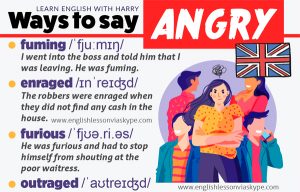

16 Better Ways to Say Angry or Annoyed in English
Learn 16 better ways to say angry or annoyed in English · Furious · Fit to be tied · Hot under the collar meaning · Video lesson

Learning English Christmas Vocabulary
With Christmas only around the corner, learning English Christmas vocabulary may not be on your priority list. We are all
Adjectives that Describe People and Personality
Here you will learn 33 English adjectives that describe people and personality. I help you learn English words that describe