



Presentations in English

You may know your subject very well, but the first minute of a presentation can still be difficult in English.

You have to welcome people, explain why you are there, tell them what you are going to cover and make it clear how long the presentation will take. You may also need to tell people when they can ask questions, or bring another person into the presentation.

The good news is that you don’t need a complicated opening. You need a simple structure and a few phrases you can rely on.

The structure

A simple presentation opening you can use

Here is a good structure:

  1. Welcome people. Good morning, everyone. Thanks for joining us.
  2. Explain the purpose. The purpose of today’s presentation is to look at our plans for the next quarter.
  3. Give the agenda. I’ll start with the current situation, then I’ll look at the main changes, and finally I’ll explain the next steps.
  4. Tell people how long it will take. This should take about 15 minutes.
  5. Explain what to do with questions. If you have any questions, please feel free to ask as we go along.

Put together, your opening could sound like this:

A complete opening

Good morning, everyone. Thanks for joining us. The purpose of today’s presentation is to look at our plans for the next quarter. I’ll start with the current situation, then I’ll look at the main changes, and finally I’ll explain the next steps. This should take about 15 minutes. If you have any questions, please feel free to ask as we go along.

That’s enough. Your audience now knows why they are there, what you are going to talk about and what to expect.

Episode 368

Listen to the lesson

Listen to this lesson on Speak Better English with Harry, Episode 368, then read on and build your own opening.

Listening and reading together makes the phrases much easier to remember.

Need phrases for the rest of your presentation, including slides, transitions, questions and your closing?

37 Useful Phrases for Presentations in English →
How to start a presentation in English — welcome people, explain the purpose, give the agenda, say how long it will take and explain what to do with questions
Step one

Opening your presentation

Start simply. You don’t need a long introduction.

Neutral and natural

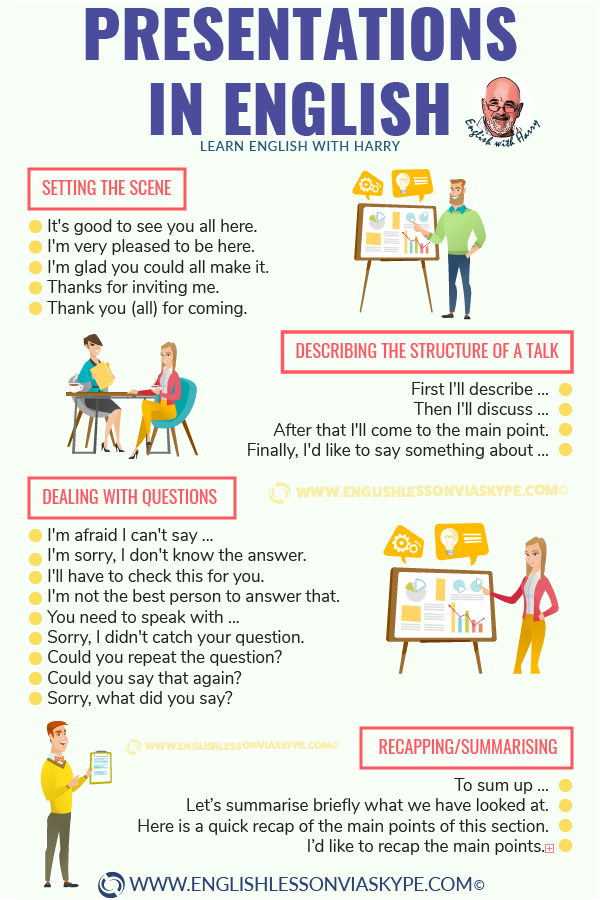
  • Good morning, everyone. Thanks for joining us.
  • Hello, everyone. It’s good to see you.
  • Thanks for coming today.
  • Thank you for joining me today.

A little more formal

  • Good morning, everyone. Thank you for being here today.
  • Thank you for taking the time to join us.
  • I’m pleased to be here today to talk about [topic].
Do you need to introduce yourself?

If everybody already knows you, don’t spend time introducing yourself again.

If some people don’t know you, keep it short:

My name is [name], and I work in [department/team].

Then move straight to the purpose of the presentation.

Step two

Explaining the purpose of your presentation

Your audience should understand very quickly why they are listening to you.

You can say:

  • Today, I’d like to talk about [topic].
  • The purpose of today’s presentation is to [purpose].
  • Today, I’m going to take you through [report/process/results].
  • I’d like to give you an overview of [project/topic].
  • Today, I’d like to show you [results/proposal/new system].
  • We’re here today to look at [topic/problem/plan].

For example:

In practice

Today, I’d like to take you through the results from the first three months of the project.

The purpose of today’s presentation is to explain the changes to our reporting process.

I’d like to give you an overview of the proposal before we discuss the details.

A useful Business English point

Be careful with present and explain.

Present — no person after the verb
Don’t say

I’ll present you the new system.

Say

I’ll present the new system.

I’ll take you through the new system.

Why: Present doesn’t take a person straight after the verb. Take you through is often the more natural choice in a workplace presentation.
Explain — the person needs to
Don’t say

I’ll explain you the results.

Say

I’ll explain the results.

I’ll explain the results to you.

Why: Explain works the same way. If you want to mention the person, use to after the thing you are explaining.
Step three

Giving the agenda

Once people know the purpose, tell them how the presentation is organised.

You don’t need a formal agenda for every presentation. In a short project update, one sentence may be enough.

You can say:

  • I’ll start with [first point].
  • Then I’ll move on to [second point].
  • After that, I’ll look at [third point].
  • Finally, I’ll explain [final point].
  • There are three things I’d like to cover today.
  • First, we’ll look at [topic]. Then we’ll discuss [topic]. Finally, we’ll look at [topic].

For example:

In practice

There are three things I’d like to cover today. First, I’ll give you a quick update on the project. Then I’ll explain the main problem we’ve had. Finally, I’ll go through the options for the next stage.

That is clearer than giving your audience a long list before you have started.

Step four

Telling people how long the presentation will take

This is especially useful in workplace presentations.

People may have another meeting afterwards, or you may have a fixed amount of time with a client.

You can say:

  • This should take about 15 minutes.
  • I’ll keep this to about 10 minutes.
  • The presentation will take around 20 minutes.
  • We have 30 minutes, so I’ll focus on the main points.
  • I’ll speak for about 15 minutes and leave 10 minutes for questions.

Questions during the presentation

If you want people to ask questions while you are speaking:

  • If anything is unclear, please feel free to ask as we go along.
  • Please stop me if you have any questions.

If you prefer questions at the end:

  • I’ll leave some time for questions at the end.
  • If you have any questions, I’ll be happy to take them at the end.

Tell people which you prefer. Otherwise, some people may interrupt while others wait until the end.

English Pronunciation Course

Do people sometimes ask you to repeat yourself when you speak English?

Knowing the right phrase is important, but people also need to understand you when you say it.

My English Pronunciation Course gives you focused practice with English sounds, word endings, stress, intonation and connected speech, so you can speak more clearly in presentations, meetings and everyday conversations.

Get the English Pronunciation Course →

€39 · 41 focused lessons · Lifetime access

Step five

Asking another person to speak

You won’t always give the whole presentation yourself.

You may need to ask a colleague to explain one section, talk about the figures or add something from their area.

Here are some natural ways to do that.

Handing over to another speaker

  • I’ll hand over to Sarah, who’ll take you through the figures.
  • James is going to explain the next stage of the project.
  • Maria, would you like to take us through the results?
  • Peter, could you say a few words about the timeline?
  • Perhaps I can hand over to Anna at this point.

Asking someone to add something

  • Sarah, would you like to add anything here?
  • Is there anything you’d like to add from the finance side?
  • James, do you want to say a few words about this?
  • Would anyone like to add anything before I move on?
One phrase to be careful with

You may have learnt:

I give the floor to Maria.

This is correct English, but it sounds formal and is more suitable for a conference, official meeting or organised debate.

In a normal workplace presentation, this usually sounds more natural:

I’ll hand over to Maria.

Or:

Maria, would you like to take us through the figures?

Useful English phrases for presentations — opening, explaining the purpose, giving the agenda, saying how long it will take and handling questions
In practice

Three complete presentation openings

1. Internal project update

With your own team

Morning, everyone. Thanks for joining. The purpose of today’s update is to look at where we are with the rollout. I’ll cover the current position, the main issue we’ve had and the next steps. This should take about 10 minutes, and then we can discuss any questions.

2. Client presentation

With a client

Good morning, everyone. Thank you for taking the time to join us. Today, I’d like to take you through our proposal and explain how the new process would work. I’ll start with the current situation, then look at the proposed changes, and finally cover the timing and next steps. I’ll keep this to about 15 minutes and leave some time for questions at the end.

3. Online presentation

On Teams or Zoom

Hi, everyone. Can you hear me okay? Great. I’m going to share my screen now. The purpose of today’s presentation is to show you the latest results from the pilot. I’ll start with the figures, then explain the main issue, and finally look at what happens next. This should take about 10 minutes. Please feel free to stop me if anything is unclear.

Get ready

Don’t write a speech for your opening

Prepare your opening, but don’t try to memorise every word.

Before your presentation, write down these five things:

  1. Welcome.
  2. Purpose.
  3. First, second and final point.
  4. Timing.
  5. Questions.

Then practise saying the opening aloud once or twice.

If you forget one sentence during the real presentation, it won’t matter. You still know the structure.

Afterwards

When your presentation becomes a discussion

Giving the prepared part of a presentation is one thing.

The difficult part can come afterwards.

Someone asks an unexpected question. A colleague disagrees. You need a few seconds to think. You want to clarify something or bring another person into the discussion.

You don’t need a perfect answer immediately. You need a few phrases that help you start.

For example:

  • That’s a good question. Give me a second to think.
  • Just to make sure I’ve understood your question…
  • Can I clarify one point before I answer?
  • I can see your point, but I think we also need to consider…
Speak Up in Meetings

Have the words ready when the discussion starts

Speak Up in Meetings gives you practical English for joining discussions, asking for clarification, buying time, giving your opinion, disagreeing carefully and checking what happens next.

Use it for face-to-face meetings, Teams and Zoom.

Get Speak Up in Meetings →

€17 · Instant access · One-time payment

In short

A simple way to prepare your next presentation

For your next presentation, don’t try to learn 30 new phrases.

Prepare these five sentences:

Fill in the brackets

Thanks for joining us today.

The purpose of today’s presentation is to [purpose].

I’ll start with [first point], then [second point], and finally [final point].

This should take about [number] minutes.

If you have any questions, [ask as we go along / I’ll take them at the end].

Change the words so they fit your real work.

Then say the complete opening aloud.

Do that a few times and the beginning of your presentation will become much easier.

Keep learning

More Business English lessons

If this lesson was useful, these will help you with the rest of the presentation and with the discussion that follows it.