
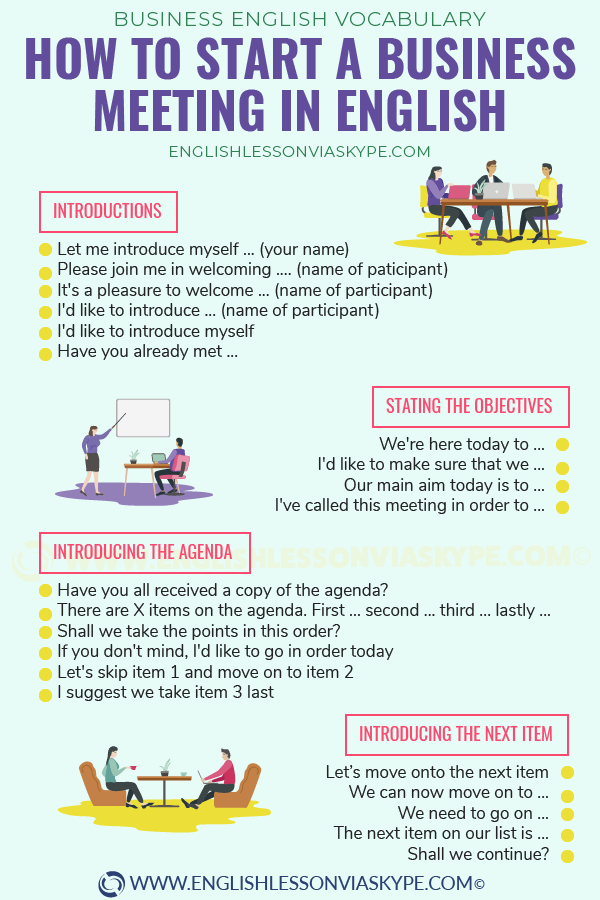

If you have to lead a meeting in English, the first minute can be the difficult part.
You need to get everyone’s attention, explain why you’re meeting, tell people what you’re going to cover and get the discussion started. And you need to do all of that without sounding too formal or reading from a script.
The good news is that you don’t need a long introduction.
A clear meeting opening usually has five parts:
- Welcome everyone.
- Explain the purpose.
- Say how much time you have.
- Give the agenda.
- Ask someone to start the discussion.
Here’s a simple example:
Good morning, everyone. Thanks for joining. The purpose of today’s meeting is to agree the final timeline for the launch. We’ve got 30 minutes, and there are three things we need to cover: testing, the budget and responsibilities. Let’s start with testing. Anna, could you give us a quick update?
That’s enough. Everyone knows why they’re there.
- How to open a business meeting in English
- Start the meeting
- Explain the purpose of the meeting
- Tell people how much time you have
- Introduce the agenda
- Introduce people only when you need to
- Ask someone else to speak
- A complete opening you can adapt
- Two examples of natural meeting openings
- Common mistakes when starting meetings
- Before your next meeting
How to open a business meeting in English
Let’s look at each part of the opening and the phrases you can use.
Step oneStart the meeting
In most normal workplace meetings, you don’t need a formal announcement.
You can simply say:
- Right, shall we get started?
- Okay, I think everyone’s here. Let’s make a start.
- Thanks for joining, everyone. Shall we begin?
- If everyone’s ready, let’s get started.
- Good morning, everyone. Thanks for being here.
For an online meeting:
- I think we’ve got everyone now. Shall we get started?
- Let’s give it another minute and then we’ll start.
- Can everyone hear me okay?
- Right, I think we’re ready to start.
A little more informal
With colleagues you know well, you may also hear:
- Right, let’s get started.
- Okay, let’s kick off.
- Shall we kick things off?
Kick off is common in everyday workplace English. It means to start something.
I’d be a little more careful with Let’s get down to business. It’s perfectly good English, but it can sound abrupt if people have only just joined, particularly with clients or people you don’t know well.
Avoid making the opening too formal
You don’t normally need expressions such as:
I would like to commence today’s meeting.
Shall we get started?
Explain the purpose of the meeting
This is one of the most important parts.
Don’t simply announce the topic. Tell people what you want the meeting to achieve.
You can say:
- The purpose of today’s meeting is to…
- We’re here today to…
- The main aim today is to…
- I called this meeting because we need to…
- What we need to decide today is…
- By the end of this meeting, I’d like us to have…
- The main thing we need to agree today is…
For example:
The purpose of today’s meeting is to agree the launch date.
We’re here today to review the client’s feedback and decide what needs to change.
By the end of this meeting, I’d like us to have agreed who is responsible for each part of the project.
Compare:
Today we’re going to talk about the new website.
with:
Today we need to agree what needs to change on the new website before it goes live.
The second version is much clearer because people know what decision needs to be made.
Tell people how much time you have
This small step makes a meeting much easier to manage.
You can say:
- We’ve got about 30 minutes.
- We have 45 minutes for this.
- I’d like to keep this to around half an hour.
- We need to finish by eleven.
- We’re a little short on time today, so I’d like to focus on three points.
- Let’s try to finish by [time].
For example:
We’ve got about 30 minutes, so I’d like to focus on the two decisions we need to make today.
I’d like to keep this to 45 minutes. If there are any points we can’t finish, we can follow up afterwards.
This also gives you a natural reason to bring people back to the subject later if the discussion starts to go off track.
Step fourIntroduce the agenda
You don’t need to read a long agenda word for word.
Usually, it’s enough to tell people the main points.
You can say:
- There are three things I’d like us to cover today.
- We have three main points on the agenda.
- First, we’ll look at…
- Then we need to discuss…
- Finally, we’ll decide…
- I’d like to start with [topic], then move on to [topic].
- Before we start, is there anything urgent we need to add?
For example:
There are three things I’d like us to cover today. First, the client’s feedback. Then we need to look at the revised timeline. Finally, we’ll agree who is responsible for the next steps.
If the agenda has already been sent to everyone, you don’t need to explain every item again.
You can simply say:
You’ve all got the agenda, so I won’t go through every point. The main thing we need to decide today is the deadline.
That sounds much more natural than spending five minutes reading information everyone already has.
If you need to change the order
You can say:
- I’d like to take the second item first today.
- Can we start with [topic]?
- I suggest we leave [topic] until the end.
- Let’s deal with [topic] first because [reason].
- We can come back to [topic] later.
For example:
I’d like to take the budget first today because Mark needs to leave at half past ten.
That gives people a clear reason for changing the order.
Step fiveIntroduce people only when you need to
The old-fashioned idea that every business meeting needs a formal round of introductions isn’t true.
If everyone already knows each other, don’t waste time introducing them again.
If some people haven’t met, keep it short:
- Before we begin, perhaps we could quickly introduce ourselves.
- Not everyone has met, so let’s do some quick introductions first.
- Could we quickly go around and say our name and role?
- Let’s start with a quick introduction from everyone.
- Could you briefly introduce yourself and explain how you’re involved in the project?
For example:
Not everyone has met before, so let’s quickly go around. Just your name, your role and how you’re involved in the project.
If you need to introduce a new person yourself:
Before we start, I’d like to introduce Maria. She’s joining us from the finance team and will be working with us on the budget.
That’s usually all you need.
Step sixAsk someone else to speak
Once you’ve explained the purpose and agenda, somebody has to start the actual discussion.
This is where a lot of learners become unsure because they don’t want to sound as if they’re giving orders.
Here are some natural ways to invite someone to speak:
- Anna, could you give us a quick update?
- James, would you like to take us through the figures?
- Could I ask Maria to start with the client feedback?
- Peter, could you talk us through what happened?
- Would you like to start, Anna?
- Anna, perhaps you could start us off.
- Let’s hear from the sales team first.
- Would you like to kick us off, James?
Would you like to kick us off? is natural but fairly informal. It works well with colleagues and in relaxed meetings.
With a client or a more formal group, I’d normally use:
Daniel, would you like to take us through the latest version?
Could I ask Daniel to give us a brief update?
Asking the whole group to contribute
You may also want to make it clear from the beginning that you want people to speak:
- Please feel free to ask questions as we go.
- I’d like to hear everyone’s view on this.
- Before we make a decision, I’d like to hear from each team.
- If anyone has a concern, please raise it as we go.
- We’ll leave a few minutes at the end for any final questions.
This is useful when you don’t want one or two people to dominate the whole meeting.
Your templateA complete meeting opening you can adapt
Here’s a simple structure you can use before your next meeting.
Good [morning/afternoon], everyone. Thanks for [joining/being here].
The purpose of today’s meeting is to [purpose].
We have [amount of time], and there are [number] main things I’d like us to cover: [item 1], [item 2] and [item 3].
By the end of the meeting, I’d like us to [decision/result].
Let’s start with [first item].
[Name], could you [give us a quick update/take us through the figures/explain where things stand]?
Don’t learn the whole thing word for word. Use the structure and change the details for your own meeting.
Two examples of natural meeting openings
Internal team meeting
Morning, everyone. Thanks for joining.
The aim today is to decide which launch date we can realistically commit to.
We’ve got about 25 minutes. There are three things we need to check: testing, client approval and resources.
Let’s start with testing. Marta, could you give us a quick update on where things stand?
This works well because it’s short. There’s no unnecessary formal language.
Meeting with a client
Good afternoon, everyone. Thank you for joining us.
The purpose of today’s meeting is to review the proposal and make sure we’re clear on the next steps.
We have about 45 minutes. I’d like to cover three areas: the scope, the timing and responsibilities.
Before we begin, is there anything you’d particularly like us to add?
If not, let’s start with the scope. Daniel, would you like to take us through the latest version?
The tone here is slightly more careful, but the English is still simple.
Starting the meeting is only the first part
Once the discussion starts, you may need to join in quickly, ask someone to clarify a point, buy yourself a few seconds to think, disagree carefully or check exactly what has been decided.
Speak Up in Meetings gives you practical phrases for those moments, with examples for face-to-face, Teams and Zoom meetings.
Get Speak Up in Meetings →Immediate access · No subscription · Opens in a new tab
If you need to review the previous meeting
Not every meeting needs this.
But if there are actions or decisions from the previous meeting that matter today, deal with them briefly before moving on.
You can say:
- Before we start, let’s quickly check the actions from our last meeting.
- Can we quickly go over what we agreed last time?
- There are two points from our previous meeting that we need to follow up on.
- Before we move on, can we check where we are with [action]?
- Last time, we agreed that [decision]. Is that still the position?
For example:
Before we start on the new proposal, let’s quickly check the two actions from last week. Anna, did we get final approval from finance?
You don’t need to read all the minutes unless there is a formal reason to do so.
Watch outCommon mistakes when starting meetings in English
As you are all aware, during the past few months we have been considering a number of different possibilities regarding…
The main decision today is whether we launch in June or September.
I would now like to commence proceedings.
Right, shall we get started?
First we’ll discuss the budget, then the timetable.
We need to decide today whether the current budget and timetable are realistic.
Saying nothing about how long the meeting will last.
We’ve got 30 minutes, so let’s focus on the two decisions we need to make.
Giving a long explanation of your own view before anyone else has spoken.
Sarah, could you give us your view on the deadline?
Mark, what are you seeing from the client’s side?
Before your next meeting
Don’t prepare a long script.
Write down five things:
- How you’ll start.
- The purpose of the meeting.
- How much time you have.
- The main agenda points.
- Who you’ll ask to speak first.
Then say your opening aloud once or twice. For example:
Thanks for joining, everyone. The purpose today is to agree the final deadline. We’ve got 30 minutes. I’d like to look at testing, resources and client approval. Let’s start with testing. Anna, could you give us a quick update?
If you can say that comfortably, you’re ready to start the meeting.
In shortFinal advice
You don’t need an impressive speech to start a business meeting in English. In most meetings, 30 to 60 seconds is enough.
Make four things clear:
- Why you’re meeting.
- What you need to discuss.
- How much time you have.
- Who should speak first.
Then get the discussion started. Simple English works very well here.
Have the words ready when the discussion starts
Opening the meeting is easier when you have a structure. The more difficult part is often what comes next: finding the right English quickly enough to join the discussion, answer a question or disagree without sounding too direct.
Speak Up in Meetings gives you practical phrases for each stage of a real work meeting, including what to say when the conversation moves quickly or you need a moment to think.
See Speak Up in Meetings →Immediate access · No subscription · Opens in a new tab
More Business English lessons for meetings
If this lesson was useful, these will help you sound clearer and more natural once the discussion starts.
- English Phrases for Meetings: Speak Up at Work Useful phrases for joining a discussion, asking for clarification, giving your opinion, disagreeing carefully, giving updates and checking the next steps.
- Must-Have English Phrases for Online Meetings Practical English for Zoom, Teams and other online meetings, including technical problems, interruptions, clarification and speaking when people talk over each other.
- How to Disagree in English Politely Learn how to disagree clearly at work without sounding rude, including safer phrases for managers, clients and meetings.
- How to Give Your Opinion in English Natural ways to introduce your opinion, explain your view and contribute to a discussion without repeating I think all the time.