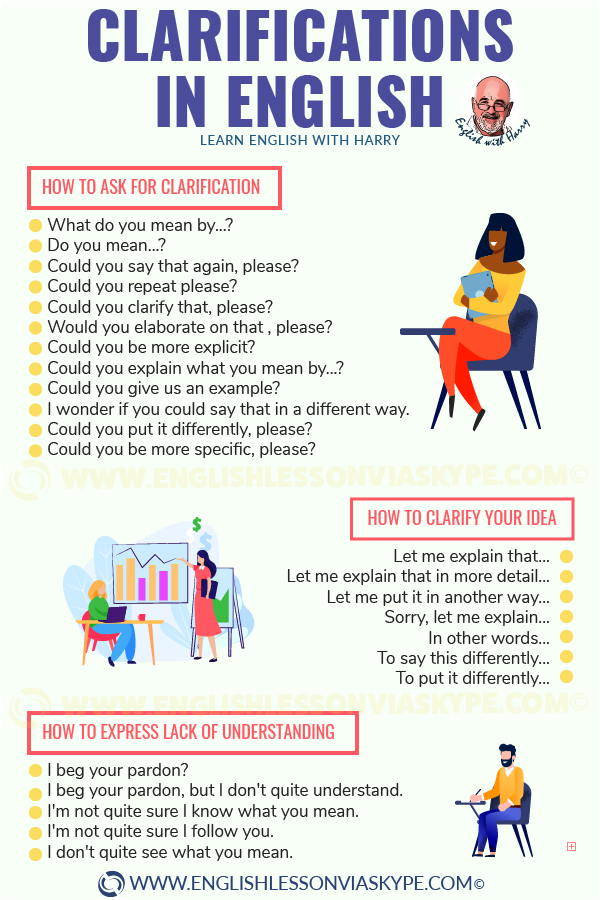
In this lesson, you’ll learn natural everyday English phrases for both situations: asking someone to clarify what they mean, and making your own meaning clearer.
Someone says something and you’re not completely sure what they mean. Or you explain an idea and realise that the other person has understood you differently.
You’ll learn expressions such as What exactly are you saying?, I don’t quite follow, Come again?, What I meant to say was… and My point is this… You’ll also see how your intonation can change the way some of these phrases sound.
Listen to the lesson
Listen to this lesson on Speak Better English with Harry, Episode 129, then read on and choose the phrases that fit the conversations you actually have.
With these phrases the tone matters as much as the words, so listening and reading together is especially useful here.
- What does it mean to clarify something?
- Everyday English phrases for asking for clarification
- Everyday phrases for clarifying what you mean
- How intonation changes the meaning
- Clarification phrases in real conversations
- Quick practice
- Frequently asked questions
- Summary: phrases for clarifying something in English
What does it mean to clarify something?
To clarify something means to make it clearer or easier to understand.
You can also clear something up when there has been confusion or a misunderstanding.
Let’s clear up one point before we continue.
When two people understand something in the same way, you can say: We’re on the same page.
In British English, you may also hear: We’re singing from the same hymn sheet.
Both expressions mean that people have the same understanding of a situation.
Everyday English phrases for asking for clarification
Use these phrases when another person has said something but you want them to make their meaning clearer.
1. What exactly are you saying?
Use this when you want the other person to state their meaning more clearly.
What exactly are you saying? Do you mean we should start again?
This is direct, but it is perfectly natural English. With a calm tone, it can simply show that you want a clearer explanation. Strong stress on exactly can make it sound more challenging.
2. What are you suggesting?
Use this when you want to understand the action, idea or solution the other person has in mind.
What are you suggesting? Are you suggesting that we cancel it and start all over again?
This is a very normal question in discussions when somebody has described a problem but has not made their proposed solution clear.
3. Basically, you’re saying…
Use this when you want to put the other person’s idea into your own words and check that you have understood correctly.
Basically, you’re saying that we have to cancel it and start again, right?
This is useful because the other person can immediately confirm or correct your understanding.
4. I don’t quite follow
Use this when you understand some of what the person is saying, but their main point is not completely clear.
I don’t quite follow. Could you explain that in a little more detail?
Quite makes the phrase slightly softer than simply saying I don’t follow. But both are natural.
5. Come again?
A short, informal way to ask someone to repeat or explain what they have just said.
Come again? Do you mean you’re leaving tonight?
This is natural spoken English. It is more informal than I don’t quite follow, so it fits everyday conversation particularly well.
Quick reference
| Situation | Phrase |
|---|---|
| You want a clearer explanation | What exactly are you saying? |
| You want to know their proposed action | What are you suggesting? |
| You want to check your interpretation | Basically, you’re saying… |
| You do not quite understand the point | I don’t quite follow. |
| Informal conversation | Come again? |
Need to ask for information or clarification more carefully?
How to Ask Indirect Questions in English →Use English in meetings?
Test your meeting English with 8 real workplace situations. Check what you would say when you need to clarify something, disagree, interrupt politely or give yourself time to answer.
Test your meeting English →Takes only 2 minutes · Instant result
Everyday phrases for clarifying what you mean
Clarification also works in the other direction. Sometimes somebody has misunderstood you, and you need to explain what you intended to say.
1. That’s not what I’m saying. What I meant to say was…
Use this when somebody has interpreted your words differently from the way you intended.
That’s not what I’m saying. What I meant to say was that we need to rethink the whole process and come up with a better plan.
This is natural spoken English. That’s not what I’m saying is fairly firm, which can be useful when you need to correct the misunderstanding clearly.
A slightly softer version is: That’s not quite what I meant.
2. My point is this…
Use this when you want to bring the listener back to the main idea.
My point is this. We need to do something different if we want to win new customers.
This is clear and quite firm. It works well when a discussion has become complicated and you want to state your main point again.
3. Listen, what I mean is…
Use this when you want to stop and explain your meaning more clearly.
Listen, what I mean is simply this. We all need to try a little harder.
Listen adds emphasis. It is normal spoken English and can sound completely natural between people who know each other. As with many spoken expressions, the tone makes a difference.
4. I mean…
One of the simplest and most common ways to explain or correct what you have just said.
I mean we should contact them again. I’m not saying we should abandon the idea.
You can also use it when you realise that your first explanation was not precise enough.
We need to do it soon. I mean sometime this week, not necessarily today.
How intonation changes the meaning
The words themselves are only part of the message. Your voice can show that you are confused, surprised, interested or challenging what somebody has said.
What exactly are you saying?
You are asking the person to make their point clearer.
What exactly are you saying?
It can sound more challenging or surprised.
Come again?
A rising tone makes it clear that you want the person to repeat or explain.
Come again?
That’s not what I’m saying
Stress can help you correct the important part.
That’s not what I’m saying. What I am saying is that we need more time.
Basically, you’re saying…?
A rising tone at the end shows that you are checking your understanding rather than making a statement.
Basically, you’re saying we should wait until Monday?
Practice note: say each phrase aloud twice. First, say it calmly. Then put stress on one particular word and listen to how the tone changes.
In contextClarification phrases in real conversations
Conversation 1: Checking what somebody means
A: I think we should leave earlier and stop somewhere overnight.
B: Basically, you’re saying we should leave on Friday evening instead of Saturday morning?
A: Exactly.
Conversation 2: Asking about somebody’s suggestion
A: This approach clearly isn’t working. We need to make some changes.
B: What are you suggesting? That we start again?
A: Not completely. I think we can keep the first part and change the rest.
Conversation 3: Correcting a misunderstanding
A: So you don’t want to help me?
B: That’s not what I’m saying. What I meant to say was that I can’t do it today.
A: Ah, okay. Tomorrow is fine.
Conversation 4: Making your point clear
A: Are you saying the whole idea is bad?
B: No. My point is this: the idea is good, but the timing isn’t right.
Conversation 5: Informal clarification
A: We might have to leave at five tomorrow morning.
B: Come again? Five in the morning?
A: Unfortunately, yes.
Quick practice
Read each situation and decide what you would say, then check it underneath.
1. Someone has explained their idea, but you still do not understand the main point.
Show answer
I don’t quite follow. Could you explain that in a little more detail?
2. Someone has described a problem, but you want to know what they think should be done.
Show answer
What are you suggesting?
3. You want to repeat somebody’s idea in your own words and check that you have understood.
Show answer
Basically, you’re saying that [your understanding], right?
4. Someone has misunderstood something you said.
Show answer
That’s not what I’m saying. What I meant to say was…
5. You want to bring a complicated discussion back to your main idea.
Show answer
My point is this…
Do you use English in meetings at work?
Clarifying your meaning is only one part of a meeting.
Speak Up in Meetings gives you practical phrases for joining the discussion, asking questions, buying time, disagreeing, raising concerns and checking what has been agreed.
Get Speak Up in Meetings →Speak more clearly · Join discussions more easily
Frequently asked questions about clarification in English
How do you ask someone to clarify what they mean?
You can say:
- What exactly are you saying?
- What are you suggesting?
- I don’t quite follow.
- Basically, you’re saying…?
Choose the phrase that fits the situation and your relationship with the other person.
Is “Come again?” natural English?
Yes. Come again? is natural informal spoken English. You can use it when you want somebody to repeat or explain what they have just said.
How do you clarify something you said?
Useful phrases include:
- What I meant to say was…
- My point is this…
- What I mean is…
- I mean…
What does “we’re on the same page” mean?
It means two or more people understand a situation in the same way or agree about what is happening.
Phrases for clarifying something in English
What exactly are you saying?
What are you suggesting?
Basically, you’re saying…
I don’t quite follow.
Come again?
That’s not what I’m saying. What I meant to say was…
My point is this…
Listen, what I mean is…
I mean…
Choose two or three phrases that sound natural to you and practise saying them aloud.
With clarification phrases, intonation matters. The same words can sound curious, surprised, firm or challenging depending on how you say them.
More English lessons about communication
If this lesson was useful, these will help you explain yourself and understand others more easily.
- How to Ask Indirect Questions in English Learn how to make questions softer and how the word order changes in indirect questions. Useful when you need to ask for information or clarification more carefully.
- 14 Phrasal Verbs Related to Communication Learn phrasal verbs such as get across, get through and talk over for explaining ideas and communicating more effectively.
- How to Agree and Disagree in English Useful everyday phrases for showing agreement, giving a different opinion and explaining how you see something.
- English Phrases for Meetings A broader Business English lesson with phrases for joining a discussion, asking for clarification, giving opinions, disagreeing and checking decisions.
- Must-Have English Phrases for Online Meetings Useful language for Zoom, Teams and other online meetings, including repetition, clarification, interruptions and technical problems.