How do you say in natural English that you need to relax or take a break?
You can use expressions such as take it easy, switch off, unwind and recharge your batteries.
You’ll learn 13 of them here, with examples and the differences between them.
Watch the lesson
Hear the pronunciation and see how these 13 expressions are used in natural English.
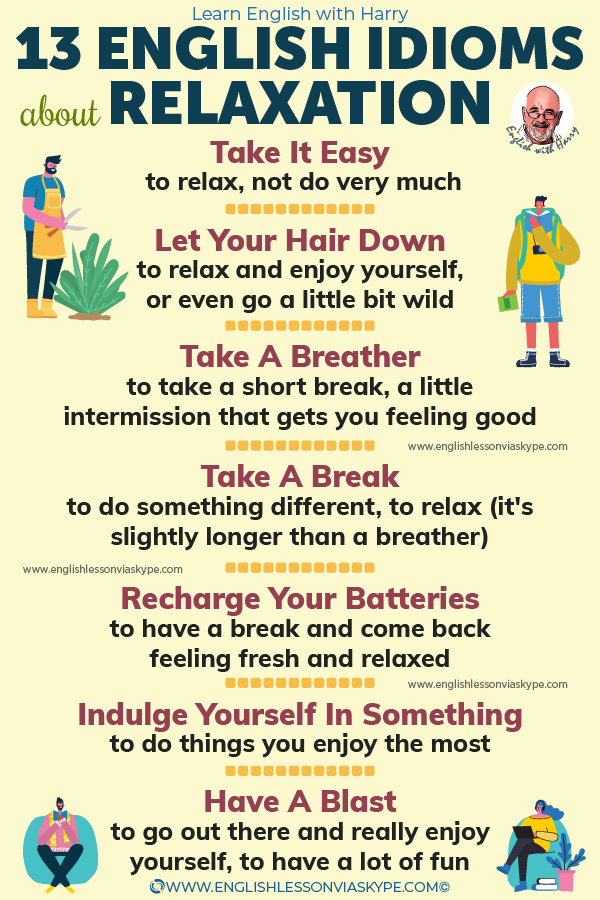
13 English expressions about relaxation and rest
Some of the expressions below are idioms, others are phrasal verbs or common fixed expressions. They are all useful ways to talk about relaxing and taking a break in English.
1. Take it easy
MeaningTo relax, avoid too much effort or stop worrying about something.
This is a very common expression in everyday English. You can use it when you are talking about rest, weekends, holidays or recovering after a busy period.
I’ve had a really busy week, so I’m going to take it easy this weekend.
The doctor told him to take it easy for a few days.
Take it easy this evening. You’ve been working all day.
2. Slow down
MeaningTo reduce your pace or do less because you have been too busy.
You can use slow down for your own life, or when work itself becomes less busy.
I’ve been working too much recently. I need to slow down a little.
Things usually slow down in the office during August.
She decided to slow down and stop working so late every evening.
3. Let your hair down
MeaningTo relax and enjoy yourself after being serious, busy or under pressure.
This is an informal expression. It is particularly useful when you talk about parties, celebrations, team dinners or going out after work.
After the conference, everyone went out for dinner and let their hair down.
It was nice to let our hair down after such a busy week.
The project was finally finished, so the team went out and let their hair down.
4. Switch off
MeaningTo stop thinking about work, problems or responsibilities and relax.
Switch off is very common in British English when people talk about evenings, weekends and holidays.
I find it difficult to switch off after a late meeting.
Once I’m on holiday, I try not to check work messages so I can switch off properly.
Reading for half an hour helps me switch off in the evening.
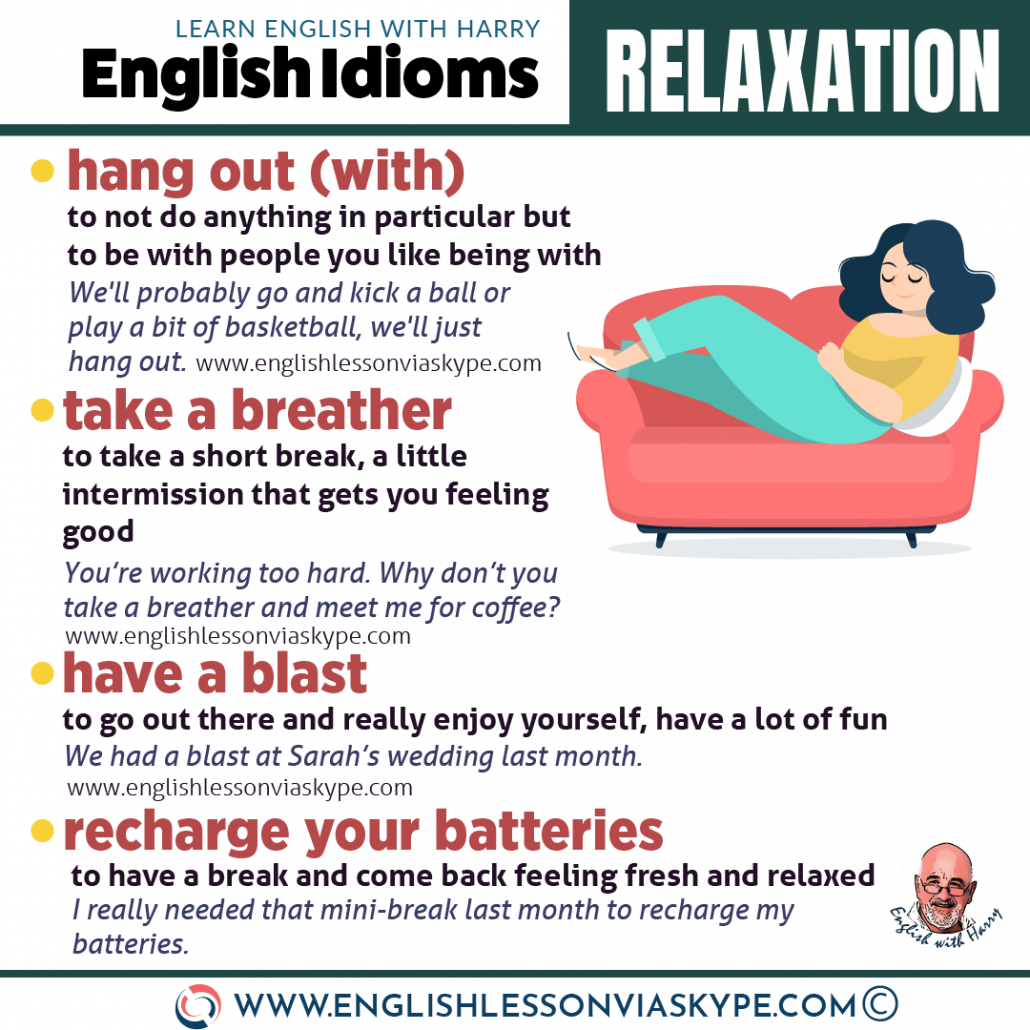
5. Hang out with someone
MeaningTo spend relaxed, informal time with someone without having a particular plan.
Hang out is informal. It is common in conversation, but you would not normally use it in a formal business email.
A few of us hung out after the training session.
I spent Saturday hanging out with some friends.
Do you want to hang out after work?
6. Unwind
MeaningTo gradually become relaxed after being busy, tired or stressed.
Unwind is useful when you talk about what you do after work, or at the beginning of a holiday.
I usually go for a walk after work to unwind.
It took me a couple of days to unwind once the holiday started.
A quiet evening at home helps me unwind after a busy day.
7. Take your mind off something
MeaningTo do or think about something else so that you stop worrying about a problem for a while.
Let’s get some lunch. It might take your mind off the presentation for a while.
Going for a run helps me take my mind off work.
She watched a film to take her mind off the interview.
8. Take a breather
MeaningTo stop for a short rest, especially after working or concentrating for some time.
A breather is usually short. The expression is conversational and quite informal.
We’ve been discussing this for two hours. Let’s take a breather.
I need five minutes to take a breather before the next call.
We stopped halfway up the hill to take a breather.
9. Take a break
MeaningTo stop an activity for a period of time so that you can rest or do something different.
Take a break is more neutral than take a breather, and the break can be short or long.
Let’s take a ten-minute break and continue at half past two.
I’ve been looking at this report all morning. I need to take a break.
She decided to take a short break from work and travel for a month.
10. Footloose and fancy-free
MeaningFree from responsibilities and able to do what you want.
This expression is playful and informal. You are more likely to hear it when people talk about their personal lives than in normal workplace communication.
I’m footloose and fancy-free this weekend, so I can go anywhere.
Before they had children, they were footloose and fancy-free and travelled a lot.
He had no plans and no responsibilities. He was completely footloose and fancy-free.
11. Have a blast
MeaningTo have a very good time and enjoy yourself a lot.
This is an informal expression.
We had a blast at the team dinner.
Have a blast in Barcelona!
Everyone had a blast at the reunion.
12. Recharge your batteries
MeaningTo rest so that you feel energetic and ready to work or do things again.
This expression is particularly common when people talk about weekends, holidays and taking time off after a busy period.
I’m taking Friday off to recharge my batteries.
A few quiet days at home helped me recharge my batteries.
The weekend away gave us time to recharge our batteries.
13. Indulge in something
MeaningTo allow yourself to enjoy something pleasant or special.
You can also say indulge yourself, particularly when you give yourself something enjoyable.
On holiday, I indulged in long lunches and late breakfasts.
After finishing the project, she indulged herself with a spa day.
Sometimes I like to indulge in a good book and do nothing else.
We normally say indulge in something or indulge yourself with something.
- indulge yourself in a spa dayindulge yourself with a spa day
Indulge yourself in something does not sound natural in this meaning.
Quick recap: 13 English expressions about relaxation
- take it easy
- slow down
- let your hair down
- switch off
- hang out with someone
- unwind
- take your mind off something
- take a breather
- take a break
- footloose and fancy-free
- have a blast
- recharge your batteries
- indulge in something
Listen to the lesson
You can also listen to this lesson with episode 477 of Speak Better English with Harry.
Hear these expressions in context while you’re travelling, walking or practising your listening.
Similar expressions: what is the difference?
Several of these English phrases for relaxation have similar meanings, but we do not always use them in the same situation.
Take a break vs take a breather
Both mean that you stop what you are doing for a while.
Take a breather usually means a short pause and sounds more informal. Take a break is more neutral, and the break can be short or much longer.
- Take a breatherWe’ve been working on this for two hours. Let’s take a breather.
- Take a breakLet’s take a fifteen-minute break.
- Take a breakI’m taking a short break from work.
Switch off vs unwind
Switch off focuses on stopping yourself from thinking about work or problems. Unwind means gradually becoming more relaxed after a busy or stressful period.
- Switch offI find it difficult to switch off after work.
- UnwindI usually listen to music to unwind.
Take it easy vs slow down
Take it easy usually means relax or avoid too much effort. Slow down means reduce your pace.
- Take it easyI’m going to take it easy this weekend.
- Slow downI’ve been working too much. I need to slow down.
Let your hair down vs have a blast
Let your hair down describes becoming more relaxed and less serious. Have a blast focuses on how much you enjoyed something.
- Let your hair downWe went out after the conference and let our hair down.
- Have a blastWe had a blast at the party.
How to use these relaxation expressions at work
Several expressions in this lesson sound completely natural when you talk to colleagues about busy periods, breaks, weekends and time off. Some work well in normal workplace conversation. Others are better kept for informal or social situations.
Natural when talking to colleagues
- Take a break Could we take a short break and come back at three? I’ve been working on this all morning. I’m going to take a break and come back to it.
- Take a breather We’ve covered a lot. Shall we take a breather before we start the next section?
- Slow down Things should slow down once the end-of-month reporting is finished.
- Switch off I find it difficult to switch off when I’ve been working late.
- Unwind I usually go for a walk after work to unwind.
- Recharge your batteries I’m taking a few days off next week to recharge my batteries.
- Take your mind off something Let’s get a coffee. It might take your mind off the deadline for ten minutes.
Better for informal or social conversations at work
These expressions are natural with colleagues, but they are mainly social rather than formal Business English.
- Let your hair down It was good to let our hair down after the conference.
- Hang out A few of us hung out after the event.
- Have a blast We had a blast at the team dinner.
- Footloose and fancy-free I’m footloose and fancy-free this weekend.
When clear English is better than an idiom
If you are asking your manager for time off, talking about workload or writing a formal email, a simple sentence is often clearer.
| Instead of | You could say |
|---|---|
| I need to recharge my batteries. | I’d like to take Friday off, if possible. |
| I need a breather. | Could we take a ten-minute break and continue at 2:30? |
| I really need to slow down. | My workload should be lighter once the month-end reporting is finished. |
At work, you do not need to use an idiom just because you know one. Use the clearest English for the situation.
Do you work in English?
If you work in English, you may also need help with meetings, emails, unexpected questions and difficult conversations.
The free Business English resources give you practical phrases, quizzes and tools for those situations.
See free Business English resources →Quick practice: choose the best expression
Choose an expression from this lesson to complete each sentence. Your score appears once you’ve answered all six.
0 of 6 answered
A whole weekend of doing very little.
I’ve had a very busy week. I’m going to ________ this weekend and do absolutely nothing.
A short pause in the middle of a long discussion.
We’ve been discussing this for nearly two hours. Let’s ________ before we continue.
Stopping yourself from thinking about work.
I stopped checking my work email once the holiday started. I really needed to ________.
A team relaxing after a long, serious project.
The team went out for dinner after the project finished. Everyone ________.
Time off so that you have energy again.
I’m taking a few days off because I need to ________ before the next project starts.
Relaxed time with people, with no particular plan.
I spent most of Saturday ________ with some old friends.
Answers
Show the answers
- take it easy
- take a breather
- switch off
- let their hair down (had a blast also works)
- recharge my batteries
- hanging out
Frequently asked questions
What are some common English idioms about relaxation?
Common English idioms and expressions about relaxation include:
- take it easy
- let your hair down
- switch off
- take a breather
- recharge your batteries
- take your mind off something
What does “recharge your batteries” mean?
Recharge your batteries means to rest so that you feel energetic again.
I’m taking a few days off to recharge my batteries.
It does not normally refer to actual batteries when it is used about a person.
What is the difference between “take a break” and “take a breather”?
Both mean that you stop an activity for a while.
A breather is normally short and informal.
Let’s take a breather for five minutes.
A break can be short or long.
Let’s take a fifteen-minute break. / She took a six-month break from work.
What does “switch off” mean in British English?
When you switch off, you stop thinking about work, problems or responsibilities and allow yourself to relax.
I find it difficult to switch off after a busy day.
It is very common in conversational British English.
Can I use “let your hair down” at work?
You can use let your hair down when talking informally with colleagues, particularly about a party, celebration, conference or social event.
We went out after the conference and let our hair down.
It would sound unusual in a formal email or a serious business discussion.
Is “footloose and fancy-free” common English?
The expression is still understood, but it sounds playful and is less common than expressions such as take it easy, unwind or switch off.
It is mainly used when someone has few responsibilities and can do what they want.
What is the difference between “relax” and “unwind”?
Relax is a general verb.
I want to relax this evening.
Unwind usually describes becoming relaxed after you have been busy, stressed or working hard.
I go for a walk after work to unwind.
Need English for meetings, emails or difficult conversations?
The free Business English resources include practical phrases, quizzes and tools you can use when you work in English.
Explore free Business English resources →Practical phrases · Quizzes and tools · Free to use
Related English lessons
If this lesson was useful, these will help you talk about work, time and conversations in English.
- English Collocations Connected with Work Use it to learn common English collocations for talking about work, workload and working life.
- 10 English Verbs Related to Time Management Use it to talk about managing time, priorities and tasks in English at work.
- How to Make Small Talk in English Use it to practise natural conversation before and after meetings, and when talking informally with colleagues.
- Key Business English Phrases for the Workplace Use it to continue from everyday English expressions into practical vocabulary used at work.
- 10 Ways to Say I’m Busy in English Use it when you want more natural ways to describe a busy schedule or a heavy workload.