
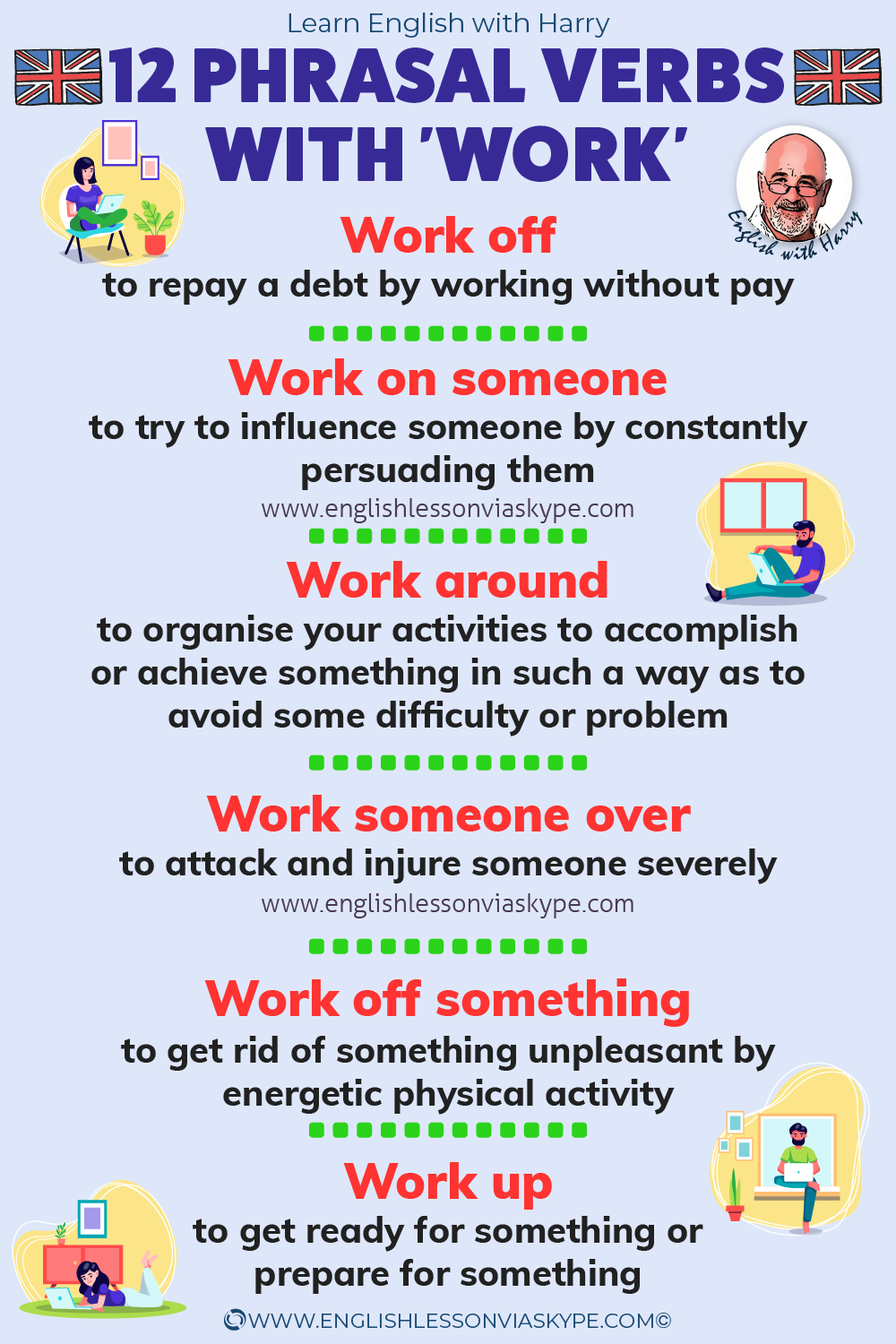
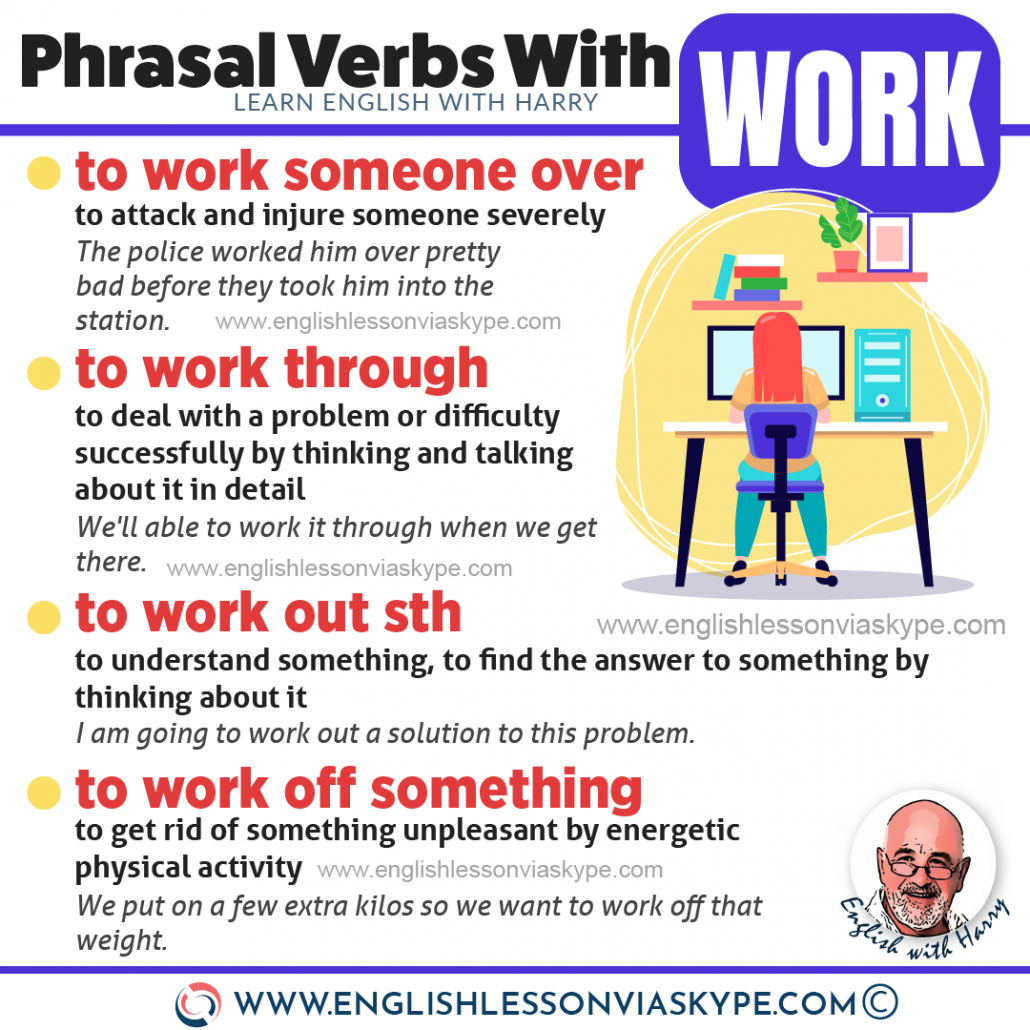

Here you’ll learn 12 common phrasal verbs with work, with simple meanings and natural examples.
Some are useful in everyday English, while others come up very often at work when you’re talking about projects, problems, progress and things that need to be completed.
The difficult thing about work is that a small change can give you a completely different meaning. You can work on a project, work through a problem or work around a difficulty. And work out alone has several different meanings.
So let’s go through them one by one.
Video lesson: 4 phrasal verbs with work
Harry explains work out, work off, work up and work on. Watch it first, then use the written lesson below to practise all 12.
12 phrasal verbs with work
We’ll start with the same four you’ve just seen in the video, then add eight more.
1 work out
Meaning: to find the answer to a problem or calculate something.
- We need to work out why the figures don’t match.
- Can you work out the total cost before the meeting?
- I couldn’t work out what was causing the problem.
You’ll hear this a lot at work when people are trying to find an answer or solve a problem.
Be careful with the word order. You can separate the verb, but a pronoun always goes in the middle:
- work out the cost
- work the cost out
- work it out
- work out it
2 work off
Meaning: to get rid of stress, extra energy or the effects of eating too much by doing physical activity.
- I usually go for a walk after work to work off some stress.
- We had a huge lunch, so I think I need to work some of it off.
You can also work off a debt, which means to repay money you owe by working.
3 work up
Meaning: to gradually develop a feeling or physical condition.
- A long walk usually works up an appetite.
- I had to work up the courage to ask my manager for some feedback.
- She was nervous about the presentation, but eventually she worked up the confidence to do it.
So you can work up an appetite, but you can also work up the courage or work up the confidence to do something.
4 work on
Meaning: to spend time developing, improving, producing or repairing something.
- I’m working on the presentation this afternoon.
- We’re working on a new way to deal with customer complaints.
- I need to work on my pronunciation before the conference.
This is probably the most useful combination with work.
At work, you can:
- work on a project
- work on a report
- work on a presentation
- work on a problem
- work on a new product
- work on a skill
Phrasal verbs with work you’ll hear at work
The next group is particularly useful if you use English at work.
You’ll hear these when people are discussing a project, trying to solve a problem, talking about progress or deciding how to move forward.
5 work around
Meaning: to find another way to deal with a difficulty without removing the problem completely.
- The system is still down, but we can work around the problem by using the backup file.
- We’ll have to work around Anna’s schedule because she’s away for most of next week.
This is useful when the problem is still there, but you find another way to continue.
6 work through
Meaning: to deal with something carefully, one part at a time.
- We need to work through the client’s comments before we send the final version.
- There are several problems here. Let’s work through them one by one.
If you work through a problem, you deal with it directly.
If you work around a problem, you find another way to continue without necessarily solving the original problem.
7 work towards
Meaning: to make an effort over time to reach a particular goal.
- We’re working towards a September launch.
- The team is working towards the same target.
- She’s working towards a management position.
In British English we say towards. You’ll also see toward without the “s”, particularly in American English, and it means exactly the same thing.
8 work at
Meaning: to make a continuing effort to improve something.
- He’s been working at his presentation skills.
- I’ve been working at becoming more confident when I speak in meetings.
You can use both when you talk about improvement, but there is a small difference.
I’m working on my presentation. You are preparing or changing a particular presentation.
I’m working at my presentation skills. You are making a continuing effort to become better at presenting.
9 work out (a second meaning)
Meaning: to develop successfully or have a good result.
- The new arrangement is working out well.
- I wasn’t sure about the new supplier at first, but everything has worked out.
- Unfortunately, the plan didn’t work out as we expected.
This is a completely different meaning from work out a problem. Compare: We need to work out the problem — we need to find the answer. Everything worked out well — everything ended successfully.
10 work something in / work something into something
Meaning: to manage to include something.
- Can you work a short example into the presentation?
- I’ll try to work the client call in before lunch.
- We should work that point into the final report.
This is useful when you already have a plan, schedule, presentation or document and you need to find room for something else.
Do you use English in meetings?
Knowing the vocabulary is one thing. Using the right English quickly in a meeting can be more difficult.
Try 8 common meeting situations and see which answers sound natural in English.
Test your meeting English →Only 2 minutes · Instant result
Two more useful phrasal verbs with work
11 work up to something
Meaning: to gradually prepare for something that is more difficult or demanding.
- Start by giving short updates and work up to giving the full presentation.
- I can run five kilometres now, and I’m slowly working up to ten.
At work, this is useful when somebody develops a skill or takes on greater responsibility little by little.
12 work on someone
Meaning: to keep trying to persuade someone to do or agree to something.
- I’ll work on James and see if he’ll agree to the extra budget.
- She’s been working on her manager to let the team work from home on Fridays.
Use it carefully: this is fairly informal. It can also suggest that you are repeatedly trying to persuade somebody, so I wouldn’t use it directly with a client or in formal communication.
Work on, work out, work through or work around?
These four are the ones learners mix up most often, so here they are side by side.
| Phrase | What are you doing? | Example |
|---|---|---|
| work on | spending time developing or improving something | We’re working on the new proposal. |
| work out | finding an answer or solution | We need to work out what went wrong. |
| work through | dealing with all the parts carefully | Let’s work through the client’s comments. |
| work around | finding another way past a difficulty | We can work around the technical problem for now. |
| work towards | making progress towards a goal | We’re working towards a June launch. |
You don’t need to learn five dictionary definitions and hope you remember them. Think about what is happening.
- Are you developing something? Work on it.
- Are you trying to find the answer? Work it out.
- Are you dealing with the problem step by step? Work through it.
- Can’t solve the problem now, but you can find another way? Work around it.
- Have you got a goal in the future? Work towards it.
That makes the differences much easier to remember.
In conversationPhrasal verbs with work in a real workplace conversation
Manager: How are we getting on with the new reporting system?
Marta: We’re still working on the final version. We need to work through a few problems with the old data.
Manager: Can we work around those problems for the first release?
Marta: I think so. I’ll work out which data we can move automatically and which parts need to be checked manually.
Manager: Good. We’re still working towards the September launch.
Marta: Yes. If the testing goes well next week, I think it should work out.
What do you notice?
- Marta is working on the system because she is developing it.
- The team needs to work through several problems because they need to deal with them carefully.
- They may work around some problems because they need to keep the project moving.
- Marta will work out which data can be moved because she needs to find the answer.
- They are working towards a future goal.
- And finally, Marta hopes everything will work out, meaning she hopes the project will be successful.
Practice: which phrasal verb with work fits?
Choose the best phrasal verb, then check your answer underneath.
1. We need to why the figures are different.
Show answer
work out
2. Our team is a new customer support system.
Show answer
working on
3. The software problem is still there, but we’ve found a way to it.
Show answer
work around
4. We spent most of the morning the client’s comments.
Show answer
working through
5. We’re a launch at the end of October.
Show answer
working towards
6. Can you this example the presentation?
Show answer
work … into
Your turn
Think about your own job. Can you complete these three sentences?
- At the moment, I’m working on…
- I’m working towards…
- One problem we need to work through is…
You’re much more likely to remember a phrasal verb if the example is connected with something you actually do.
Have the words ready when you need to speak
Vocabulary such as work through or work around is useful. But in a real meeting, you also need to know how to join the discussion, ask for clarification, buy yourself a little time, disagree and check what has been agreed.
Speak Up in Meetings gives you practical phrases for those situations, with examples for face-to-face, Teams and Zoom meetings.
See Speak Up in Meetings →Immediate access · No subscription · Opens in a new tab
A quick recap
So, we’ve looked at:
- work out
- work off
- work up
- work on
- work around
- work through
- work towards
- work at
- work out — when something is successful
- work something in
- work up to something
- work on someone
Don’t try to memorise all of them today. Pick three or four that you can actually use. Make your own examples and say them aloud a few times.
Then come back and add another couple. That’s a much easier way to make phrasal verbs part of your English.
Do you need help using English at work?
In a one-to-one English lesson, you can practise the meetings, presentations, calls and other work situations you actually deal with.
Your teacher can also correct the vocabulary, grammar and pronunciation problems that keep coming up when you speak.
Book a free trial →Lessons built around your own work · Opens in a new tab
Related English lessons
If this lesson was useful, these will help you sound clearer and more natural at work.
- 22 Phrasal Verbs for Business Learn business phrasal verbs such as bring in, firm up, hand over, look into, take over and turn around, with business examples.
- 30 Phrasal Verbs with Get Continue with another very common verb. The lesson covers different meanings of get phrasal verbs with examples from everyday and working English.
- Understanding the Grammar of Phrasal Verbs Useful if you understand the meaning but are unsure where the object or pronoun goes. It explains transitive, intransitive and separable phrasal verbs.
- Advanced English Expressions with Work Move beyond phrasal verbs and learn expressions with work, including work a treat, work the system, work your way through and work your way up.