




How to Accept and Decline Invitations in English

  • Post author:
  • Post last modified:09/07/2026
  • Post category:Everyday English
  • Reading time:11 mins read

Someone invites you somewhere in English. You want to say yes, no or maybe, but you're not sure what sounds natural.

Saying yes is usually easy. Saying no is harder. A direct no can sound rude, but a long excuse can sound uncomfortable too.

In this lesson, you'll learn how to:

  • invite someone naturally
  • accept an invitation and continue the conversation
  • say maybe when you're not ready to answer
  • decline without sounding rude
  • respond to invitations from colleagues and other people you know through work

You'll also hear the phrases in the video, so you can listen to the intonation Harry uses. Watch the lesson first, or continue below for the phrases and examples.

Let's start with the basic difference between saying yes, maybe and no.

How to respond to an invitation in English

When someone invites you somewhere, you normally have three choices. You can say yes. You can say you're not sure yet. Or you can say no. Here are some simple ways to do all three.

To accept an invitation

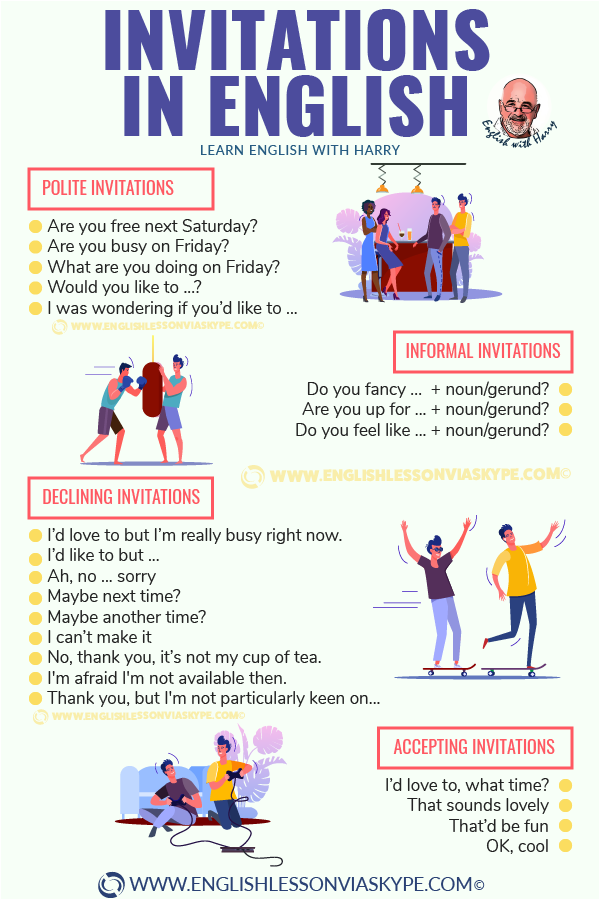
  • I'd love to.
  • That sounds great.
  • Yes, I'd love to. What time?
  • That would be lovely, thank you.

To say maybe

  • I'm not sure yet. Can I let you know?
  • Let me check and get back to you.
  • I think I'm free, but I'll check.

To decline an invitation

  • I'd love to, but I can't make it.
  • Thanks for asking, but I'm busy that evening.
  • I'm afraid I can't, but thanks for inviting me.

The words matter, but so does what comes next. A natural reply is often more than yes or no. Let's look at that in more detail.

How to invite someone in English

There are lots of ways to invite someone. The best phrase depends on how well you know the person and how formal the situation is.

Neutral invitations

These work in most situations:

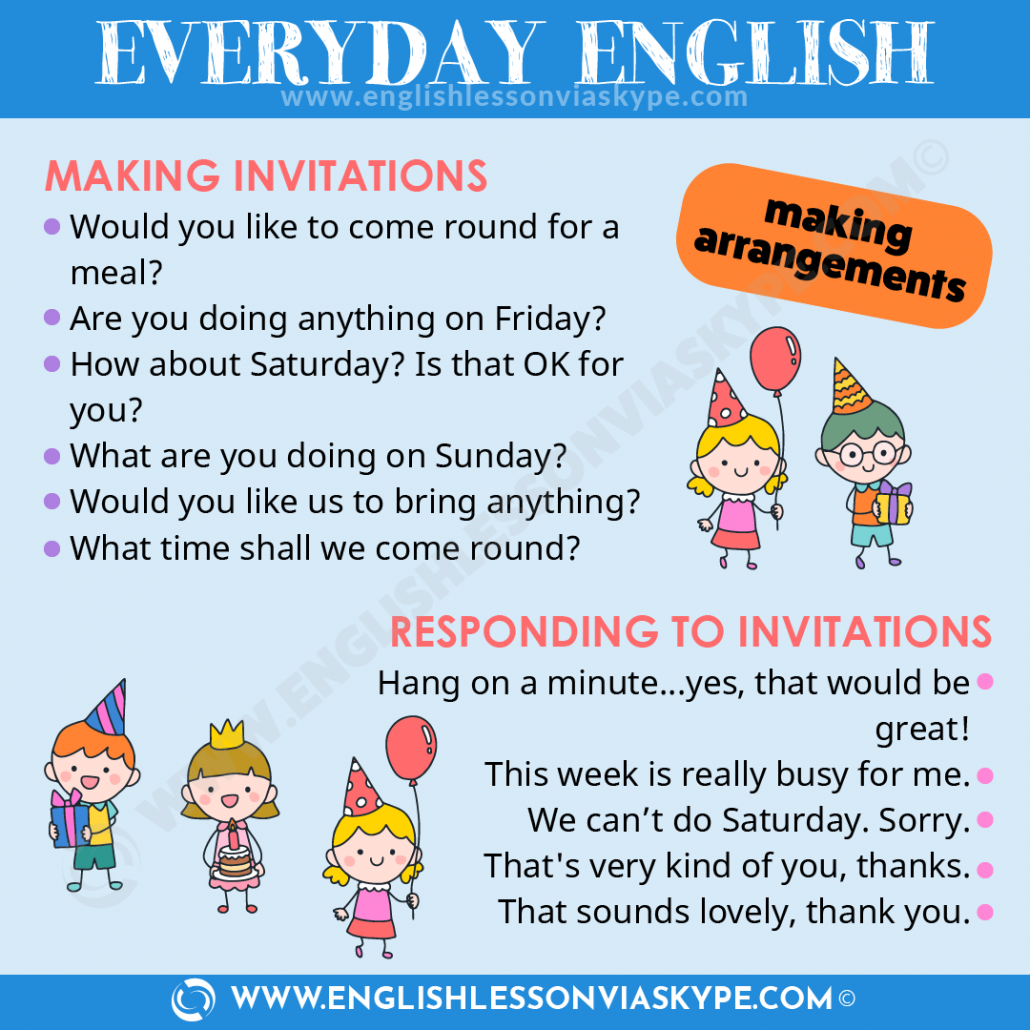
  • Are you free next Saturday?
  • Are you free for lunch next week?
  • Would you like to come for dinner on Saturday?
  • Would you like to join us?
  • I was wondering if you'd like to come along.
  • I was wondering if you'd like to join us for dinner.

Would you like to...? is one of the safest ways to invite someone. You can use it with friends, colleagues and people you don't know very well.

I was wondering if you'd like to... sounds a little more careful. For example:

  • I was wondering if you'd like to come to the exhibition with us.
  • I was wondering if you'd like to join us for lunch next week.

More casual invitations

With friends or colleagues you know well, you can also say:

  • Do you fancy going for a drink?
  • Are you up for dinner later?
  • Do you feel like going out tonight?
  • What are you doing on Friday?

Do you fancy...? is very common in British English. For example:

  • Do you fancy going for a coffee?
  • Do you fancy coming over for dinner?

Are you up for...? is also informal. For example:

  • Are you up for a walk later?
  • Are you up for going out tonight?

You probably wouldn't use these with a client you've just met or in a formal invitation.

Vocabulary for invitations in English: how to make, accept and decline invitations

How to accept an invitation naturally

A simple yes is fine, but we often say a little more. A very natural reply has three parts:

positive reaction + clear yes + practical question

For example:

  • That sounds great. I'd love to come. What time are you starting?
  • Yes, I'd love to. Should I bring anything?
  • That would be lovely, thank you. Where are you meeting?

Here are some useful ways to accept.

Warm and neutral

  • That would be great.
  • That sounds lovely, thank you.
  • I'd love to. What time?
  • That's very kind of you, thanks.

More casual

  • That'd be fun.
  • OK, cool.
  • Sounds good.

The last three are better with friends or people you know well.

When you accept, it's often natural to ask a small question. For example:

  • What time should I come?
  • Where are you meeting?
  • Should I bring anything?
  • Who else is coming?

This helps the conversation continue.

How to say maybe when you're not ready to answer

Sometimes you can't say yes or no immediately. You might need to check your calendar, speak to someone at home or find out more about the plan. You can say:

  • Let me check and get back to you.
  • I'm not sure yet. Can I let you know tomorrow?
  • I think I'm free, but I'll check.
  • I might be able to make it. When do you need to know?
  • Can I check and let you know later?

Be careful with I'll think about it. This can sound as if you're deciding whether you want to go. If the problem is simply your schedule, it's clearer to say: Let me check and get back to you.

English gets harder when you have to respond quickly

You might know the right English when you have time to think. In a meeting, you often need the words immediately.

How strong is your meeting English? Take the 2-minute quiz.

Test Your Meeting English

How to decline an invitation politely

Saying no can feel difficult, especially when English isn't your first language. The good news is that you don't need a long explanation. A simple pattern works in most situations:

thank the person + say no clearly + give a short reason if useful

For example:

  • Thanks for asking, but I can't make it.
  • I'd love to, but I'm away that weekend.
  • That sounds lovely, but I'm afraid I'm busy that evening.
  • Thanks for inviting me, but I won't be able to come.

A short reason is usually enough. You don't need to explain everything. Instead of giving a long story, you can simply say:

I'd love to, but I've already got plans.

Or:

Thanks for asking, but I'm busy that evening.

That sounds natural and polite.

Softer ways to say no

Here are a few more ways to decline or show that something isn't for you.

I'm afraid not

A: Are you free on Saturday?

B: I'm afraid not. I'm working.

This is polite and very useful.

It's not really my cup of tea

Use this when the activity itself doesn't interest you.

A: Would you like to come to the opera with us?

B: Thanks, but it's not really my cup of tea.

This is informal and common in British English.

I'm not really into that sort of thing

This also means that the activity doesn't interest you.

A: Do you want to come to the car show on Sunday?

B: Thanks, but I'm not really into that sort of thing.

It's not something I'm really interested in

This is a little more neutral.

A: Would you like to come to a talk about modern art?

B: Thanks for asking, but it's not something I'm really interested in.

Be careful here. There's a difference between saying you can't go and saying you don't want to go.

I'd love to, but I can't make it.

You want to go, but you can't.

It's not really my cup of tea.

You're not interested in the activity.

How to accept and decline invitations in English: vocabulary and example phrases

Strong ways to refuse: understand these, but use them carefully

Some ways of saying no are much stronger. You may hear these in conversations, but they are not polite ways to decline a normal invitation.

Certainly not

This is a strong no. It can also be used when refusing permission. For example:

A: Can I stay out until two in the morning?

B: Certainly not.

You probably wouldn't use this when a friend politely invites you to dinner.

No way

This is very direct and informal.

A: Are you going back to that restaurant?

B: No way. The service was terrible.

It can sound serious or joking, depending on the speaker's tone.

Not in a million years

This means absolutely never.

A: Would you go bungee jumping?

B: Not in a million years.

Again, this is much stronger than a polite refusal.

I wouldn't be seen dead in there

This is a very strong, informal expression. It means you strongly dislike a place or activity.

A: Are you going to that new nightclub?

B: I wouldn't be seen dead in there.

You might hear this between friends or family. It can sound humorous, dramatic or rude, depending on the situation.

These expressions are useful to understand, but don't use them when you simply need to decline someone's invitation politely.

Invitations at work

Invitations at work are not always formal. A colleague might invite you to lunch, for coffee, to an after-work event or to a company dinner. The language you use depends on how well you know the person.

Inviting a colleague to lunch

  • Are you free for lunch next week?
  • A few of us are going for lunch on Friday. Would you like to join us?
  • Do you want to grab some lunch?

The last one is more casual.

Inviting a colleague for a drink after work

With a colleague you know well:

We're going for a drink after work. Do you fancy coming?

A more neutral version is:

A few of us are going for a drink after work. Would you like to join us?

Accepting an invitation from a colleague

  • That sounds great. I'd love to come.
  • Thanks for inviting me. What time are you heading over?
  • Yes, that would be lovely. Where are you meeting?

Declining an invitation from a colleague

  • Thanks for asking, but I can't make it this time.
  • I'd love to, but I've already got plans that evening.
  • Thanks for the invitation. I won't be able to make it, unfortunately.

Do you need to give a reason?

Not always. With a colleague you know well, a short reason can sound natural. For example:

  • I'd love to, but I need to pick up the kids.
  • Thanks for asking, but I've got family coming over.

In a more formal situation, you can keep the reason general:

Thank you for the invitation. Unfortunately, I won't be able to attend.

You don't need to explain your private plans.

Common mistakes when accepting and declining invitations

Mistake 1: giving a very long excuse

You don't need to explain every detail.

Instead of

I'm very sorry, but on Friday my sister is coming and I promised her two weeks ago that I would...

Say

I'd love to, but I've already got plans on Friday.

Mistake 2: saying maybe when you already mean no

If you already know you can't go, maybe can create confusion.

Instead of

Maybe. I'll see.

Say

I'm afraid I can't make it.

Mistake 3: using very formal English with friends

You might see phrases such as I regret that I am unable to attend. This is possible in a formal written invitation, but it sounds unnatural when a friend invites you to dinner.

Instead of

I regret that I am unable to attend.

Say

I'd love to, but I can't make it.

Mistake 4: saying only no

A simple no is grammatically correct, but it can sound abrupt in response to a friendly invitation.

Instead of

No.

Say

No, thanks. / Thanks for asking, but I can't make it.

What would you say?

Try answering these before you look back at the phrases above.

  1. A colleague invites you to lunch, but you already have plans.
  2. A friend invites you to a party and you want to go.
  3. You need to check your calendar before you answer.
  4. A colleague you know well invites you for a drink after work.
  5. You receive a formal invitation to an event but you can't attend.

There isn't only one correct answer. The important thing is to choose a phrase that fits the person and the situation.

Listen to the lesson

Prefer listening? Hear Harry explain the phrases and examples in Speak Better English with Harry, episode 424.

You know the phrase. Can you find it quickly when you need it?

That's where many English learners get stuck, especially in meetings.

Test My Meeting English

Free · Takes 2 minutes