12 Other Ways to Say It’s Hot in English

How do you say it’s very hot without repeating the word hot?

In this English vocabulary lesson, you’ll learn 12 natural ways to describe hot weather in English, including boiling, sweltering, scorching, stifling and roasting. You’ll see what each expression means, when to use it and which words sound most natural in everyday English.

Weather is one of the easiest topics for small talk, so these expressions are useful when you’re travelling, talking to friends and colleagues, or simply commenting on a very hot summer day.

Hi there, this is Harry. Let’s look at some better ways to talk about hot weather in English.

Video lesson

Watch the lesson

Watch the video first, then use the explanations and examples below to practise.

The vocabulary

12 other ways to say it’s hot in English

A lot of English expressions for extreme heat are connected with cooking. We boil water, roast meat and bake bread, so it’s quite easy to see how some of these words came to describe very hot weather.

Let’s go through them one by one.

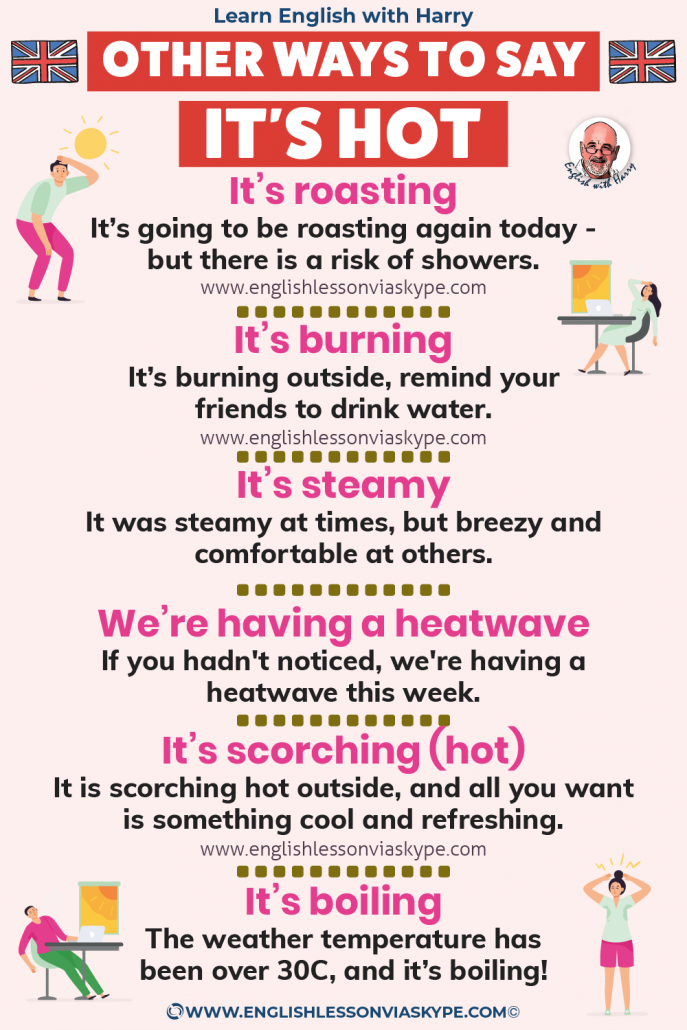
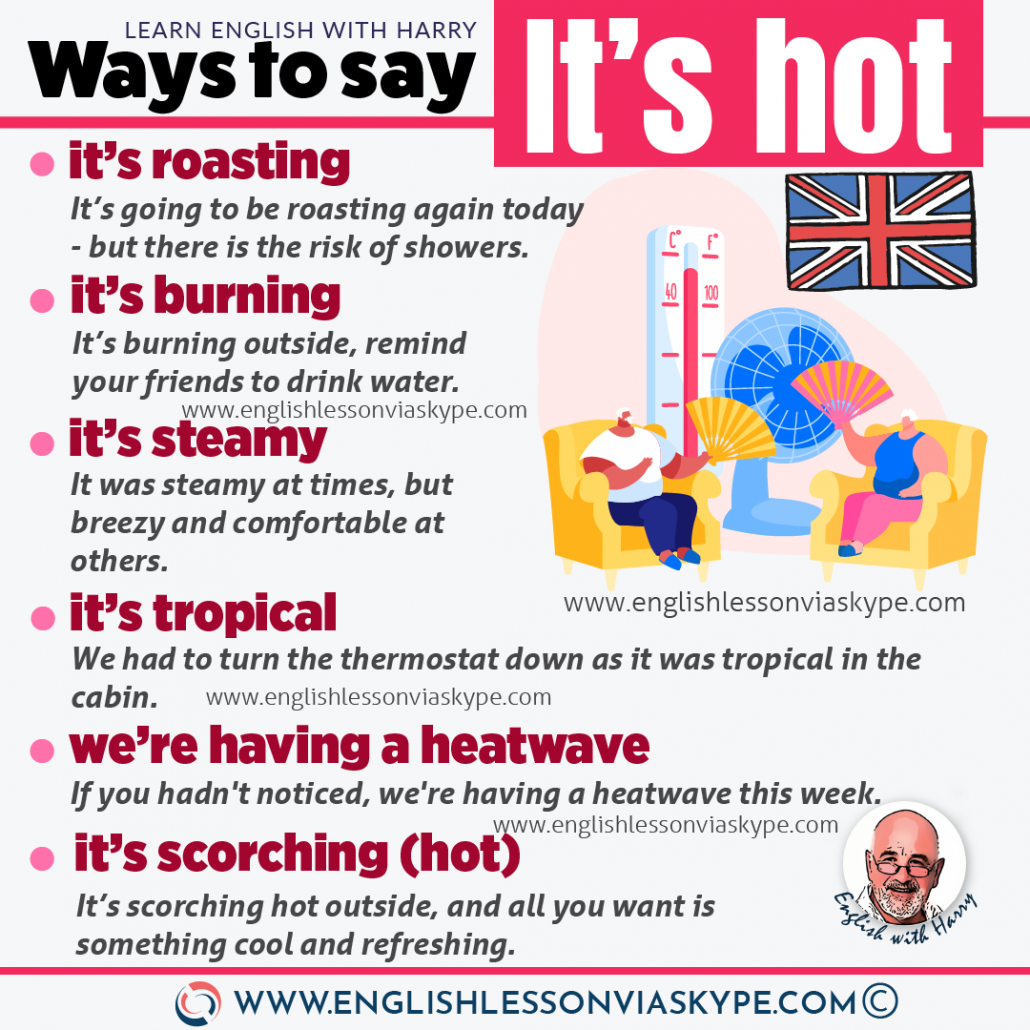
1It’s boiling

Meaning: extremely hot.

Boiling is very common in informal British and Irish English. You can use it for the weather, a room or how you personally feel. Of course, you’re not literally at boiling point. You’re simply saying that you feel extremely hot.

Examples“It’s absolutely boiling today. I don’t feel like going anywhere.”
“It’s boiling in here. Can we open a window?”
“I’m boiling after walking all the way up that hill.”

If someone asks “What’s the weather like?” you could simply reply “It’s boiling.” You’ll hear absolutely boiling quite often when someone wants to make the expression stronger.

2Stifling

Meaning: extremely hot and uncomfortable, especially when there isn’t enough fresh air.

Stifling is particularly useful when the heat feels heavy and it’s difficult to breathe comfortably. Imagine walking into a room where the windows have been closed all day. The air is hot, there’s no breeze and you immediately want to open a window.

Examples“It’s stifling in this room. Could we open the door?”
“The hotel room was stifling because the air conditioning wasn’t working.”
“We went outside after dinner, but the heat was still stifling.”

You’ll also hear stifling heat, stifling conditions and a stifling room. Stifling doesn’t simply mean very hot. It also gives you the feeling of hot, heavy, airless conditions.

3It’s roasting

Meaning: extremely hot.

Here we have another expression connected with cooking. You roast meat or vegetables in a very hot oven, so when you say it’s roasting, you mean the weather is extremely hot. This is another very natural informal expression in British and Irish English.

Examples“It’s roasting today. Let’s wait until later before we go for a walk.”
“I’m roasting in this jacket. I should’ve left it at home.”
“It was roasting on the beach by lunchtime.”

You can also say it’s roasting hot or I’m absolutely roasting. Both sound natural in informal conversation.

4Sizzling hot

Meaning: extremely hot.

When food is cooking in a frying pan or on a barbecue, you can hear it sizzle. We can use the same idea to describe very strong heat. Sizzling hot is more colourful and expressive than simply saying very hot. You’ll often see it in weather reports, headlines and descriptions of summer weather.

Examples“We’re expecting another sizzling hot weekend.”
“The city was sizzling in temperatures of almost 40°C.”
“They spent the afternoon on the beach in the sizzling heat.”

It’s more natural to say sizzling hot or sizzling heat than simply “It’s sizzling” when you’re talking about the weather.

5Burning hot

Meaning: extremely hot, hot enough to feel as if something could burn you.

You may hear people say “It’s burning hot outside,” “The pavement is burning hot” or “The sun is burning down today.” Burning hot is more natural than simply saying “It’s burning” when you mean the weather.

Examples“The sand was burning hot, so we had to put our shoes back on.”
“It’s burning hot outside. Take some water with you.”
“The sun was burning down on us all afternoon.”

If something is literally burning, of course, that means it’s on fire. Adding hot makes your meaning much clearer when you’re describing extreme temperatures.

6Tropical

Meaning: very warm or hot and humid, similar to weather in tropical countries.

Tropical describes more than temperature. It usually suggests heat combined with humidity. Rather than simply saying “It’s tropical,” you’ll often hear it feels tropical, we’re having tropical weather or the conditions are almost tropical.

Examples“It feels tropical today. It’s warm, humid and there’s hardly any breeze.”
“We’re having tropical weather this week, with high temperatures and heavy evening rain.”
“It was almost tropical outside after the storm.”

This expression works particularly well when the weather is unusually warm and humid for the place you’re in.

12 Other Ways to Say It's Hot in English. Advanced English vocabulary. Save

7Sweltering

Meaning: uncomfortably hot.

Sweltering describes heat that makes you feel physically uncomfortable. You’re probably sweating, looking for shade and wishing the temperature would drop.

Examples“It’s sweltering today. I need to get out of the sun.”
“We were sweltering on the train because the air conditioning wasn’t working.”
“It was a sweltering afternoon, even in the shade.”

You can also say sweltering heat, sweltering conditions and I’m sweltering. Sweltering is a very useful word when hot doesn’t seem strong enough.

8It’s scorching

Meaning: extremely hot.

Scorching is one of the most useful words for describing very strong heat, particularly strong sunshine and very hot weather.

Examples“It’s scorching today. Make sure you take some water.”
“We had scorching temperatures all weekend.”
“The sun was scorching by midday.”

You’ll often hear scorching hot, scorching heat and a scorching day. If you’re walking on a beach and the sand is so hot that you can hardly stand on it, scorching is a very good word to use.

9Steamy

Meaning: hot and humid.

Think about the air in a bathroom after a long hot shower. It’s warm, wet and full of moisture. Weather can feel similar.

Examples“It was a hot, steamy afternoon.”
“The air felt steamy after the rain.”
“We stepped outside into the steamy evening heat.”

Steamy is possible when you’re describing weather, although it’s less common in everyday conversation than hot, humid, muggy or sweltering. It can also have other meanings in English, so when you’re talking about weather, it’s clearer to use expressions such as steamy weather, steamy heat or a steamy afternoon.

10Sultry

Meaning: hot, humid and often still.

Sultry is usually used for warm or hot weather when there’s a lot of moisture in the air and very little breeze.

Examples“It was a sultry summer evening, and everyone was waiting for the storm to arrive.”
“The day had been hot and sultry.”
“We’ve had several sultry nights this week.”

Sultry is slightly more descriptive than words such as hot or humid, so you’ll often see it in written descriptions of the weather. Be careful with this word: sultry can also describe a person, voice or appearance in a completely different way. If you’re learning English, using it with weather, evening, night or conditions makes your meaning clear.

11It’s baking hot

Meaning: extremely hot.

Here’s another expression from the kitchen. We bake bread and cakes in a hot oven, so if a room, car or outdoor space feels extremely hot, we can describe it as baking hot.

Examples“It’s baking hot outside today.”
“The car was baking hot after sitting in the sun all afternoon.”
“It’s baking in this office. Has the air conditioning stopped working?”

Baking and baking hot are particularly common in informal British English.

12I’m sweating

Meaning: your body is producing sweat because you’re hot.

This one is slightly different. I’m sweating doesn’t describe the weather itself. It describes what the heat is doing to you.

Examples“I’m sweating just standing here.”
“I was sweating after five minutes in the sun.”
“Can we find somewhere with air conditioning? I’m sweating.”

Sweat is the normal everyday word. Perspire means the same thing, but it sounds more formal and you’re much less likely to say “I’m perspiring” in an ordinary conversation.

Bonus expression: temperatures are soaring

Soar means to rise very quickly or dramatically. When we talk about hot weather, we often say temperatures are soaring.

“Temperatures are soaring across southern Europe this week.”
“The temperature soared from 28°C to almost 40°C in just a few days.”
“With temperatures soaring, many people are staying indoors during the afternoon.”

Notice the difference: “It’s scorching” describes how hot it is, while “Temperatures are soaring” tells us that the temperature is rising quickly.

Choosing the right word

Which expression should you use for hot weather?

These words don’t all describe exactly the same type of heat.

For an ordinary conversation on a very hot day

  • It’s boiling.
  • It’s roasting.
  • It’s baking hot.

These are natural, informal expressions, especially in British and Irish English.

When the sun and temperature are extremely strong

  • It’s scorching.
  • It’s burning hot.
  • It’s sizzling hot.

When the heat feels uncomfortable

  • It’s sweltering.
  • It’s stifling.

Sweltering focuses on how uncomfortable you feel in the heat. Stifling often suggests that the air feels hot, heavy and difficult to breathe.

When the weather is hot and humid

  • tropical
  • steamy
  • sultry

You could also use humid or muggy, which we’ll look at in a moment.

When you’re describing yourself

  • I’m boiling.
  • I’m roasting.
  • I’m sweltering.
  • I’m sweating.
Words that are easy to confuse

Hot, warm, humid and muggy: what’s the difference?

These words are closely connected, but they don’t mean exactly the same thing.

Word What it means
WarmPleasantly or moderately hot — much weaker than boiling, scorching or sweltering. “It’s lovely and warm today.” / “The sea was surprisingly warm.”
HotThe normal general word. There’s nothing wrong with it — the expressions in this lesson simply give you more precise ways to describe different types of heat. “It’s really hot today.” / “The room gets very hot in the afternoon.”
HumidThere’s a lot of moisture in the air. A day can be humid without being extremely hot, although the two often come together. “It’s hot and humid today.” / “The humidity makes 30°C feel much hotter.”
MuggyUnpleasantly warm and humid — a very useful everyday word for uncomfortable humid weather. “It’s really muggy tonight. I don’t think I’ll sleep well.” / “There’s no breeze at all. It feels very muggy.”
Extend your vocabulary

More useful English vocabulary for very hot weather

  • A heatwave — a period of unusually hot weather that continues for several days or longer. “We’re in the middle of a heatwave.” / “The heatwave is expected to continue until Friday.”
  • Intense heat — very strong heat. “We stayed indoors during the intense afternoon heat.” / “The intense heat made walking around the city difficult.”
  • Unbearable heat — so unpleasant that it’s extremely difficult to tolerate. “The heat was unbearable by midday.” / “It gets unbearably hot in this room in summer.”
  • The heat is easing — the temperature or intensity is becoming less severe. “The heat should start easing tomorrow.” / “It was still warm in the evening, but the heat had finally begun to ease.”
Everyday conversation

How to talk about hot weather in English at work

Talking about the weather isn’t Business English in itself, but weather is one of the easiest ways to start a short conversation at work.

You might use it while you’re waiting for a meeting to begin, when a client joins a video call early, when you meet someone at a conference or when you’re having coffee with colleagues. You don’t need a long conversation. One comment and one simple question are usually enough.

Before an online meeting

Conversation

You: It’s absolutely boiling here today. Is it hot where you are?

Them: Yes, we’re having a heatwave this week.

You: I saw that. Anyway, shall we get started?

With a colleague

Conversation

You: It’s sweltering outside.

Them: I know. I went out for lunch and regretted it immediately.

You: I think I’ll stay inside until this evening.

With a visitor or client

Conversation

You: You’ve arrived during our hottest week of the year.

Them: I noticed. It feels almost tropical.

You: Yes, this definitely isn’t our normal weather.

In the office

A polite request

“It’s a bit stifling in here. Would anyone mind if I opened the window?”

That last example is particularly useful because it combines weather vocabulary with a polite workplace request. Weather small talk doesn’t need to continue for ten minutes. You can use it to start the conversation naturally, then move to the meeting, the trip, the event or the reason you’re speaking.

One-to-one lessons

Want to practise your English in real conversation?

If you’d like personal help with your spoken English, vocabulary, pronunciation or English for work, you can book a short trial lesson. We’ll look at your current level, what you use English for and what you’d like to improve.

Book a Free Trial Lesson →
Get it right

Common mistakes when talking about hot weather in English

1. “It’s burning”

If you simply say “It’s burning,” people may think that something is actually on fire. For hot weather, it’s clearer to say:

  • It’s burning hot.
  • The sun is burning down.
  • The pavement is burning hot.

2. “It’s tropical”

This is possible, but in everyday conversation these versions often sound more natural:

  • It feels tropical today.
  • We’re having tropical weather.
  • The conditions feel almost tropical.

3. “I’m hot” and “It’s hot”

It’s hot describes the weather, the room or another place. I’m hot describes how you feel.

  • Says nothing about you: the place is hotIt’s hot outside. / It’s hot in here.
  • Says nothing about the place: you feel hotI’m hot. I’m going to take this jumper off.

The meaning is normally perfectly clear from the situation.

4. “I’m perspiring”

Perspire is correct English, but it’s more formal. In normal conversation, say:

  • I’m sweating.

5. Using “sultry” without context

Make the context clear

Sultry has another meaning when it describes a person, voice or appearance. For weather, make the context clear:

  • a sultry evening
  • sultry weather
  • hot, sultry conditions
12 Other Ways to Say It's Hot in English. Advanced English vocabulary. Save
Your turn

Practice: choose the best hot weather expression

Choose the expression that fits the situation best, then open Show answer to check.

1. The meeting room has been closed all afternoon. It’s very hot and there’s no fresh air.

A. tropical    B. stifling    C. sizzling

Show answer

B. stifling

Stifling describes a place that feels very hot and airless.

2. The sun is extremely strong and the pavement is almost too hot to touch.

A. scorching    B. warm    C. steamy

Show answer

A. scorching

Scorching is useful for very strong heat, particularly intense sunshine.

3. Your British colleague comes into the office on a very hot summer morning. “It’s absolutely ______ today.”

A. boiling    B. mild    C. damp

Show answer

A. boiling

“It’s absolutely boiling” is a very common informal way to say that the weather is extremely hot.

4. You’ve been walking around a city in hot weather and you’re uncomfortable and sweating heavily.

A. chilly    B. sweltering    C. fine

Show answer

B. sweltering

Sweltering describes very uncomfortable heat.

5. The temperature has risen from 29°C to 39°C in just a few days. “Temperatures are ______.”

A. baking    B. soaring    C. stifling

Show answer

B. soaring

Soaring tells us that temperatures are rising very quickly.

6. You want to describe what the heat is doing to your body, not describe the weather itself.

A. I’m sweating.    B. It’s tropical.    C. It’s scorching.

Show answer

A. I’m sweating.

“I’m sweating” describes your physical reaction to the heat.

Common questions

FAQ: ways to say it’s hot in English

What are some natural ways to say it’s very hot in English?

You can say:

  • It’s boiling.
  • It’s roasting.
  • It’s baking hot.
  • It’s scorching.
  • It’s sweltering.
  • It’s stifling.

The best expression depends on the type of heat and how informal you want to sound.

What’s the difference between scorching and sweltering?

Scorching focuses mainly on extremely high temperatures or very strong sunshine. Sweltering focuses more on how uncomfortable the heat feels.

It was a scorching 38°C outside.

We were sweltering in the crowded train.

Can I say “I’m boiling” in English?

Yes. “I’m boiling” is a very common informal expression in British and Irish English. It means you feel extremely hot.

I’m boiling. I need to get out of this jacket.

What does stifling mean when talking about weather?

Stifling means extremely hot and uncomfortable, usually because the air feels heavy and there isn’t enough fresh air.

You can say:

  • It’s stifling in here.
  • The stifling heat made it difficult to sleep.
Is “It’s burning” a natural way to describe hot weather?

You may occasionally hear it, but “It’s burning hot” is clearer and more natural. You can also say:

  • The sun is burning down.
  • The pavement is burning hot.
What does sultry weather mean?

Sultry weather is hot, humid and often still, with very little breeze.

It was a hot, sultry evening.

Sultry can have another meaning when it describes a person or voice, so for English learners it’s safest to use it clearly in a weather context.

What’s a natural word for hot and humid weather?

Muggy is very useful in everyday English.

It’s hot and muggy today.

You can also use humid, sweltering, tropical, steamy or sultry, depending on the exact situation.

Quick summary

Quick summary: ways to describe hot weather in English

Natural everyday expressions for a very hot day

  • It’s boiling.
  • It’s roasting.
  • It’s baking hot.

For extremely strong heat

  • It’s scorching.
  • It’s burning hot.
  • It’s sizzling hot.

For uncomfortable heat

  • It’s sweltering.
  • It’s stifling.

For hot and humid weather

  • tropical
  • steamy
  • sultry
  • muggy
  • humid

To describe how you feel

  • I’m boiling.
  • I’m roasting.
  • I’m sweltering.
  • I’m sweating.

When temperatures are rising very quickly

  • Temperatures are soaring.

You don’t need to learn all of these at once. Pick three or four that you can imagine yourself using. Say them aloud, put them into your own examples and use them the next time someone starts talking about the weather.

One-to-one lessons

Would you like personal help with your English?

If you want to speak more naturally and get individual corrections, book a free trial lesson.

You can tell us where you use English, what you find difficult and what you want to improve.

Book a Free Trial Lesson →

Free trial lesson · Trial details and the booking form are on the same page

Episode 388

Listen to the lesson

Prefer listening? Episode 388 of Speak Better English with Harry explains these hot weather expressions and examples in the podcast.

So there you have it. Twelve different ways to talk about very hot weather in English, plus a few extra words that will help you describe exactly what the weather feels like. As always, practise the expressions that are useful to you — use a few regularly and they’ll soon become part of your English.

Share this lesson

Found this lesson useful? Share it with someone who is building their English vocabulary.

Keep learning

Related English lessons

If this lesson was useful, these will help you talk about the weather, summer and everyday small talk more precisely.