
How to use articles correctly in English?
In this lesson, you will learn the 6 simple rules for using articles in English correctly.
This lesson will teach you six simple rules to help you to use English articles better. To improve your English fluency and sound more natural you need to use English articles well. To get better results in English proficiency exams (CAE, TOEFL, IELTS), you need to improve your English grammar skills and the way you use articles.
Listen to the podcast Speak Better English with Harry or watch it on YouTube at Learn English with Harry. englishclass101
6 rules to use articles correctly
How To Use Articles Correctly In English

Harry
Now, the reason why articles cause problems for a lot of people is that they don’t exist in their own native tongue. Just they’re not there.
So when you come to learn English, it becomes very complicated. They are the smallest words that we have in the English language. But they cause mountains and mountains of problems for ESL students.
So we’ll try and dispel some of the myths. And we try and sort out some of the problems that you might come across.
improve english on a budget
Online English Courses from €7.99

articles in English
there are three articles. Two indefinite and one definite, the.
Indefinite articles are A and AN.
a car, a boy, a man
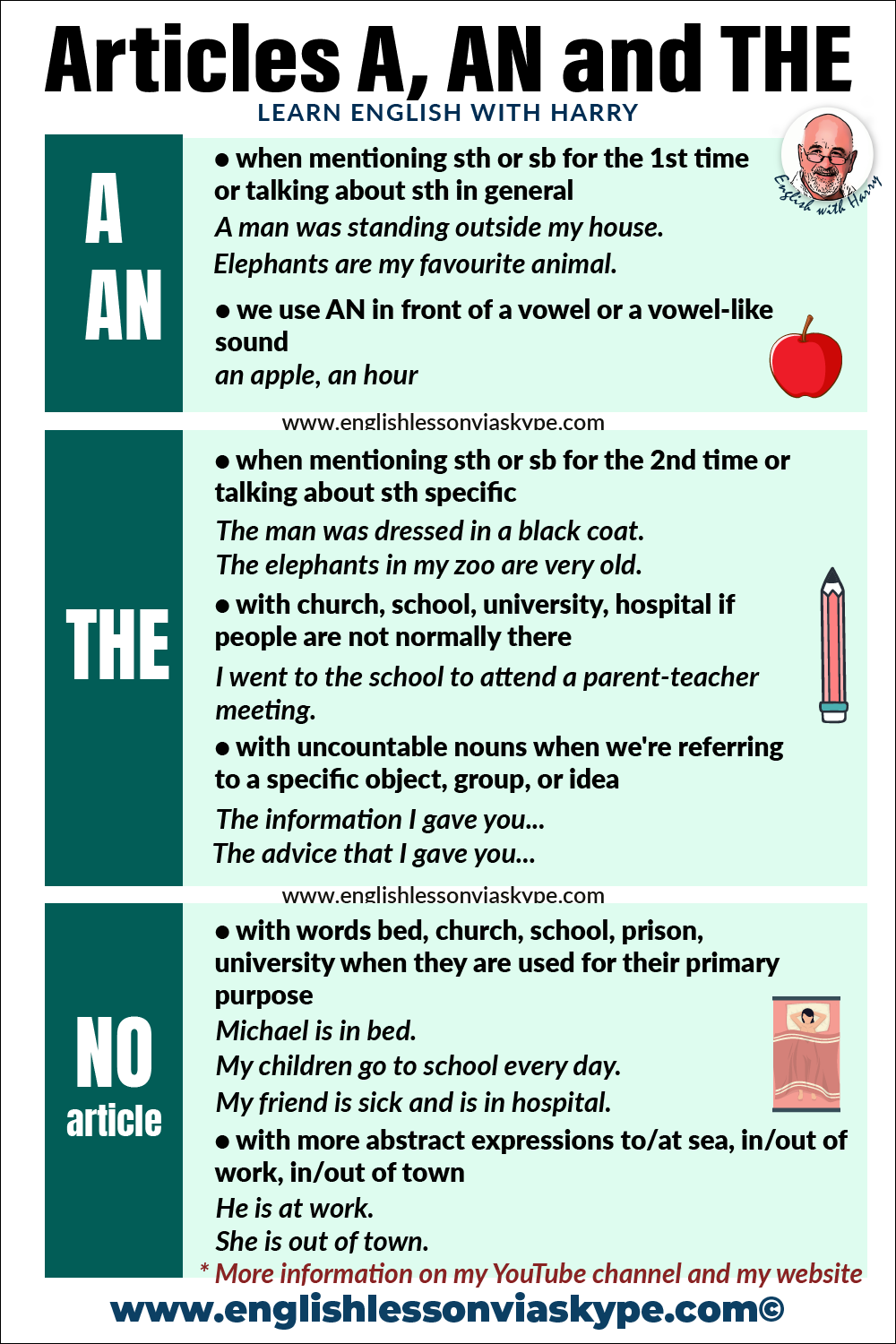
We use AN when it is in front of a vowel or a vowel-like sound
an apple, an hour
And then the definite article, only one, the definite article, THE.
The pronunciation depends on the situation and position when you use it.
the difference between a, an and the
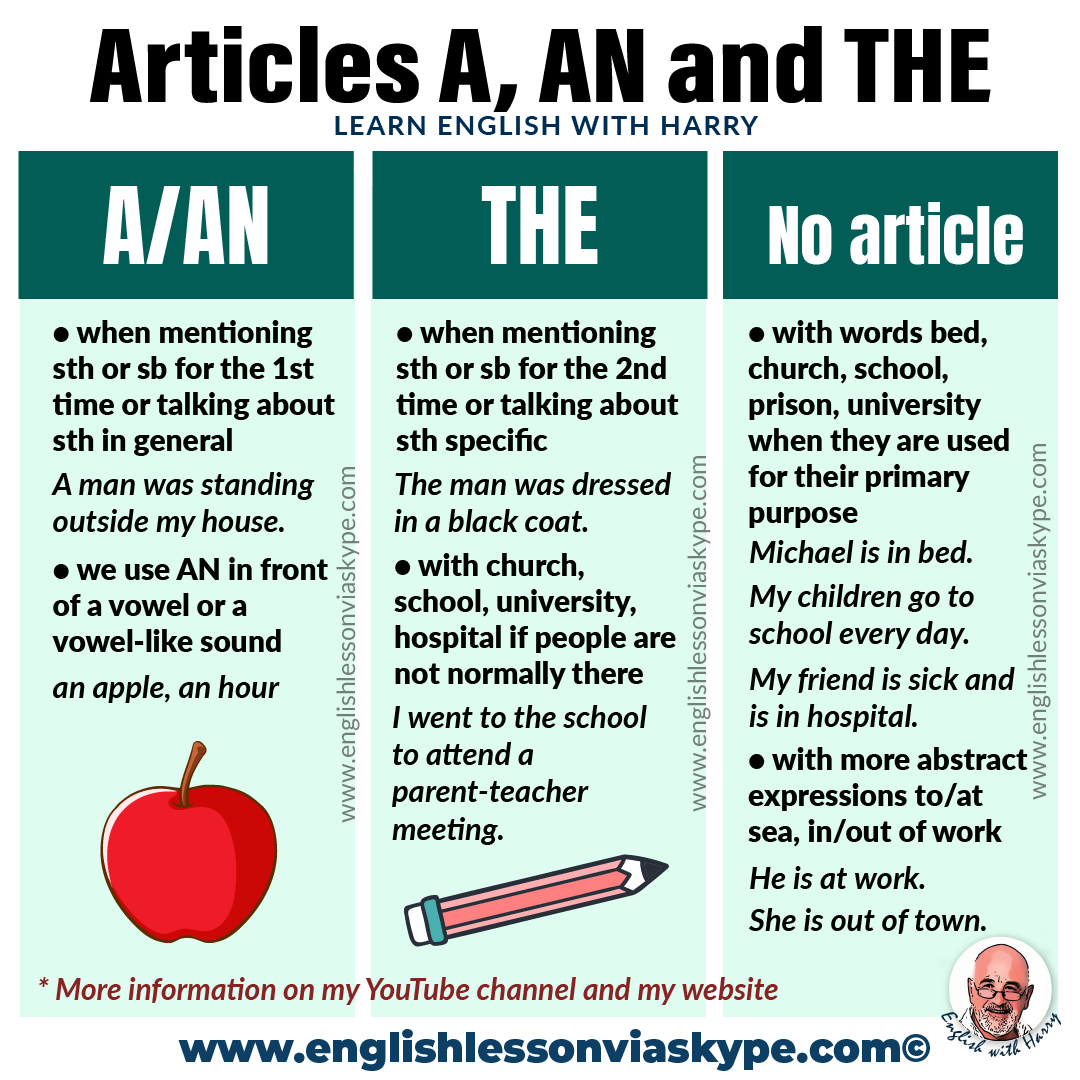
We use A/AN when mentioning sth or sb for the first time.
A man was standing outside my house.
We use THE when mentioning sth or sb for the second time.
The man was dressed in a black coat.
The man was wearing a woolly hat.
Let me give you another example.
I went to get some lunch. I bought an apple and a sandwich.
Here’s the first time that I’ve mentioned to you what I bought for lunch.
The apple was green, and the sandwich was a tuna sandwich with lettuce.
I’m talking specifically about the apple/sandwich that I bought.
How To Use Articles Correctly In English
We use THE
We use THE when the existence of sth is common knowledge or comes as no surprise.
✅ I’ve got a hole in the roof.
❌ I’ve got a hole in a roof.
My house has only one roof.
I put my clothes into the washing machine, and I went out into the garden.
I assume there’s only one washing machine/garden in the house.
no article or THE
We don’t use the article when we’re talking about something in general.
Elephants are my favourite animal.
We use the article THE when we’re talking about sth specific.
The elephants in my zoo are old.
The elephants in my zoo have a lot of freedom.
Let me give you another example.
Roses are my favourite flowers.
I’m talking about something in general.
But the roses in my garden are mostly pink.
I’m talking about something specific.
book your trial English Lesson
articles with bed, school, prison, university, etc
No article is used when they are used for their primary purpose.
✅ I go to bed every night at 10 o’clock.
❌ I go to the bed every night at 10 o’clock.
Michael is in bed.
Jonathan has just got out of bed.
When the person who should be there is there, then we don’t use the article.
My children go to school every day.
The children normally spend their time in school.
My friend is sick and is in hospital.
Sick people usually spend their time in hospital.
I go to church on Sundays.
People who are following their religion tend to go to church on a Friday, Saturday or Sunday.
My son is 20 and is studying economics in university.
Students who study spend their time in universities.
If people are not normally there, then we use the article THE.
I went to the school to attend a parent-teacher meeting.
I’m a parent, I’m not normally at that school. I went to the school for the meeting.
I visited my friend in the hospital because she was sick.
I am well, but I went to the hospital to visit my friend.
When I go to new cities, I like to visit the churches in that cities.
I am not normally in that city. I like to see how they’re designed.
There was a ceremony in the university for the graduates.
I attended it because I’m a parent of one of the graduates.
How To Use Articles Correctly In English
articles with sea, work, office, etc
Articles are also not needed in more abstract expressions:
- to/at sea
- to/at/out of work
- in/out of town
He is at sea.
He is at work/out of work.
She is in/out of town.
With the word “office, we use the article THE when we’re talking about a place of work.
Jonathan is working in the office today. He’ll be working at home tomorrow.
He went to the office at six o’clock this morning because he has a lot of work to do.
Articles are not needed when we’re talking about the government.
The government has been in office for four years. They have 12 months left.
speak better English with Harry podcast- episode 418
articles with countable and uncountable nouns
Countable nouns always take either A(AN) or THE.
An apple a day keeps the doctor away.
The apple I bought in the shop was red.
The apples in the bag weighed two kilos.
Uncountable nouns never take A or AN.
❌ an information
❌ an advice
THE is sometimes used when we’re referring to a specific object, group, or idea.
The information I gave you…
The advice that I gave you…
And remember, I haven’t given you a totally inclusive definition of the article because there’s a lot to go through.
But you will find much more information in a really good grammar book as I mentioned, Murphy’s.
And I am launching a new grammar course in the very near future, so you’ll get all the details about other aspects of how to use articles in English.
If you need more information, more help more guidance and contact me on www.englishlessonviaskype.com Really happy to help you and really happy to include your suggestions, as I’ve done today, in the future lesson.
This is Harry, thank you for watching and listening, and remember to join me for the next lesson.
more information
For more information on English grammar rules, English collocations and English idioms, check out the links below:
You can always study English advanced level at Learning English with the BBC and British Council Learn English.
You will love these English lessons

10 Ways to Say I’m Busy in English
Here you will learn 10 different ways to say I’m busy in English. You won’t be surprised to hear that
11 Simple Ways to Improve Your Written English
Do you want to improve your written English? Today, I want to talk to you about ways to improve your
Useful Speaking Phrases For Job Interviews
Learn useful speaking phrases for job interviews in English. Even in your native language, job interviews can be nerve-wracking; now,