16 Other Ways To Say I’m Sick In English

There are many ways to say I’m sick or I’m not feeling well in English. The phrase you choose depends on how ill you feel, who you’re speaking to and how formal the situation is.

You might say I’m unwell, I’m under the weather, I’m not 100% or I think I’m coming down with something. Some expressions are neutral and useful in many situations. Others are very informal and should only be used with people you know well.

If you use English at work, you also need to know what sounds appropriate with a manager or colleague. Later in the lesson, you’ll learn how to say you’re sick professionally, how to call in sick, what to write in a short message to your manager and what the British expression pull a sickie really means.

Video lesson

Watch: 16 other ways to say I’m sick in English

Watch Harry explain the expressions and hear how they sound in natural English.

Let’s look at each expression more carefully. Pay attention to the tone, because some of these phrases are perfectly natural with friends but would sound too informal when you’re speaking to your manager.

Expressions 1–4

Everyday ways to say you feel unwell

These four are the expressions you’ll hear most often in ordinary conversation. Two of them are strong and informal, and two are soft and neutral.

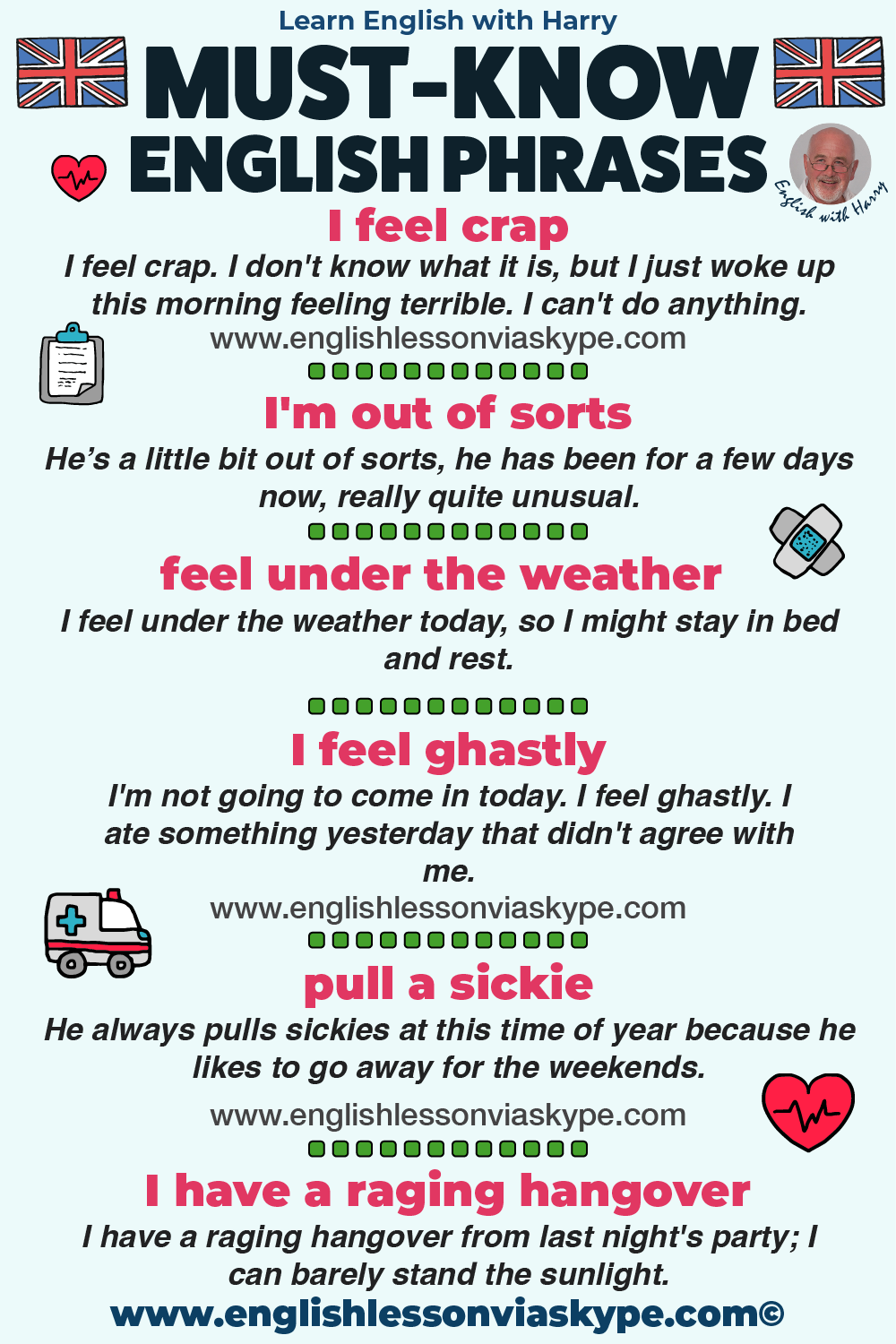
1. I feel crap / I feel like shit

Meaning

These are strong informal ways to say that you feel very bad.

I feel crap is informal. I feel like shit is much stronger and can sound vulgar, so keep it for very informal conversations with people you know well.

Examples

I feel crap today. I think I’ve caught something.

I feel like shit. I barely slept last night and my head is killing me.

At work

Don’t use these expressions with a manager, a client or somebody you don’t know well. Say I’m not feeling well or I’m unwell instead.

2. I don’t feel so good

Meaning

This is a common way to say that you feel unwell without explaining exactly what is wrong.

Examples

I don’t feel so good today. I think I’m going to stay at home and rest.

I didn’t feel so good after lunch, so I went home early.

In British English, I don’t feel very well is also very natural and is a little more neutral.

At work

I don’t feel very well this morning, so I’m going to take the day off.

3. I’m out of sorts

Meaning

If you are out of sorts, you don’t feel like your normal self. You may feel slightly ill, tired, uncomfortable or simply not quite right.

Examples

I’ve been a bit out of sorts all day. I think I might be coming down with something.

He’s been out of sorts for a few days, which is unusual for him.

This expression is quite vague, so it’s better for conversation than for formally telling your employer that you can’t work.

4. I don’t feel the best / I don’t feel my best

Meaning

This is a softer way to say that you’re not feeling well.

Examples

Thanks for the invitation, but I don’t feel my best today, so I think I’ll stay at home.

I didn’t go to the gym yesterday because I wasn’t feeling my best.

I don’t feel my best is a useful neutral version that works in many situations.

10 ways to say you’re sick at work in English, including I’m not feeling well today, I’m unwell today and I’m under the weather
Expressions 5–8

Neutral and stronger expressions

Two of these are the safest expressions you can use at work. The other two are natural in conversation but too informal for a message to your manager.

5. I’m unwell

Meaning

I’m unwell is a neutral and clear way to say that you’re ill. It can sound slightly more formal than I’m not feeling well, but it’s completely natural in professional situations.

Examples

I’m unwell today, so I won’t be able to come into the office.

She’s been unwell for a few days, but she’s starting to feel better.

At work

I’m unwell and won’t be able to work today. I’ll update you tomorrow morning.

This is one of the safest expressions to use with a manager.

6. I’m under the weather

Meaning

If you’re under the weather, you feel slightly ill or not quite yourself. It usually suggests that the illness isn’t extremely serious.

Examples

I’m feeling a bit under the weather today, so I’m going to stay at home.

I’ve been under the weather since the weekend.

At work

I’m a bit under the weather today, so I’m going to work from home.

This is natural with colleagues and managers you know reasonably well. If you need to make it completely clear that you can’t work, I’m unwell or I’m not feeling well is more direct.

7. I’m not 100%

Meaning

If you say I’m not 100%, you mean that you don’t feel completely well. It’s informal but very common in conversation.

Examples

I’m not 100% today, but I’m feeling better than yesterday.

I haven’t been 100% since I got back from the trip.

Be clearer if you’re taking the day off
Too vague

I’m not 100% today.

Clear

I’m not feeling well today, so I need to take the day off.

Why: I’m not 100% is fine if you’re still working. It works well for something smaller — I’m not 100% today, so I may finish a little earlier. If you’re taking the whole day off, your manager needs to hear it directly.

8. I feel ghastly

Meaning

If you feel ghastly, you feel extremely unwell. This is a strong expression and is particularly associated with British English.

Examples

I feel ghastly. I think it was something I ate.

I felt absolutely ghastly yesterday, but I’m much better today.

It’s natural in conversation, but I’m unwell is a better choice for a formal message to your manager.

Free resources

Free Business English resources

If you use English at work, choose a free guide, quiz or tool for the situations you need most.

Get practical help with meetings, work emails and difficult situations at work.

See free resources →
Expressions 9–12

Catching something — and pulling a sickie

These four are about becoming ill rather than describing how you feel. The last one is different from all the others, so read it carefully.

9. I feel like I’ve been hit by a bus

Meaning

This is an exaggerated, informal way to say that you feel extremely ill, weak or exhausted.

Examples

I’ve got the flu and I feel like I’ve been hit by a bus.

When I woke up this morning, I felt as if I’d been hit by a bus.

Use this with friends or colleagues you know well. It’s too dramatic for most formal work messages.

10. I’m coming down with something / I’ve come down with something

Meaning

These two expressions are similar, but the timing is slightly different.

Expression Use it when
I’m coming down with something You’re beginning to feel ill.
I’ve got a sore throat and a headache. I think I’m coming down with something.
I’ve come down with something You have now become ill.
I’ve come down with some sort of stomach bug, so I’m staying at home today.

This is a very useful expression when you don’t know exactly what illness you have.

At work

I think I’m coming down with something, so I’m going to finish early and get some rest.

11. I picked something up

Meaning

To pick something up can mean to catch an illness or infection. It’s particularly common when you don’t know exactly where the illness came from.

Examples

I think I picked something up on the flight home.

He must have picked up a bug while he was away.

I’ve picked something up and haven’t felt well for the last two days.

12. Pull a sickie

Meaning

This expression is different from the others. To pull a sickie doesn’t simply mean to be sick.

In British English, pull a sickie means to pretend that you’re ill so that you can take time off work.

Examples

He pulled a sickie on Friday and went to the football match.

She accused him of pulling a sickie because he had been perfectly well the night before.

This is British slang and normally suggests that the person is being dishonest. Don’t use pull a sickie as another way to say call in sick.

Call in sick

You are genuinely ill.

I called in sick this morning.

Pull a sickie

You are pretending to be ill.

He pulled a sickie and went to the match.

English expressions for feeling unwell including coming down with something, picking something up and pulling a sickie
Expressions 13–16

Viruses, nausea and stronger informal expressions

The last four cover the illness itself. Two of them are neutral, and two are informal enough that you need to think about who you’re speaking to.

13. It’s some sort of virus

Meaning

You can use this when you think you have a virus but don’t know exactly what it is.

Examples

I think it’s some sort of virus. I’ve felt terrible for two days.

There’s some sort of virus going around the office at the moment.

If you’re not sure what is causing the illness, you can make that clear:

Say instead

I think I’ve picked up some sort of virus.

14. I have morning sickness / I feel nauseous

Meaning

These expressions have different meanings.

Expression What it means
Morning sickness Nausea and vomiting during pregnancy.
She’s been suffering from morning sickness for the last few weeks.
I feel nauseous You feel as if you may vomit. Anyone can feel nauseous.
I felt nauseous after lunch, so I went home.

In British English, you’ll also hear I feel sick.

Be careful

In British English, I feel sick often means I feel as if I’m going to vomit, rather than simply I’m generally unwell.

15. I have a raging hangover

Meaning

A hangover is the unpleasant feeling you have after drinking too much alcohol. A raging hangover means a very bad hangover.

Examples

I’ve got a raging hangover. I’m never drinking that much again.

He spent most of Sunday in bed with a terrible hangover.

This describes the reason you feel unwell, but it isn’t something you would normally tell a manager when reporting an absence.

16. I was throwing my guts up all night

Meaning

This is a very informal and graphic way to say that you were vomiting repeatedly.

Examples

I was throwing my guts up all night. I think I ate something bad.

He was throwing his guts up for hours after dinner.

More neutral

I was throwing up all night.

Or at work:

I was unwell during the night and I’m not well enough to work today.

Choosing an expression

Neutral, informal and strong expressions

The meaning is only half the decision. Before you use one of these expressions, ask yourself who you’re speaking to.

Tone Expressions
Neutral — safe with a manager or client I’m unwell · I’m not feeling well · I don’t feel very well · I don’t feel my best · I’m coming down with something · I feel nauseous
Informal — fine with colleagues you know I’m under the weather · I’m not 100% · I’m out of sorts · I don’t feel so good · I picked something up · It’s some sort of virus
Strong — friends only I feel crap · I feel like shit · I feel ghastly · I feel like I’ve been hit by a bus · I have a raging hangover · I was throwing my guts up
Episode 480

Prefer to listen?

Listen to Speak Better English with Harry, Episode 480, and hear the full lesson as a podcast.

Business English

How to tell your manager you’re unwell in English

When you’re sick and can’t work, you normally don’t need a complicated explanation.

Your manager mainly needs to understand three things.

  1. That you are unwell
  2. Whether you can work
  3. When you will update them

A clear message can be very simple.

Model wording

I’m not feeling well this morning, so I need to take the day off. I’ll update you tomorrow morning.

I’m unwell and won’t be able to work today. I’ll let you know tomorrow whether I’m well enough to return.

If your absence affects something important, add one practical piece of information.

Adding one practical detail

I’m not feeling well today, so I need to take the day off. The figures for the client are already in the shared folder. I’ll update you tomorrow morning.

You don’t need to use complicated or very formal English.

Useful professional phrases

  • I’m not feeling well today.
  • I’m unwell and won’t be able to work today.
  • I need to take the day off sick.
  • I’m still unwell, so I need another day to recover.
  • I think I’m coming down with something, so I’m going to finish early today.
  • I’m feeling better and expect to be back tomorrow.

These expressions are clear without giving unnecessary details about your symptoms.

Workplace vocabulary

Call in sick, take a sick day or be off sick?

These expressions are related, but they don’t mean exactly the same thing.

Call in sick

To call in sick means to tell your employer that you’re too ill to work.

Example

Magda called in sick this morning because she had a fever.

The exact way you report your illness depends on your company. The important meaning is that you have told your workplace that you can’t work because you’re ill.

Be off sick

Be off sick is very common in British English. It means to be absent from work because you’re ill.

Examples

Hans is off sick today.

She was off sick for three days last week.

Take a day off sick

This means not to work for a day because you’re ill.

Example

I’m going to take the day off sick and get some rest.

Take a sick day

This is also common and widely understood, particularly in American English.

Example

I need to take a sick day today.

Sick leave

Sick leave is a more formal workplace and HR term. It means time away from work because of illness.

Examples

She’s currently on sick leave.

He had to take two weeks of sick leave after the operation.

Call in sick vs pull a sickie

This distinction is important, so these are not interchangeable expressions.

Call in sick

You’re genuinely unwell and tell work that you can’t come in.

Pull a sickie

You pretend to be unwell so that you can take time off.

Model messages

How to write a short sick-day message to your manager

You don’t need to write a long explanation. Keep the message clear and tell your manager what they need to know.

You need the day off

Hi Anna,

I’m not feeling well this morning, so I need to take the day off. I’ll update you tomorrow morning.

The client file is in the shared folder if the team needs it today.

Best,
Sven

You’re still unwell the next day

Hi Anna,

I’m still unwell today and need another day to recover. I’ll update you tomorrow morning and let you know whether I’ll be back on Thursday.

Best,
Sven

You need to cancel a meeting

Hi Marta,

I’m sorry, but I’m unwell and won’t be able to join the 2 pm meeting today.

Could we move it to Thursday? If that isn’t possible, I can send my notes to Daniel.

Thanks,
Hans

You need to finish work early

I’m not feeling well, so I’m going to finish early today. I’ve already sent the figures to Finance, and I’ll pick this up tomorrow if I’m feeling better.

Other ways to say I’m sick in English including unwell, under the weather and not feeling my best
Get it right

Common mistakes when talking about being sick in English

“I feel sick” doesn’t always mean “I’m ill”

In British English, I feel sick often means I feel as if I’m going to vomit.

If you simply mean that you’re generally unwell, say:

  • I don’t feel well.
  • I’m not feeling well.
  • I’m unwell.

Don’t say “I have sick”

I have sick
Incorrect

I have sick today.

Correct

I’m sick today.

I’m unwell today.

I feel ill.

Why: sick and ill are adjectives here, so they follow be or feel, never have.

Use “have” with the illness

You do use have when you name the illness itself.

  • I have a cold.
  • I have the flu.
  • I have a headache.
  • I have a stomach bug.

Coming down with vs came down with

Which one do you need?
Symptoms beginning

I think I’m coming down with a cold.

Already ill

I came down with the flu at the weekend.

I’ve come down with some sort of virus.

Why: use coming down with when the symptoms are starting, and came down with or have come down with once you have become ill.

Don’t use “pull a sickie” when you really are ill

Genuinely ill, or pretending?
If you’re pretending

I pulled a sickie.

If you’re genuinely ill

I called in sick.

Why: pull a sickie says that you were dishonest. It’s not a neutral way to describe a real sick day.

“I’m not 100%” can be too vague

This is natural English:

Natural

I’m not 100% today.

But if your manager needs to know whether you’re working, be clearer:

Clearer

I’m not feeling well today, so I need to take the day off.

Your turn

Which expression would you use?

Read each situation and decide what you would say.

1. You have a sore throat and you think you’re starting to get ill.

Show answer

I think I’m coming down with something.

2. You need to tell your manager that you can’t work today.

Show answer

I’m not feeling well today, so I need to take the day off.

3. A colleague asks how you are. You feel slightly ill, but it’s nothing serious.

Show answer

I’m a bit under the weather.

4. Somebody pretends to be ill so that they can stay away from work.

Show answer

They’re pulling a sickie.

5. You feel as if you’re going to vomit.

Show answer

I feel sick.

Or

I feel nauseous.

6. You need a neutral phrase for a professional message.

Show answer

I’m unwell today.

Common questions

Frequently asked questions

What can I say instead of “I’m sick”?

Some of the most useful alternatives are:

  • I’m not feeling well.
  • I’m unwell.
  • I’m under the weather.
  • I’m not 100%.
  • I think I’m coming down with something.
  • I don’t feel my best.

The best expression depends on the situation and how informal you want to sound.

How do I say “I’m sick” professionally?

A simple professional phrase is:

I’m not feeling well today.

You can also say I’m unwell today. If you can’t work, make that clear:

I’m not feeling well today, so I need to take the day off.

How do I tell my boss or manager that I’m sick?

Tell them clearly that you’re unwell and explain what this means for work. For example:

I’m unwell and won’t be able to work today. I’ll update you tomorrow morning.

If something urgent is affected, add one short practical update.

What does “call in sick” mean?

To call in sick means to tell your employer that you’re ill and can’t work. For example:

Hans called in sick this morning.

What does “pull a sickie” mean?

Pull a sickie is a British informal expression. It means to pretend that you’re ill so that you can take time off work.

It doesn’t simply mean to take genuine sick leave.

Is “under the weather” professional?

It can be used in friendly workplace conversations. For example:

I’m a bit under the weather today.

However, if you need to tell your manager clearly that you can’t work, I’m unwell or I’m not feeling well is more precise.

What is the difference between “I’m sick” and “I feel sick” in British English?

I’m sick can mean that you’re ill, although British speakers often use I’m ill or I’m unwell.

I feel sick commonly means that you feel nauseous, or feel as if you’re going to vomit.

Is “I’m not 100%” correct English?

Yes. It’s a natural informal way to say that you don’t feel completely well. For example:

I’m not 100% today, but I’m feeling better than yesterday.

For a formal absence message, use a clearer phrase such as I’m not feeling well today.

In short

Other ways to say I’m sick in English

You now have several ways to describe feeling unwell without always saying I’m sick.

For everyday English, some of the most useful expressions are:

  1. I’m not feeling well.
  2. I’m unwell.
  3. I’m under the weather.
  4. I’m not 100%.
  5. I’m coming down with something.
  6. I’ve picked something up.

Remember that tone matters. I feel like shit and I was throwing my guts up are very informal. I’m unwell and I’m not feeling well are much safer at work.

And remember the important difference

Call in sick means that you really are ill and you tell work that you can’t come in.

Pull a sickie means that you pretend to be ill so that you can take time off.

If you need to tell your manager that you can’t work, you don’t need complicated English. A simple sentence is enough:

All you need to say

I’m not feeling well today, so I need to take the day off. I’ll update you tomorrow morning.

Free resources

More English for work

If you use English with colleagues, managers or clients, you can get free practical resources for the situations that are harder to handle in English.

Choose from free resources for meetings, work emails and difficult situations at work.

See free resources →

Free · Guides, quizzes and tools · Instant access

Keep learning

Related English lessons

If this lesson was useful, these will help you talk about health and handle the situations around it in English.