
Here you will learn at least 37 useful phrases for presentations in English. Improve your business English skills and feel confident when making presentations in English.
Presentation phrases for setting the scene, recapping, ending a presentation in English and more.
Listen to the podcast Speak Better English with Harry or watch it on YouTube at Learn English with Harry.
List of phrases for presentations in English

Harry
useful phrases for presentations in English
Hi there, this is teacher Harry, and welcome back to my English lessons where I try to help you to get a better understanding of the English language.
Okay, so what are we going to cover in the lesson today? Well, all of us, myself included, have to make presentations, from time to time to staff or to bosses, or to clients or customers, whoever it may be. And if you’re using English, not as your native language, then it can be a bit of a challenge. You might feel lacking in confidence. You might feel that you’re not up to the other guys.
But you can do it.
So I’m going to give you some useful phrases that you can use in relation to presentations.
give a gift of learning Offer up to 50% off
Great way to improve your English. Use code LOVE24

setting the scene
You might just simply say at the presentation particularly if it’s online,
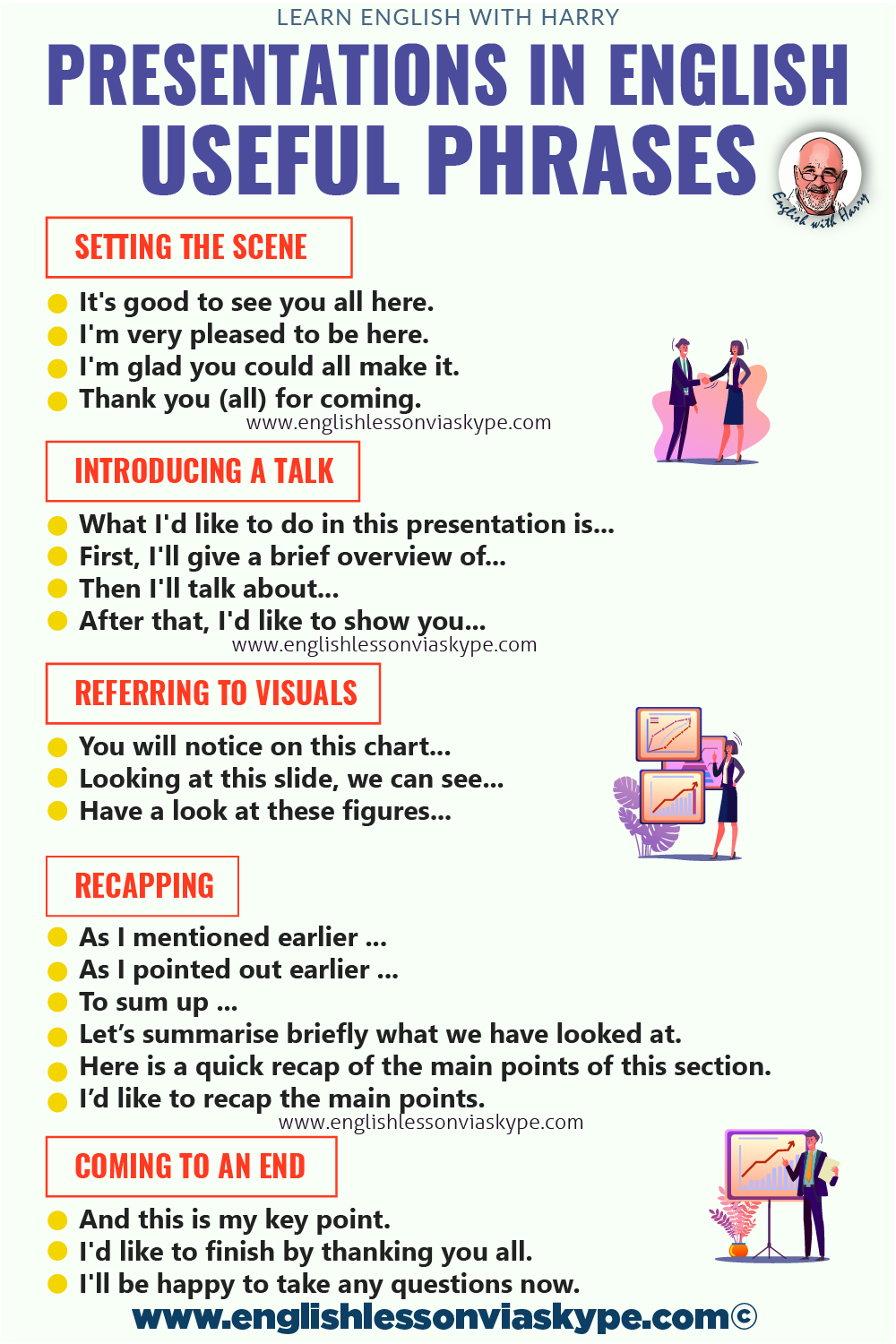
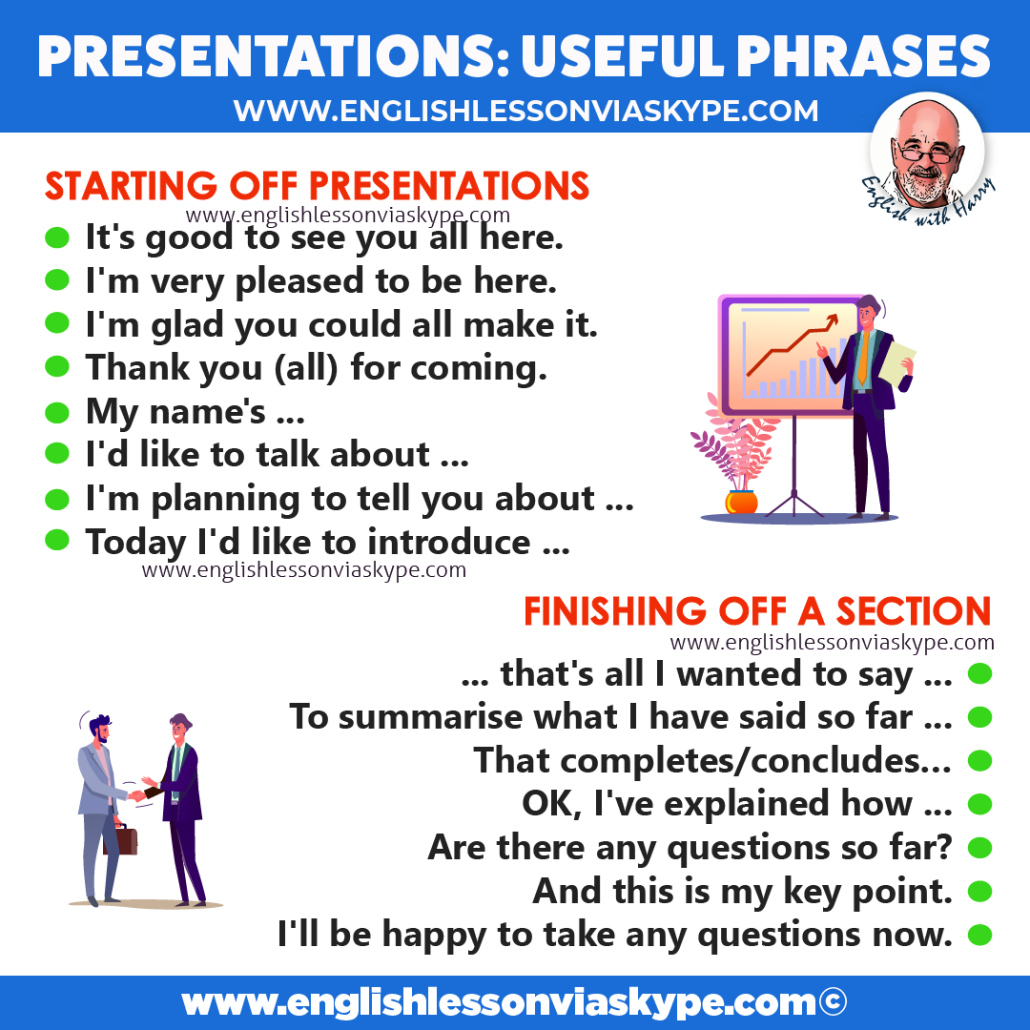
- It’s good to see you all here.
- It’s great that you could join me.
- I’m very pleased to be here.
- I’m very pleased to be talking to you today.
- I’m very pleased to be presenting to you today.
- I’m glad you could all make it.
- Thank you all for coming.
- Thank you all for joining in.
- Thank you all for coming together on Zoom.
Whatever it might be, you can adjust the words to suit the media and the medium by which you’re presenting to your guests. Staff, colleagues, clients.
common phrases for starting off presentations
And then if we talk about other useful expressions and phrases.
It’s a good idea to spend 30 seconds introducing yourself.
So my name is Harry, I work in this department, I’d like to talk to you today about…
Or
- The topic of my presentation today is….
- I’m planning to tell you about today….
- I’d like to introduce you to….
So in those sorts of expressions, you’re setting the scene again, you’re telling them exactly what you’re going to cover. And that’s a really good idea in a presentation because then everybody knows what’s going to be spoken about.
My name is Harry, I work in the marketing department. My presentation today is about a new product. The presentation is probably going to take about 20 minutes. And if you have any questions, then please ask them as we go through the presentation.
book your trial English Lesson
introducing a talk
Now, if you want to introduce the talk, you could say:
- What I’d like to do in this presentation is…
- First of all, I’ll give you a brief overview of…
A brief overview of the product, a brief overview of the background, a brief overview of our plans.
- Okay, then I’ll talk about….
- And after that, I’d like to show you some market research.
- After that, I’d like to show you our projections.
- After that, I’d like to show you this specific plan for the launching of this product.
So you go step by step by step.
referring to visuals
So in any presentation, visuals are really important, and they can help you.
And they can also support you if you’re a little bit lacking in confidence about the presentation itself.
And you perhaps don’t want to be the focus of everything.
So the type of phrases you might use in that context would be something like:
- You will notice on this chart…
- If you look at this slide, we can see…
- Have a look at these figures…
As I said, it helps you, it supports you and enables you to just sort of hide a little bit behind those slides that focus on the screen, not specifically on you.
Useful Phrases For Presentations In English
Share and help other students to improve English language skills.
finishing off a section
And when you want to finish off in relation to those sort of aspects, you might just summarise by saying,
- Well, that’s all I wanted to say on that particular topic.
- If you’ve got any questions, I’d be happy to take them now.
- To summarise what I said is…
- If you want to contact me offline, just send me an email.
- As I promised, I’ve now finished the presentation, it only took 20 minutes.
- I appreciate you watching and listening and your attention.
- If I have any questions, I’ll be happy to answer them now.
- Have you any questions?
So again, helpful information directly in them, how they can get in touch with you after your presentation.
speak better English podcast - episode 368
checking and moving on
So during the presentation, we want to make sure that the people are listening, but you also don’t want to spend too much time on each particular point.
So you check their understanding so far, and then you move on. So you might say to the people,
- Does that sound okay to you?
- Do you follow that?
- Is it clear?
- Can I clarify anything else?
- If not, let’s move on.
- Let’s look at the next slide.
- Now, let’s move on to the really important topic of…
- Let’s turn to the topic of budgets.
So you pinpoint exactly what you want to cover. When you’re going to cover it and then you move on. So you check that they understand it.
recapping
I also find in these types of presentations, particularly if they’re a bit longer than a few short slides, that it’s a good idea to do some recapping.
To recap means to go over what you’ve done before. Not a huge amount of detail because you don’t want to bore them by going through everything, but you recap quite quickly.
- Before I move on…
- I’m going to recap quickly…
- Let me summarise briefly…
- Here’s a quick recap of what we’ve covered today.
- I’d like to recap the main points.
- Let me go over the main points for you once more.
All of those good, acceptable expressions and words that you can use.
Useful Phrases For Presentations In English
coming to an end
And then when you come to the end of the presentation, you want to sign off, you want to finish them. We can say,
- Well, this is my key point.
- This is the key point in all of this, so let me finish on this.
- To sum up.
- This is what I want to say to sum up in a few words.
- I’d like to finish now by thanking you all for your kind attention.
- Thank you.
- I look forward to joining you again soon.
- I look forward to any questions.
- I look forward to receiving your emails.
- I’d be happy to take any questions now.
All nice and polite ways of informing people that this is the end.
So there’s somebody out there in the audience who’s asleep, they’ll probably wake up at that point when you say and finally or, in conclusion
Well, hopefully you’ve got something in particular that you can hold onto there. Something that can help you if you’re making presentations in English.
If you have any other queries, come to me, I’m very, very happy to help you. My contact details are www.englishlessonviaskype.com.
And indeed, if you want some help, how to make presentations, if you want some help, how to get through interviews, or you just want general help with your English well, why not try our one-to-one online English lessons.
Thanks for listening. Join me again soon.
More information
For more information on English grammar rules, English collocations and English idioms, check out the links below:
How to learn English vocabulary easily
English idioms about holidays and travel
You can always study English advanced level at Learning English with the BBC and British Council Learn English.
You will love these English lessons

12 English Idioms Relating to Communication
Here you will learn 12 English idioms relating to communication: in black and white, from horse’s mouth, keep someone posted

Difference between Present Simple and Present Continuous
Today we are going to talk about the difference between Present Simple and Present Continuous. So, when do we use

Learn English Vocabulary connected to Losing a Job
Here you will learn useful English vocabulary connected to losing a job. What other words can you use in English