
How to Express Likes in English
There are many ways to say that you like something in English. The phrase you choose depends on how strongly you feel and how informal you want to sound.
You don’t need to learn all of these expressions at once. Start with a few that you can use naturally in conversations.
1. “I like…”
This is the simplest and most common way to say that you have a positive feeling about something.
I like working with international teams.
I like Italian food.
I like the new design.
2. “I really like…”
Use really when you want to make your positive feeling stronger.
I really like the way they’ve organised the new office.
I really like travelling by train.
3. “I love…”
This is much stronger than I like.
I love spending time outdoors.
I love working on new projects.
4. “I enjoy…”
Use enjoy especially when you are talking about an activity.
I enjoy cooking.
I enjoy meeting new people.
I enjoy working with clients.
5. “I’m quite keen on…”
This is a useful English expression. It shows that you like something, but it is not as strong as I love.
I’m quite keen on the first idea.
I’m quite keen on running.
6. “I’m into…”
This is informal and very common when you talk about interests and hobbies.
I’m really into photography at the moment.
I’m not really into football.
7. “I have a soft spot for…”
Use this when you feel a special affection for someone or something.
I’ve always had a soft spot for old films.
I have a soft spot for small family-run restaurants.
How strong is the feeling?
| Phrase | Strength | Example |
|---|---|---|
| I like… | Normal | I like working from home. |
| I really like… | Stronger | I really like this option. |
| I enjoy… | Positive, often for activities | I enjoy meeting clients. |
| I’m quite keen on… | Positive but not very strong | I’m quite keen on the second proposal. |
| I love… | Strong | I love travelling. |
| I adore… | Very strong and emotional | I adore Italian food. |
You don’t need a stronger expression just because your English is advanced. Native speakers use simple phrases such as I like, I really like and I enjoy all the time.
Want more natural ways to talk about the things you like and enjoy?
Read: Other Words for Like in English →How to Express Dislikes in English
You can also choose between mild and very strong ways of saying that you don’t like something.
This difference matters. I’m not keen on it and I can’t stand it give the listener totally different messages.
1. “I’m not keen on…”
This is a useful way to express a mild dislike.
I’m not keen on very spicy food.
I’m not keen on the first option.
2. “I’m not a big fan of…”
This is natural and quite conversational.
I’m not a big fan of large networking events.
I’m not a big fan of this layout.
3. “It’s not really my thing.”
Use this when something simply does not suit your taste or interests.
Camping isn’t really my thing.
Reality TV isn’t really my thing.
4. “I don’t particularly like…”
This is stronger than I’m not keen on, but still controlled.
I don’t particularly like working late.
I don’t particularly like this colour.
5. “I hate…”
This expresses a strong dislike.
I hate waiting in queues.
I hate getting up very early.
6. “I can’t stand…”
This is also very strong.
I can’t stand being late.
I can’t stand very crowded places.
7. “I can’t bear…”
This is another strong expression.
I can’t bear listening to people argue.
I can’t bear really hot weather.
8. “I loathe…” / “I detest…”
These are very strong words. You will hear them, but you will need them much less often in normal conversation.
I loathe wasting time.
He detests being told what to do.
Mild or strong?
- I’m not keen on…
- I’m not a big fan of…
- It’s not really my thing.
- I don’t particularly like…
- I hate…
- I can’t stand…
- I can’t bear…
- I loathe…
- I detest…
If you only dislike something a little, don’t automatically use hate. A milder phrase often describes your real opinion more accurately.
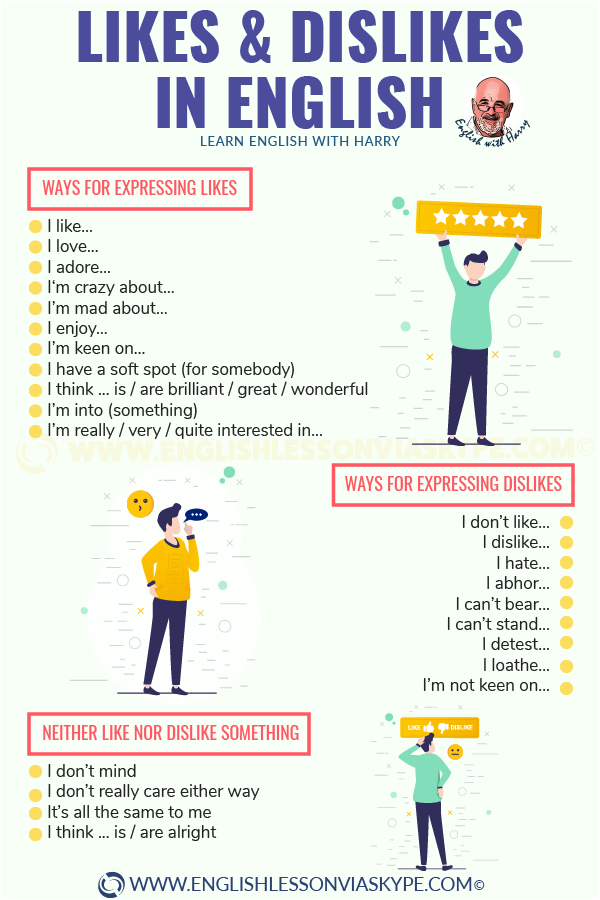
What If You Neither Like Nor Dislike Something?
Sometimes you neither like nor dislike something. You simply feel neutral about it.
1. “I don’t mind it.”
A: What do you think of the new office?
B: I don’t mind it. I preferred the old one, though.
2. “It’s okay.”
A: Did you like the film?
B: It was okay. I wouldn’t watch it again.
3. “I’m fine with it.”
This is useful when you are accepting an option rather than showing enthusiasm.
A: We could move the meeting to Thursday.
B: I’m fine with that.
4. “I don’t have a strong preference.”
A: Would you prefer Tuesday or Wednesday?
B: I don’t have a strong preference.
5. “Either is fine with me.”
A: We can meet online or in the office.
B: Either is fine with me.
“I don’t mind” doesn’t normally mean “I don’t like it.”
If you say:
I don’t mind working from home.
you mean that working from home is acceptable to you. You are not saying that you dislike it.
How to Talk About Preferences in English
Sometimes you don’t simply want to say what you like or dislike. You want to compare two choices.
That is when prefer and would rather are useful.
I prefer X to Y
I prefer tea to coffee.
I prefer the first design to the second one.
I prefer smaller meetings to large meetings.
I prefer the first option than the second.
I prefer the first option to the second.
I prefer doing X to doing Y
I prefer working in the morning to working late at night.
I prefer talking to clients directly to sending long email chains.
I’d rather + verb
I’d rather stay at home tonight.
I’d rather discuss it tomorrow.
I’d rather wait until we have the final figures.
I’d rather to wait.
I’d rather wait.
I’d rather X than Y
I’d rather take the train than drive.
I’d rather speak to the client than send another email.
Grammar After Like, Love, Enjoy and Keen On
Three short rules cover almost everything you need here.
Like, love and hate
You can commonly use these with a noun or an -ing form.
I like coffee. I like travelling.
I love good food. I love working with children.
I hate traffic. I hate waiting.
Enjoy + -ing
Use enjoy + verb-ing.
I enjoy travelling.
I enjoy learning languages.
I enjoy working with clients.
I enjoy to work with clients.
I enjoy working with clients.
Keen on + noun or -ing
I’m keen on photography.
I’m keen on learning Spanish.
I’m quite keen on the second proposal.
I’m keen in learning Spanish.
I’m keen on learning Spanish.
Likes and Dislikes in a Real Conversation
Here is how these phrases sound together in an ordinary conversation.
Kate: What do you like doing at the weekend?
Sarah: I love being outdoors, especially when the weather’s good. I’m really into hiking at the moment. What about you?
Kate: I’m not really into hiking, but I enjoy cycling. I’m also quite keen on photography.
Sarah: Really? I’ve never been very good at photography.
Kate: You don’t have to be. I just enjoy it.
Sarah: What about football? Are you into that?
Kate: Not at all. I can’t stand watching football.
Sarah: Really? I don’t mind it, but I’d rather watch tennis.
Notice the difference
- I love being outdoors expresses a strong positive feeling.
- I’m really into hiking is informal and natural when talking about an interest.
- I’m not really into hiking is a mild way of saying that something does not interest you.
- I can’t stand watching football expresses a strong dislike.
- I don’t mind it means the person neither strongly likes nor dislikes it.
- I’d rather watch tennis compares two choices.
How to Express Likes and Dislikes at Work
You also need this language at work.
You may need to say what you think about an idea, a new system, a deadline, a proposal or two different ways of doing something.
In these situations, the strongest everyday expressions are not always the best choice.
I hate this idea.
I’m not keen on that approach.
I’d prefer a different approach.
When you like an idea
- I like that idea.
- I really like this option.
- I think this approach works well.
- I’m quite keen on the second option.
- I’d be happy with that.
I really like the idea of sending the client a shorter update first.
I’m quite keen on the second option because it gives us more time.
I’d be happy with that approach.
When you do not like an idea
- I’m not keen on that approach.
- I’m not sure about that option.
- I’m not a big fan of that idea.
- That wouldn’t be my first choice.
- I’d prefer a different approach.
I’m not keen on moving the deadline again.
I’m not sure about that option. We still don’t have the final figures.
That wouldn’t be my first choice. I’d prefer to speak to the client first.
When you prefer another option
- I’d prefer to…
- I’d rather…
- My preference would be to…
- I think the second option would work better.
- If I had to choose, I’d go with…
I’d prefer to send the report on Friday when we have the final figures.
I’d rather discuss this with the client before we change anything.
I think the second option would work better.
If I had to choose, I’d go with the first one.
Give your reason
A useful structure is:
Your preference + your reason + what you suggest
I’m not keen on sending this today because the figures haven’t been checked yet. I’d prefer to send it tomorrow morning.
I like the second option because it gives the team more time. I think we should go with that one.
I’d rather keep the meeting on Thursday because Maria can join then.
You don’t need a long explanation. One clear reason often makes your opinion much easier for other people to understand.
Do you know what to say in English at work?
You may know the grammar, but choosing the right phrase in a real work situation can be more difficult. Try the short quiz and see how you would respond in common workplace situations.
Take the Free Quiz →Common Mistakes When Talking About Likes and Dislikes
These five mistakes are the ones learners make most often.
I enjoy to work from home.
I enjoy working from home.
I’m keen in photography.
I’m keen on photography.
I prefer the first option than the second.
I prefer the first option to the second.
I’d rather to wait until Friday.
I’d rather wait until Friday.
I hate the new reporting system.
I’m not very keen on the new reporting system.
I’d prefer a simpler system.
Quick Practice
Choose the answer that sounds clearer and more useful.
1. Your manager suggests a 7.30 am meeting. You would prefer 9.00. Which answer sounds more useful?
- I hate early meetings.
- I’d prefer nine if that works for everyone.
Show answer
B — I’d prefer nine if that works for everyone.
I hate early meetings tells the listener how you feel, but it doesn’t help solve the situation. I’d prefer nine… gives them a clear alternative.
2. A colleague asks whether you like the new software. You think it is okay, but you do not have a strong opinion.
- I don’t mind it.
- I adore it.
Show answer
A — I don’t mind it.
I don’t mind it is useful when you neither strongly like nor dislike something.
3. Choose the correct sentence.
- I enjoy to work with international clients.
- I enjoy working with international clients.
Show answer
B — I enjoy working with international clients.
Use enjoy + -ing.
4. You prefer option B. Which sentence is correct?
- I prefer option B than option A.
- I prefer option B to option A.
Show answer
B — I prefer option B to option A.
Use prefer X to Y.
5. You disagree with an idea at work, but only mildly. Which is better?
- I loathe this idea.
- I’m not keen on this approach.
Show answer
B — I’m not keen on this approach.
Loathe expresses a very strong dislike. I’m not keen on… is much more suitable when your objection is mild.
Frequently Asked Questions
What are some common ways to express likes in English?
You can use I like…, I really like…, I love…, I enjoy…, I’m keen on… and I’m into…. The phrases express different levels of interest, so choose one that matches how strongly you feel.
What can I say instead of “I don’t like it”?
For a mild dislike, you can say I’m not keen on it, I’m not a big fan of it or it’s not really my thing.
For a stronger dislike, you can use I hate it, I can’t stand it or I can’t bear it.
What is the difference between “I don’t like” and “I can’t stand”?
I can’t stand is much stronger. Use it when something annoys you or you dislike it very strongly.
Is it “I enjoy to do” or “I enjoy doing”?
Use enjoy + -ing.
I enjoy working from home.
Not I enjoy to work from home.
How can I say that I don’t like an idea politely at work?
You can say:
- I’m not keen on that approach.
- I’m not sure about that option.
- That wouldn’t be my first choice.
- I’d prefer to…
Adding a short reason makes your opinion clearer.
Remember These Four Points
- I like, I really like, I love and I enjoy do not all express exactly the same strength of feeling. I really like this option.
- I’m not keen on… is much milder than I hate… or I can’t stand… I’m not keen on the first option.
- Use prefer and would rather when you want to compare choices. I’d rather take the train than drive.
- At work, you can often make your opinion more useful by adding a short reason and saying what you would prefer instead. I’m not keen on moving the deadline because the client is expecting it on Friday.
Do you find it difficult to give your opinion in meetings?
In a meeting, you may need more than I like this idea or I don’t agree. You may need to join the discussion, explain your opinion, disagree carefully, ask for clarification or raise a concern.
Speak Up in Meetings gives you practical English for these situations.
Get Speak Up in Meetings →Keep Improving Your English
If this lesson was useful, these will help you say what you think more clearly.
- Other Words for Like in English Use this when you want more natural ways to talk about things you like and enjoy.
- How to Agree and Disagree in English Use this when you want to respond to someone else’s opinion and agree or disagree clearly.
- Making Suggestions in English at Work Use this when you want to suggest another option instead of only saying what you prefer.
- Essential Phrases for Small Talk in English Use this when you want to talk about interests, hobbies and weekends naturally in everyday conversation.