40 Advanced English Adjectives for Fluency

If you often reach for good, bad, big, small or difficult, this lesson gives you more precise words to choose from.

You’ll learn 40 advanced English adjectives with clear meanings, common collocations and natural examples. These words are useful for everyday conversations, writing, exams and English at work.

You don’t need to replace every simple adjective you know. Good, bad and big are normal English. The aim is to give you more choice when you want to describe something more accurately.

Video lesson

Watch the lesson

Watch the video first, then use the examples and practice below to make the vocabulary part of your own English.

Before you start

A useful way to learn advanced English vocabulary

Don’t learn an adjective on its own. Learn it with the nouns it commonly describes. For example:

  • rapid growth
  • swift response
  • sluggish sales
  • challenging task
  • antiquated system
  • innovative approach

This makes it much easier to use the word naturally when you speak or write. And don’t worry about learning all 40 at once. Pick five or six that are useful to you, make your own examples and use them several times. Then come back for another group.

The vocabulary

40 advanced English adjectives with meanings and examples

Each card takes one simple adjective and gives you two stronger alternatives, with the collocations and examples that make them sound natural. Tap a word to jump straight to it.

1Good excellent & superb

Simple sentence: The food at the restaurant was good.

Excellent

Meaning: extremely good or of a very high standard.

Common collocations

  • excellent result
  • excellent service
  • excellent idea
  • excellent opportunity
  • excellent performance
  • excellent quality

Examples“The service at the hotel was excellent.”
“She gave an excellent presentation and answered all the questions clearly.”
“We had an excellent response from the client.”

Use it when something is clearly better than simply good. Excellent works naturally in everyday English and at work.

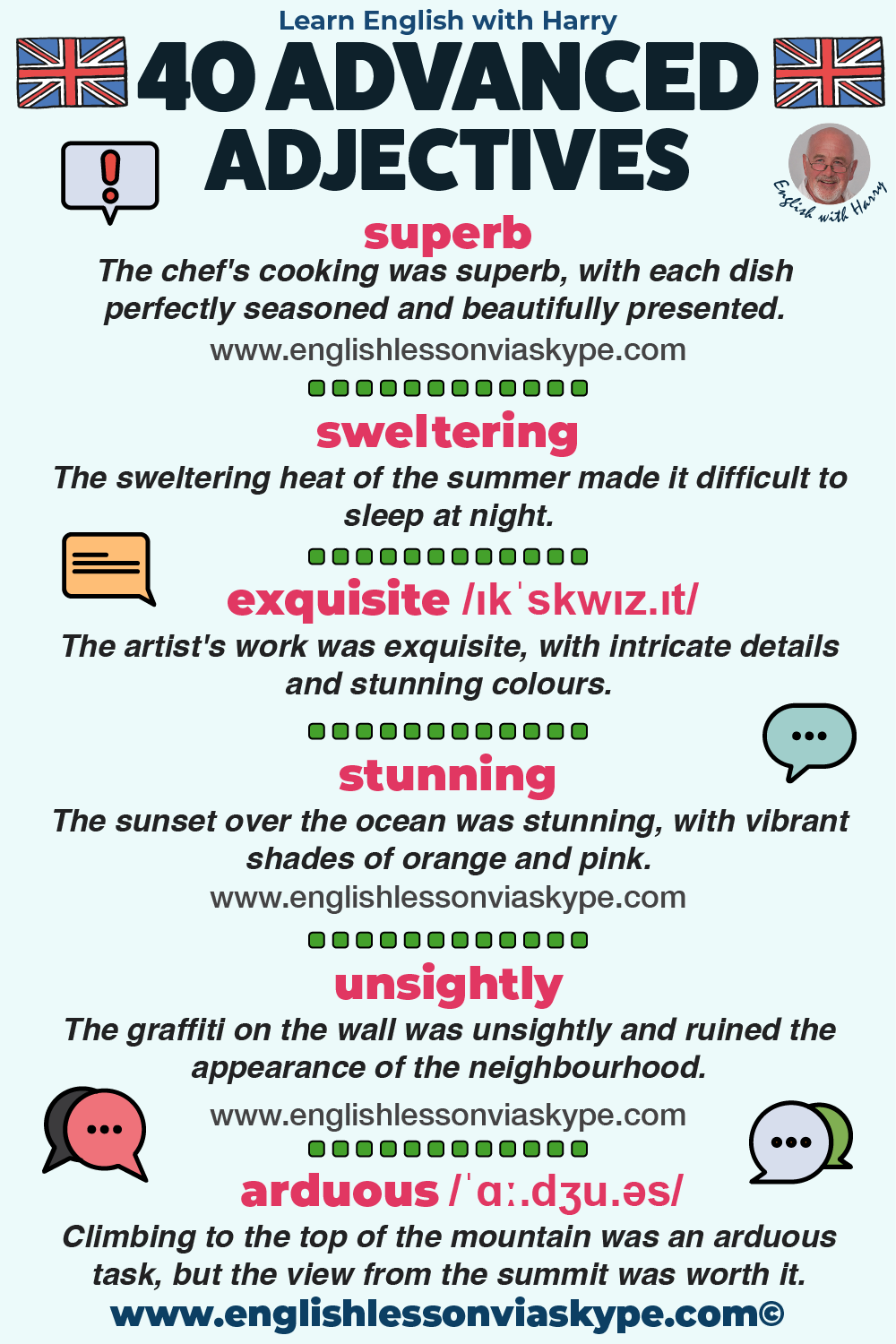
Superb

Meaning: extremely good, impressive or skilful.

Common collocations

  • superb meal
  • superb performance
  • superb view
  • superb presentation
  • superb condition

Examples“The chef prepared a superb meal.”
“The orchestra gave a superb performance.”
“He gave a superb presentation. It was clear, well organised and easy to follow.”

Superb is strong and enthusiastic. You’re saying that something is of a particularly high standard.

2Bad terrible & atrocious

Simple sentence: The weather today is bad.

Terrible

Meaning: very bad or very unpleasant.

Common collocations

  • terrible weather
  • terrible mistake
  • terrible service
  • terrible experience
  • terrible headache
  • terrible timing

Examples“We had terrible weather for most of the weekend.”
“I made a terrible mistake and sent the document to the wrong person.”
“The service was terrible, so we decided not to go back.”

Terrible is very common in spoken English. It’s much stronger than bad, but you’ll hear it regularly in everyday conversation.

Atrocious

Meaning: extremely or shockingly bad.

Common collocations

  • atrocious conditions
  • atrocious behaviour
  • atrocious service
  • atrocious weather
  • atrocious spelling

Examples“The conditions in the building were atrocious.”
“The customer service was atrocious. Nobody answered our emails for more than two weeks.”
“His spelling was atrocious when he was younger, but it has improved a lot.”

Atrocious is a very strong adjective. Don’t use it for something that is only slightly disappointing.

3Happy joyful & ecstatic

Simple sentence: I’m happy to see you.

Joyful

Meaning: very happy or full of happiness.

Common collocations

  • joyful occasion
  • joyful celebration
  • joyful smile
  • joyful moment
  • joyful atmosphere

Examples“It was a joyful occasion for the whole family.”
“The children had joyful smiles on their faces when they opened their presents.”
“There was a joyful atmosphere after the team won the final.”

Joyful often describes an occasion, expression or atmosphere rather than a simple everyday feeling.

Ecstatic

Meaning: extremely happy and excited.

Common collocations

  • ecstatic about
  • ecstatic at
  • ecstatic to hear
  • absolutely ecstatic

Examples“She was ecstatic when she heard that she had got the job.”
“The team were ecstatic about winning the championship.”
“We were absolutely ecstatic when our offer on the house was accepted.”

Ecstatic is much stronger than happy. You don’t need to say ecstatic with joyecstatic already contains that idea.

4Sad melancholy & sorrowful

Simple sentence: She felt sad after the breakup.

Melancholy

Meaning: quietly sad and thoughtful.

Common collocations

  • melancholy mood
  • melancholy song
  • melancholy feeling
  • melancholy expression
  • melancholy atmosphere

Examples“The old song put him in a melancholy mood.”
“There was something melancholy about walking through the empty house.”
“The film has a melancholy ending, but it isn’t completely depressing.”

Melancholy is often used for a quiet or thoughtful type of sadness. It can sound more literary than ordinary words such as sad or unhappy.

Sorrowful

Meaning: feeling or showing deep sadness.

Common collocations

  • sorrowful expression
  • sorrowful look
  • sorrowful voice
  • sorrowful occasion

Examples“She looked at the old family photographs with a sorrowful expression.”
“He gave us a sorrowful look before leaving the room.”
“The music gave the scene a sorrowful atmosphere.”

Sorrowful is correct, but it’s less common in everyday conversation. You’re more likely to see it in stories, descriptions or more emotional writing.

5Big enormous & colossal

Simple sentence: That’s a big house.

Enormous

Meaning: extremely large in size, amount or degree.

Common collocations

  • enormous house
  • enormous amount
  • enormous difference
  • enormous pressure
  • enormous impact
  • enormous success

Examples“The house was enormous. It had seven bedrooms and three sitting rooms.”
“There’s an enormous difference between the two proposals.”
“The company invested an enormous amount of money in the new factory.”

Enormous is very useful because you can use it for physical size and for abstract ideas such as pressure, success, difference and impact.

Colossal

Meaning: extremely large or great.

Common collocations

  • colossal statue
  • colossal amount
  • colossal task
  • colossal mistake
  • colossal failure
  • colossal waste

Examples“The statue was colossal and could be seen from several kilometres away.”
“It would be a colossal mistake to ignore the problem.”
“Building the new transport system will be a colossal task.”

Colossal is stronger and more dramatic than big. It works particularly well when the size or scale is surprising.

Back to lesson menu

6Small tiny & minuscule

Simple sentence: The puppy is small.

Tiny

Meaning: very small in size or amount.

Common collocations

  • tiny room
  • tiny detail
  • tiny amount
  • tiny village
  • tiny chance
  • tiny difference

Examples“The kitten was tiny enough to fit in the palm of his hand.”
“There’s only a tiny amount of milk left.”
“One tiny detail in the contract caused a major problem later.”

Tiny is common and natural in everyday English.

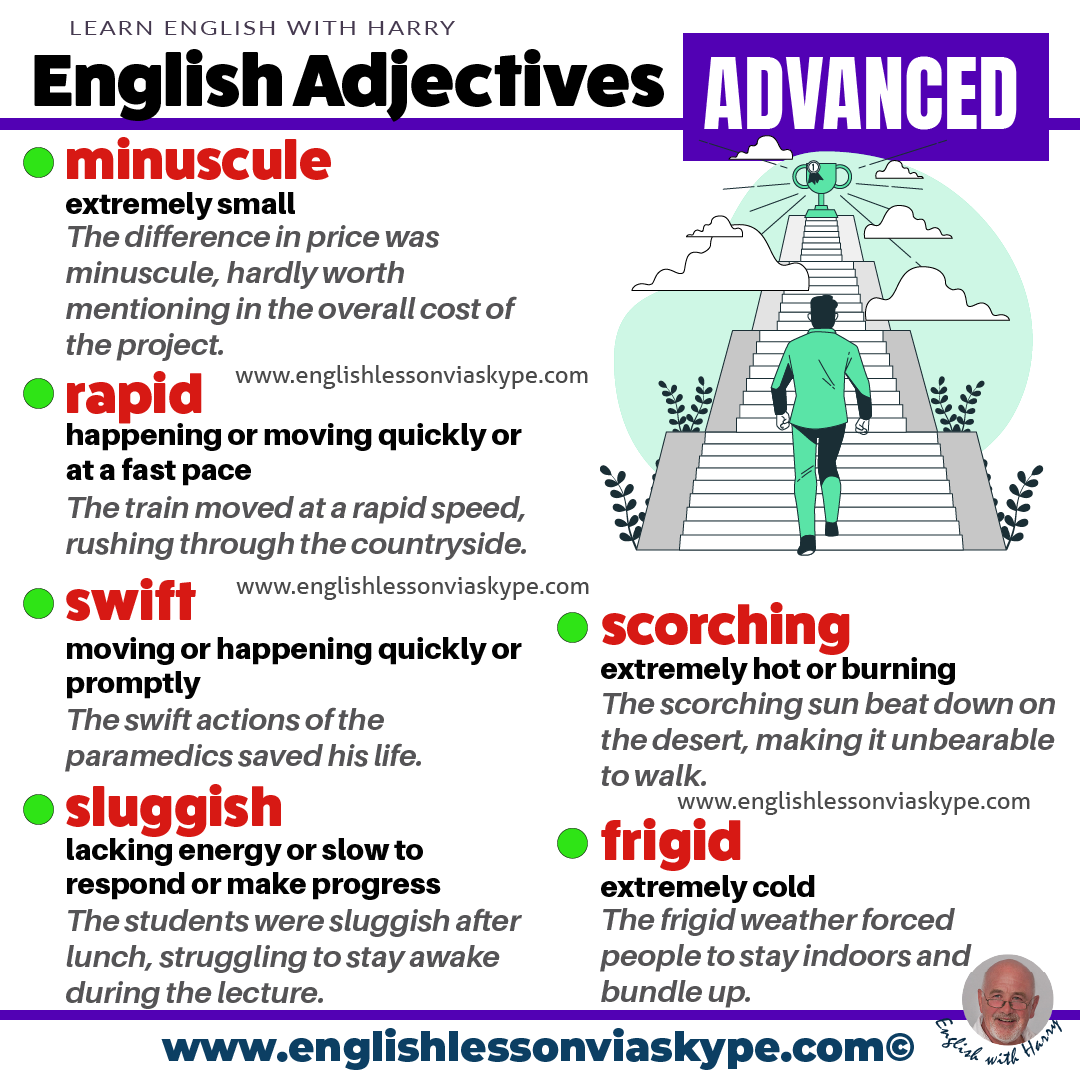
Minuscule

Meaning: extremely small.

Common collocations

  • minuscule amount
  • minuscule difference
  • minuscule percentage
  • minuscule text
  • minuscule chance

Examples“The writing on the label was minuscule.”
“The difference between the two figures is minuscule.”
“Only a minuscule percentage of customers complained.”

Minuscule is useful when you want to emphasise just how small something is.

Advanced English adjectives for fluency with stronger alternatives to common basic adjectives. Save

7Fast rapid & swift

Simple sentence: Things changed very fast.

Rapid

Meaning: happening or developing very quickly.

Common collocations

  • rapid growth
  • rapid change
  • rapid increase
  • rapid development
  • rapid progress
  • rapid decline

Examples“The city has experienced rapid growth over the last ten years.”
“There has been a rapid increase in energy prices.”
“Technology is developing at a rapid pace.”

Rapid is particularly useful for changes, increases, growth, development and progress. Instead of rapid speed, it’s usually more natural to talk about rapid growth, rapid change or a rapid increase.

Swift

Meaning: happening quickly and without unnecessary delay.

Common collocations

  • swift action
  • swift response
  • swift decision
  • swift recovery
  • swift change

Examples“The emergency services took swift action.”
“Thank you for your swift response to my email.”
“The company made a swift decision once the full cost became clear.”

Swift often describes an action or response. It suggests that something happened promptly.

8Slow sluggish & lethargic

Simple sentence: The computer is slow today.

Sluggish

Meaning: moving, developing or responding more slowly than expected.

Common collocations

  • sluggish economy
  • sluggish growth
  • sluggish sales
  • sluggish demand
  • sluggish performance
  • sluggish system

Examples“The computer has been sluggish since the latest update.”
“Sales were sluggish during the first three months of the year.”
“The economy remains sluggish despite lower interest rates.”

Sluggish is particularly useful for systems, markets, sales, growth and the economy.

Lethargic

Meaning: lacking energy and feeling unwilling or unable to do much.

Common collocations

  • feel lethargic
  • look lethargic
  • become lethargic

Examples“The heat made me feel lethargic all afternoon.”
“I always feel slightly lethargic after a very heavy lunch.”
“He looked tired and lethargic during the morning meeting.”

Lethargic usually describes a person or animal, not a slow computer, project or market.

9Hot scorching & sweltering

Simple sentence: It’s hot outside.

Scorching

Meaning: extremely hot.

Common collocations

  • scorching heat
  • scorching sun
  • scorching day
  • scorching temperatures
  • scorching weather

Examples“We walked for two hours in the scorching heat.”
“The scorching sun made it difficult to stay outside for long.”
“Temperatures remained scorching throughout the afternoon.”

Scorching is commonly used for very hot weather, temperatures and sunlight.

Sweltering

Meaning: uncomfortably hot, especially when the air feels heavy or humid.

Common collocations

  • sweltering heat
  • sweltering weather
  • sweltering room
  • sweltering afternoon
  • sweltering conditions

Examples“It was sweltering inside the meeting room because the air conditioning had stopped working.”
“We spent the afternoon walking around the city in sweltering heat.”
“It was a sweltering summer evening.”

Sweltering usually tells us how uncomfortable the heat feels.

10Cold frigid & icy

Simple sentence: The weather is cold.

Frigid

Meaning: extremely cold.

Common collocations

  • frigid temperatures
  • frigid weather
  • frigid air
  • frigid conditions

Examples“Frigid temperatures kept most people indoors.”
“A blast of frigid air came through the open door.”
“The rescue team had to work in frigid conditions.”

Frigid is much stronger than cold and is most often used for weather or air.

Icy

Meaning: extremely cold or covered with ice.

Common collocations

  • icy road
  • icy wind
  • icy water
  • icy conditions
  • icy stare
  • icy tone

Examples“The car skidded on the icy road.”
“An icy wind was blowing across the lake.”
“She gave him an icy look and walked out of the room.”

Icy can also describe somebody’s manner, voice or expression when they seem very unfriendly.

Back to lesson menu
Episode 470

Listen to the lesson

Prefer audio? Listen to the same lesson as Episode 470 of Speak Better English with Harry.

Pick five or six adjectives that are useful to you, make your own examples and use them several times. Then come back for another group.

One-to-one lessons

Want to use advanced English more confidently?

If you understand this vocabulary but aren’t always sure which words sound natural in your own conversations, a trial lesson gives you a chance to practise with a teacher and get clear corrections. We can focus on the English you use in daily life, at work, or both.

Book a Free Trial Lesson →

11Beautiful exquisite & stunning

Simple sentence: The view from the mountaintop was beautiful.

Exquisite

Meaning: extremely beautiful, delicate or finely made.

Common collocations

  • exquisite detail
  • exquisite jewellery
  • exquisite craftsmanship
  • exquisite design
  • exquisite food
  • exquisite taste

Examples“The artist’s work was exquisite, with very fine detail.”
“The necklace was an exquisite piece of jewellery.”
“We had an exquisite meal at a small restaurant near the harbour.”

Exquisite often describes something beautiful because of its quality, delicacy or attention to detail.

Stunning

Meaning: extremely beautiful or impressive.

Common collocations

  • stunning view
  • stunning scenery
  • stunning dress
  • stunning building
  • stunning photograph
  • stunning location

Examples“The view from the top of the mountain was stunning.”
“They stayed in a hotel in a stunning location beside the lake.”
“She wore a stunning blue dress to the wedding.”

Stunning is much more common in everyday conversation than exquisite.

12Ugly unappealing & unsightly

Simple sentence: That’s an ugly building.

Unappealing

Meaning: not attractive, interesting or pleasant.

Common collocations

  • unappealing colour
  • unappealing design
  • unappealing option
  • unappealing food
  • unappealing appearance

Examples“The grey walls made the room look rather unappealing.”
“Neither option was particularly attractive, but the second one was especially unappealing.”
“The food looked unappealing, although it tasted much better than I expected.”

Unappealing can describe appearance, but it can also describe an idea, option or situation that you don’t find attractive.

Unsightly

Meaning: unpleasant to look at.

Common collocations

  • unsightly building
  • unsightly wires
  • unsightly stain
  • unsightly rubbish
  • unsightly damage

Examples“The graffiti made the wall look unsightly.”
“The cables are useful, but they’re rather unsightly.”
“The old industrial buildings had become an unsightly part of the city centre.”

Unsightly normally refers to physical appearance. Don’t use it for an unattractive idea or proposal.

13Easy effortless & straightforward

Simple sentence: That was an easy task.

Effortless

Meaning: appearing to require little or no effort.

Common collocations

  • effortless performance
  • effortless style
  • effortless movement
  • effortless transition
  • effortless victory

Examples“She made the difficult piece of music sound effortless.”
“The transition from the old system to the new one was almost effortless.”
“His presentation style looks effortless, but he prepares very carefully.”

Effortless doesn’t always mean that something really required no work. It can mean that somebody made it look easy.

Straightforward

Meaning: simple, clear and not difficult to understand or do.

Common collocations

  • straightforward task
  • straightforward process
  • straightforward explanation
  • straightforward question
  • straightforward solution

Examples“The application process is quite straightforward.”
“It should be a straightforward task once we have all the figures.”
“She gave me a straightforward explanation of what had happened.”

Straightforward is one of the most useful alternatives to easy, particularly at work. In the video you’ll also hear untroublesome — that word is correct, but straightforward is much more common and useful.

14Difficult arduous & challenging

Simple sentence: It was a difficult task.

Arduous

Meaning: requiring a great deal of time, effort or physical work.

Common collocations

  • arduous task
  • arduous journey
  • arduous process
  • arduous climb
  • arduous training

Examples“The climb to the top was long and arduous.”
“Getting all the necessary approvals was an arduous process.”
“They faced the arduous task of checking thousands of old documents.”

Arduous is not simply another word for difficult. It suggests that something requires a lot of effort over a period of time.

Challenging

Meaning: difficult in a way that tests your ability, knowledge or skill.

Common collocations

  • challenging task
  • challenging job
  • challenging situation
  • challenging project
  • challenging deadline
  • challenging question

Examples“It was a challenging project, but we learned a lot from it.”
“We’re working to a very challenging deadline.”
“She asked several challenging questions during the presentation.”

Challenging is very useful in professional English. It often sounds more constructive than difficult because it can suggest that something is hard but still possible.

15Old ancient & antiquated

Simple sentence: That’s an old building.

Ancient

Meaning: extremely old or belonging to a very distant period in history.

Common collocations

  • ancient civilisation
  • ancient ruins
  • ancient building
  • ancient tradition
  • ancient history
  • ancient city

Examples“We visited the ruins of an ancient Roman settlement.”
“The town is famous for its ancient walls.”
“This tradition has its origins in ancient times.”

Ancient is appropriate when something really is very old. A ten-year-old laptop may feel old, but it isn’t ancient in the normal sense of the word.

Antiquated

Meaning: old-fashioned and no longer suitable for modern use.

Common collocations

  • antiquated system
  • antiquated equipment
  • antiquated technology
  • antiquated method
  • antiquated rules
  • antiquated process

Examples“The company is still using an antiquated computer system.”
“Some of the rules seem antiquated and need to be reviewed.”
“The approval process is slow because the system is antiquated.”

Antiquated is particularly useful when talking about outdated working methods, systems or equipment.

Back to lesson menu

16New novel & innovative

Simple sentence: They tried a new approach.

Novel

Meaning: new, original or unusual.

Common collocations

  • novel idea
  • novel approach
  • novel solution
  • novel method
  • novel concept

Examples“They took a novel approach to the problem.”
“The researchers have proposed a novel solution.”
“It was a novel idea at the time, although it’s common today.”

Novel is fairly formal. You’ll often see it in professional, technical or academic English.

Innovative

Meaning: introducing new ideas or methods in a creative and useful way.

Common collocations

  • innovative product
  • innovative company
  • innovative solution
  • innovative technology
  • innovative approach
  • innovative design

Examples“The company is known for its innovative products.”
“We need a more innovative solution to the problem.”
“They’ve introduced an innovative approach to staff training.”

Innovative is extremely useful in Business English, presentations, reports and discussions about technology or change.

17Clean pristine & immaculate

Simple sentence: The house is clean.

Pristine

Meaning: perfectly clean or in its original, undamaged condition.

Common collocations

  • pristine condition
  • pristine beach
  • pristine environment
  • pristine room
  • pristine landscape

Examples“The car was still in pristine condition after five years.”
“The beach was pristine, with clear water and very little development nearby.”
“The apartment looked pristine when we arrived.”

Pristine often suggests that something has been kept in excellent condition or hasn’t been damaged or spoiled.

Immaculate

Meaning: perfectly clean, tidy or free from faults.

Common collocations

  • immaculate house
  • immaculate kitchen
  • immaculate appearance
  • immaculate condition
  • immaculate handwriting
  • immaculate record

Examples“The kitchen was immaculate.”
“He arrived at the interview in an immaculate suit.”
“The equipment had been kept in immaculate condition.”

Immaculate can describe cleanliness, neatness and an absence of mistakes or faults.

18Dirty filthy & grimy

Simple sentence: That’s a dirty shirt.

Filthy

Meaning: extremely dirty.

Common collocations

  • filthy clothes
  • filthy floor
  • filthy kitchen
  • filthy hands
  • filthy room

Examples“The kitchen was filthy after the party.”
“Your shoes are filthy. Leave them by the door.”
“The floor was absolutely filthy.”

Filthy is a common strong adjective. We usually say absolutely filthy rather than very filthy.

Grimy

Meaning: covered with dirt, grease or a layer of unpleasant material.

Common collocations

  • grimy windows
  • grimy hands
  • grimy clothes
  • grimy walls
  • grimy streets

Examples“After working on the car all afternoon, his hands were grimy.”
“The windows were so grimy that very little light came through.”
“The old building had dark, grimy walls.”

Grimy often suggests a layer of dirt that has collected over time.

19Bright radiant & gleaming

Simple sentence: Everything looked bright in the sunlight.

Radiant

Meaning: shining or glowing brightly. It can also describe somebody who looks very happy or healthy.

Common collocations

  • radiant smile
  • radiant face
  • radiant light
  • radiant glow
  • look radiant

Examples“She had a radiant smile when she walked into the room.”
“The morning light gave the garden a radiant glow.”
“You look radiant. Have you just come back from holiday?”

Radiant is not simply a replacement for bright in every sentence. It is especially natural with faces, smiles, light and a healthy appearance.

Gleaming

Meaning: shining brightly because a surface is clean, polished or reflecting light.

Common collocations

  • gleaming car
  • gleaming floor
  • gleaming windows
  • gleaming metal
  • gleaming kitchen

Examples“The car was gleaming after he washed and polished it.”
“The hotel lobby had gleaming marble floors.”
“All the metal surfaces were clean and gleaming.”

Gleaming normally describes a surface that reflects light.

20Dark gloomy & sombre

Simple sentence: The room was dark.

Gloomy

Meaning: dark, depressing or lacking hope.

Common collocations

  • gloomy room
  • gloomy weather
  • gloomy atmosphere
  • gloomy mood
  • gloomy outlook
  • gloomy forecast

Examples“The small windows made the room feel gloomy.”
“The weather remained gloomy all weekend.”
“The economic outlook is still quite gloomy.”

Gloomy is useful because it can describe a physical place, a mood or a negative view of the future.

Sombre

Meaning: dark, serious or sad in mood, colour or tone.

Common collocations

  • sombre mood
  • sombre atmosphere
  • sombre tone
  • sombre expression
  • sombre colours

Examples“The room became sombre when the news was announced.”
“He spoke in a sombre tone about the accident.”
“She wore dark, sombre colours to the ceremony.”

Sombre is the usual British spelling. In American English, you’ll normally see somber.

Back to lesson menu Sound natural

How to use advanced English adjectives naturally

Learning advanced English vocabulary doesn’t mean replacing every simple word with a longer one. If your coffee is good, you can say it’s good. You don’t have to call it superb. The important thing is knowing the difference between the words and choosing one that fits the situation.

Learn the adjective and noun together

This is one of the quickest ways to make new vocabulary easier to remember. Instead of learning a word on its own, learn a complete phrase you can use straight away:

  • rapid growth  ·  rapid change  ·  rapid increase
  • challenging task  ·  challenging question  ·  challenging deadline
  • innovative solution  ·  innovative technology  ·  innovative approach

Be careful with intensity

Some of these advanced adjectives are much stronger than the simple adjective. Each step below is more forceful than the one before it:

  • bad terrible atrocious
  • happy joyful ecstatic
  • big enormous colossal
  • small tiny minuscule

If a restaurant was slightly disappointing, atrocious is probably far too strong. If you’re pleased that your train arrived on time, ecstatic would also be rather excessive. Choose the adjective that matches what you really mean.

You can’t always use “very”

Some strong adjectives don’t normally need very. Natural English is more likely to use absolutely or really:

  • very excellent  /  very atrocious  /  very enormous  /  very ecstatic  /  very filthy
  • absolutely excellent  /  absolutely enormous  /  absolutely ecstatic  /  absolutely filthy
  • really excellent  /  really enormous  /  really filthy

Other adjectives in this lesson work perfectly well with very: very challenging, very innovative, very gloomy, very unappealing. So don’t learn one grammar rule and apply it to every adjective — pay attention to the combinations you hear and read.

Similar adjectives aren’t always interchangeable

Same idea, different partner words

Frigid and icy can both relate to cold, but we normally talk about frigid temperatures and an icy road.

Radiant and gleaming can both relate to brightness, but a person can have a radiant smile while a polished car is gleaming.

Melancholy and sorrowful both relate to sadness, but melancholy often suggests quiet, thoughtful sadness while sorrowful suggests deeper grief.

That difference is what makes advanced English vocabulary useful. You’re not simply learning longer synonyms. You’re learning how to express a more exact meaning.

Business English

How to use these advanced English adjectives at work

You don’t need a completely separate set of adjectives for Business English. Many advanced adjectives you use in everyday life also work naturally in meetings, presentations, reports and workplace conversations. The important thing is choosing the right collocation.

  • Excellent “We had an excellent response from the client.” / “The team did an excellent job on the presentation.”
  • Enormous “The project involves an enormous amount of data.” / “There’s an enormous difference between the original estimate and the final cost.”
  • Minuscule “The difference between the two figures is minuscule.” / “We’re working with a minuscule budget compared with our competitors.”
  • Rapid “We’ve seen rapid growth in online sales.” / “There has been a rapid increase in competition.”
  • Swift “We need a swift response before the situation gets worse.” / “Thanks for taking such swift action.”
  • Sluggish “Sales remain sluggish in several European markets.” / “The system has been sluggish since the software update.”
  • Challenging “It’s a challenging deadline, but I think we can meet it.” / “This has been a particularly challenging project.”
  • Antiquated “Our current approval process is antiquated.” / “The equipment is reliable, but some of the technology is antiquated.”
  • Novel “They’ve proposed a novel approach to the problem.” / “It’s a novel idea, and I think it’s worth testing.”
  • Innovative “We need a more innovative solution.” / “They’re one of the most innovative companies in the industry.”
  • Gloomy “The economic outlook remains gloomy.” / “The latest sales forecast is rather gloomy.”
  • Sombre “The meeting had a sombre tone after the announcement.” / “The mood in the office was understandably sombre.”

In a meeting

Conversation

Manager: How are sales looking this quarter?

You: We’ve seen rapid growth in Spain and Portugal, but demand in Germany is still quite sluggish.

Manager: What about the new proposal?

You: It’s an innovative approach, but the timeline is challenging. We may need another week before we can confirm it.

That sounds natural because the adjectives are used with nouns they commonly go with: rapid growth, sluggish demand, innovative approach and challenging timeline.

Advanced English adjectives for work with natural Business English collocations and examples. Save
Get it right

Common mistakes with advanced English adjectives

1. Using a stronger adjective when you don’t need one

Advanced English isn’t about making every sentence dramatic. Choose the word that matches the real situation:

  • The meeting was good. The meeting was excellent. The meeting was superb.

Normal, more positive, then very strong. Match the word to how the meeting actually went.

2. Treating synonyms as exactly the same

Icy and frigid both relate to cold, but they don’t always describe the same things.

  • frigid temperatures  /  icy roads
  • icy temperatures in every context  /  frigid roads

Learn the whole combination, not just the single word.

3. Using formal or literary adjectives in ordinary conversation

Melancholy and sorrowful are useful words, but you probably won’t use them as often as sad, unhappy or disappointed. That doesn’t make them bad vocabulary. It simply means you need to know where they fit.

4. Choosing the adjective first and then forcing it into a sentence

Start with the idea you want to express. The meaning comes first:

  • A process is old and no longer suitable → use antiquated.
  • An idea is new and original → use novel.
  • A response happened quickly → use swift.

5. Trying to memorise all 40 words at once

Take a smaller group and use it

For example, this week you could work with: excellent, enormous, rapid, challenging and innovative.

Write one sentence about your life and one sentence about your work for each adjective. That gives you ten real examples connected to things you already know.

Your turn

Practice: choose the best advanced adjective

Choose the best adjective for each sentence, then open Show answer to check.

1. The company has experienced ______ growth since it entered the German market.

A. radiant    B. rapid    C. sorrowful

Show answer

B. rapid

Rapid growth is a very common collocation.

2. The old booking system is completely ______. We need something that works with our current software.

A. antiquated    B. joyful    C. pristine

Show answer

A. antiquated

An antiquated system is old-fashioned and no longer suitable for modern use.

3. It was ______ inside the hotel room because the air conditioning wasn’t working.

A. frigid    B. sweltering    C. gloomy

Show answer

B. sweltering

A sweltering room is uncomfortably hot.

4. The difference between the two prices is ______, so I’d choose the option with better service.

A. colossal    B. minuscule    C. radiant

Show answer

B. minuscule

A minuscule difference is an extremely small difference.

5. She was absolutely ______ when she heard that she had passed the final exam.

A. ecstatic    B. grimy    C. sombre

Show answer

A. ecstatic

Ecstatic means extremely happy and excited.

6. The walk across the mountains was long and ______.

A. arduous    B. immaculate    C. swift

Show answer

A. arduous

An arduous journey or task requires a lot of effort.

7. The kitchen was absolutely ______ after the party.

A. novel    B. filthy    C. pristine

Show answer

B. filthy

Filthy means extremely dirty.

8. The hotel had a ______ view across the lake and mountains.

A. stunning    B. sluggish    C. antiquated

Show answer

A. stunning

A stunning view is extremely beautiful or impressive.

9. The economic outlook remains fairly ______, with growth expected to stay weak.

A. gleaming    B. gloomy    C. joyful

Show answer

B. gloomy

A gloomy outlook is a negative or pessimistic view of the future.

10. The client thanked us for our ______ response to the problem.

A. melancholy    B. swift    C. grimy

Show answer

B. swift

A swift response is a response that comes quickly.

Go further

Practice: replace the basic adjective

Rewrite each sentence using one of the advanced adjectives from this lesson, then open Show answer to compare.

1. The customer service was very bad.

Show answer

The customer service was atrocious.

2. The company has had very fast growth.

Show answer

The company has experienced rapid growth.

3. The approval process is old and no longer suitable.

Show answer

The approval process is antiquated.

4. It was a difficult project that required months of work.

Show answer

It was an arduous project that required months of work.

You could also use challenging if you want to focus more on the difficulty than the amount of effort involved.

5. The view from our hotel room was very beautiful.

Show answer

The view from our hotel room was stunning.

Now make five examples of your own. Use situations from your home, job, city, travels or daily life.

Common questions

Frequently asked questions about advanced English adjectives

What are some advanced English adjectives for fluency?

Useful examples include excellent, superb, atrocious, enormous, minuscule, rapid, swift, sluggish, challenging, antiquated, novel, innovative, pristine, immaculate, gloomy and sombre.

The best adjectives to learn are the ones you can actually use. Learn them with common noun combinations rather than as isolated words.

Will advanced adjectives make my English sound more fluent?

They can help, because they allow you to express a more exact meaning. However, fluency doesn’t come from using difficult vocabulary in every sentence. Natural English includes plenty of simple words.

A fluent speaker knows when good is enough and when excellent, superb or another adjective expresses the idea better.

Are these C1 English adjectives?

This lesson is useful for upper-intermediate and advanced learners, including people working towards B2 or C1 English.

Some words in the list are common everyday adjectives, while others are more advanced or less frequent. The important step is learning how they’re used naturally, especially their common collocations.

What is the best way to learn advanced English vocabulary?

Learn a small number of words at a time and connect them to real situations. For example: rapid growth, challenging project, innovative solution, gloomy outlook, swift response.

Then make your own sentence with each phrase and say it aloud. Come back to the same words several days later and try to use them again without looking at your notes.

Can I use these advanced adjectives in Business English?

Yes. Several are very common in professional English. You can talk about a rapid growth, sluggish sales, a challenging deadline, an antiquated system, a novel approach, an innovative solution, a swift response or a gloomy outlook.

The same vocabulary can often be used in both everyday English and at work. What changes is the context and the noun you use with it.

Should I stop using simple adjectives such as good, bad and big?

No. Simple adjectives are normal English and native speakers use them constantly.

Advanced vocabulary gives you more options. It helps when good isn’t precise enough, when you want to describe the degree of something, or when a particular adjective and noun naturally belong together.

At a glance

Advanced adjectives at a glance

A quick reference you can screenshot: the simple word on the left, and the two stronger alternatives from this lesson on the right.

Basic adjective Advanced alternatives
goodexcellent, superb
badterrible, atrocious
happyjoyful, ecstatic
sadmelancholy, sorrowful
bigenormous, colossal
smalltiny, minuscule
fastrapid, swift
slowsluggish, lethargic
hotscorching, sweltering
coldfrigid, icy
beautifulexquisite, stunning
uglyunappealing, unsightly
easyeffortless, straightforward
difficultarduous, challenging
oldancient, antiquated
newnovel, innovative
cleanpristine, immaculate
dirtyfilthy, grimy
brightradiant, gleaming
darkgloomy, sombre
Quick summary

Quick review

Remember these four points:

  1. Learn adjective and noun combinations, not isolated words.
  2. Don’t replace every simple adjective just because you know a longer one.
  3. Pay attention to strength — atrocious is much stronger than bad, and ecstatic is much stronger than happy.
  4. Use a few new adjectives repeatedly before adding more.

You’ll remember rapid growth more easily than rapid on its own — and you’ll find it much easier to use when you need it.

One-to-one lessons

Want personal help with your advanced English?

If you want to improve your vocabulary, speaking or English for work, a one-to-one lesson lets you practise the English you actually need and get clear feedback on what sounds natural.

Book a Free Trial Lesson →

Free trial lesson · Trial details and the booking form are on the same page

Share this lesson

Found this lesson useful? Share it with someone who is building their English vocabulary.

Keep learning

Related English lessons

If this lesson was useful, these will help you build more precise, natural English vocabulary.