Adjectives ending in ED and ING

  • Post author:
  • Post last modified:21/08/2026
  • Post category:English Grammar
  • Reading time:6 mins read

Confused about bored and boring? Interested and interesting?

You are not alone.

Many English learners mix up adjectives ending in -ed and -ing. But the difference is actually simple.

In this lesson, you will learn:

• The clear difference between -ed and -ing adjectives
• Easy examples you can remember
• How to avoid common mistakes

At the end, there is a short quiz to check your understanding.

Let’s make this easy.

Quick answer

ED or ING? The simple difference

-ED

How someone feels

  • I'm bored.
  • She's interested.
  • We were surprised.
-ING

What causes the feeling

  • The meeting is boring.
  • The idea is interesting.
  • The news was surprising.

Compare

I was confused by the instructions.The feeling — me.

vs

The instructions were confusing.The cause — the instructions.

First of all, let’s revise quickly what is an adjective. Adjectives are those words that describe a noun. They have the same form in singular and plural.

1️⃣ Adjectives come before a noun:

A big cat. 

Here BIG is the adjective describing cat which is a noun.

An old car.

Here OLD is the adjective describing car which is a noun.

2️⃣ You put adjectives after these verbs

APPEAR, BE, BECOME, GET, LOOK, SEEM, SMELL, SOUND, TASTE

  • You look tired.
  • It’s getting dark.
  • That sounds nice.

Common Adjectives ending in ED and ING

List of English adjectives ending in ED or ING. Advanced English learning. Advanced English lessons www.englishlessonviaskype.com #learnenglish

3️⃣ You use an adjective and not an adverb after these verbs

APPEAR, BE, BECOME, GET, LOOK, SEEM, SMELL, SOUND, TASTE

  • This tastes good.
  • The coffee smells wonderful.
  • Does the milk taste bad?

4️⃣ Some adjectives have two forms. One ending in ING and one ending in ED

The boy was interestED in reading.

The book he was reading was interestING.

We use adjectives ending in ED

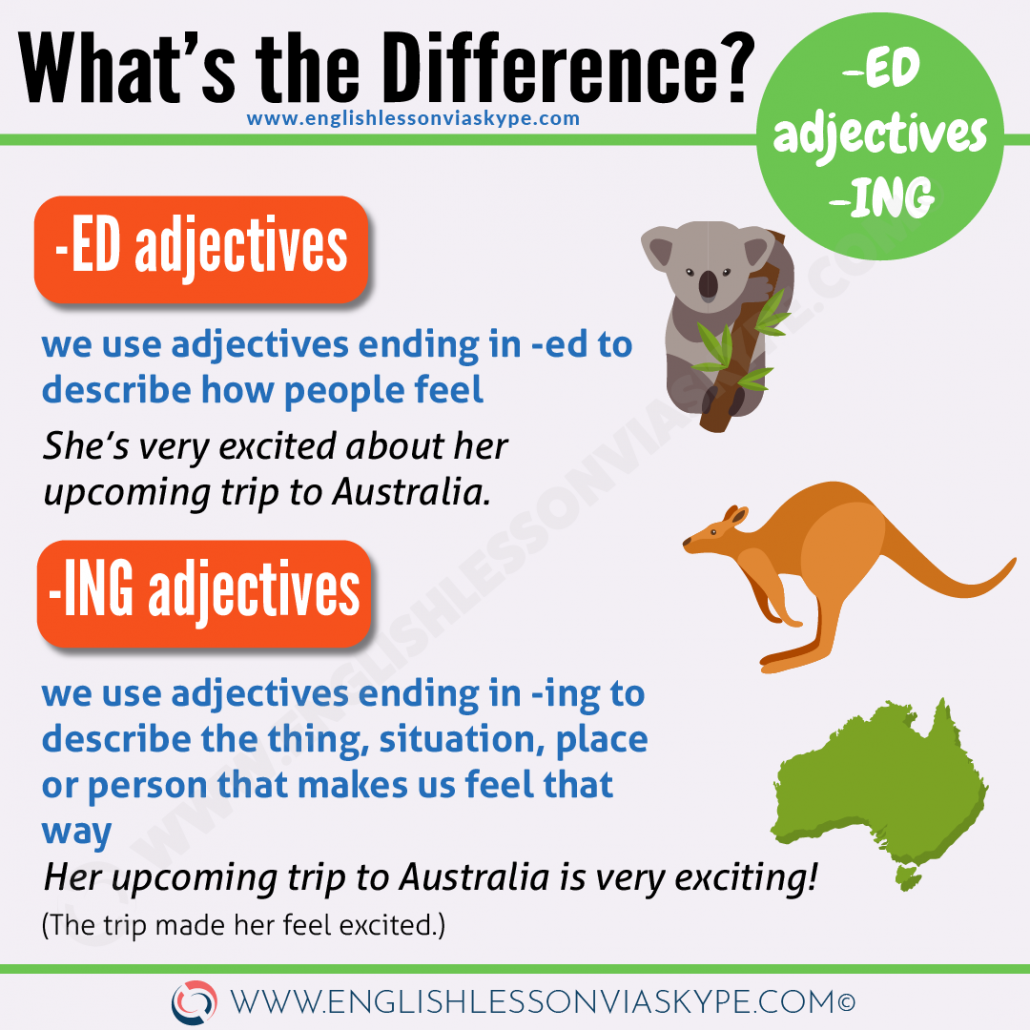
When describing how people feel we use those adjectives ending in -ed.

The boy was interested in reading. – CORRECT

The boy was interesting in reading. – WRONG

  • I’m bored.
  • You’re tired.
  • They’re frightened.
  • He’s scared.

We use adjectives ending in ING

When referring to a thing or a situation we use the -ing ending. Therefore it is correct to say the book the boy was reading was interesting.

This film was really boring.This film made me feel bored.

Her experience was really frightening.Her experience made her feel frightened.

He finds the lessons tiring.The lessons make him feel tired.

It was shocking news. – The news shocked us.

It is possible to use adjectives with -ing endings when referring to a person but it may change the meaning.

He is an interesting person.He knows a lot, he is open to new ideas.

He is really boring.He has no interests, he only talks about himself.

⛔️ So be careful how you use them.

What's the Difference between ED and ING Adjectives

English Grammar Rules - difference between adjectives ending in ED and ING. #learnenglish #englishlessons #ingles #อังกฤษ #английский #英语 #영어

Examples of adjectives ending in ED and ING

1. The man was amused by the story.

2. The story was amusing.

In the first example, the man laughed and found the story funny so he was amused.

In the second example, someone finds the story amusing.

1. The book I was reading yesterday was very boring.

2. I was really bored when I was reading this book.

In the first example, the book was not interesting and I didn’t enjoy reading it.

In the second example, I didn’t find the book interesting and I got tired of reading it. (I felt tired)

Pairs of adjectives ending in ED and ING

The following are other adjective “pairs” which will be used in a similar way:

FRUSTRATE – when something does not work out the way you would like, you become frustrated.

He was frustrated when he could not get the answer to the crossword puzzle.

The crossword puzzle can be frustrating if you cannot work out the clues.

ASTONISH – similar in meaning to surprise but usually with a negative meaning.

She was astonished when he fired her even though her work was good.

The decision to sack her was astonishing to all that heard about it.

Word list

Common -ED and -ING adjective pairs

You feel… Something is…
annoyedannoying
boredboring
confusedconfusing
disappointeddisappointing
excitedexciting
exhaustedexhausting
frustratedfrustrating
interestedinteresting
overwhelmedoverwhelming
surprisedsurprising
At work

How to use -ED and -ING adjectives at work

Same rule, real situations. The -ED form describes the person; the -ING form describes the thing that produced the feeling.

Confused or confusing

-ed

I'm a little confused about the deadline.

-ing

The information about the deadline is confusing.

Frustrated or frustrating

-ed

The team is frustrated by the delay.

-ing

The delay is frustrating.

Interested or interesting

-ed

The client is interested in the proposal.

-ing

It's an interesting proposal.

Disappointed or disappointing

-ed

The client was disappointed with the result.

-ing

The result was disappointing.

Surprised or surprising

-ed

We were surprised by their response.

-ing

Their response was surprising.

Overwhelmed or overwhelming

-ed

I'm feeling overwhelmed by the amount of work this week.

-ing

The amount of information was overwhelming.

Be careful

The ending can change what you say about someone

One letter group decides whether you are describing a feeling or blaming a person. These three are worth reading twice.

-ed

My manager is frustrated.My manager feels frustrated.

-ing

My manager is frustrating.My manager causes frustration.

-ed

The client seemed confused.The client didn't understand something.

-ing

The client was confusing.What the client said or did was difficult to understand.

-ed

I'm bored in this meeting.You feel bored.

-ing

I'm boring in this meeting.You are making the meeting boring for other people.

Free quiz

Do you use English in meetings at work?

Grammar matters, but in a meeting you also need to know what to say quickly.

Try 8 common meeting situations and see which English sounds natural.

Take the free quiz →

Free · 2 minutes · Instant result

Check yourself

Common mistakes with -ED and -ING adjectives

These four come up again and again. The first sentence in each pair is not what you mean.

I'm boring.
I'm bored.
I'm interesting in the job.
I'm interested in the job.
The instructions were confused.
The instructions were confusing.
The meeting made me boring.
The meeting made me bored.
Go deeper

Prepositions with -ED adjectives

-ED adjectives usually take a preposition before the cause of the feeling. These are the ones you will use most.

interested in

She's interested in the new role.

excited about

We're excited about the launch.

worried about

He's worried about the deadline.

disappointed with / by

They were disappointed with the results.

surprised by / at

I was surprised by the news.

bored with / by

I'm bored with this task.

Adjectives ending in ED and ING - Quiz

Keep going

Continue with English for work

If you use English at work, these lessons and guides will help with common situations in meetings and emails.